Business
Your milk costs up to ₹4 more from today. Here is who gets the extra money
By Ashish Kumar · 12 November 2026 · 6 min read

Amul's dairy plant at Anand, Gujarat, with milk silos and tanker trucks. Photo: Notnarayan, CC BY-SA 3.0, via Wikimedia Commons, resized.
The milk packet on your doorstep this morning cost a little more, and the dairies say most of that extra money is already on its way to a village.
From today, November 12, 2026, India's two biggest milk brands charge more. Amul raised prices across its main fresh milk packs by 4% to 5%, and Mother Dairy raised its liquid milk by ₹2 to ₹4 a litre, according to statements reported by Daijiworld and Kashmir Observer.
A rupee or two sounds small. But milk is bought every single day, by almost every home, so it adds up fast. Let us follow that extra money, one stop at a time, from your hand back to the animal that produced the milk.
Stop one: your wallet
Here is what changed for the most common packs.
Amul, sold across India by the Gujarat Cooperative Milk Marketing Federation (GCMMF):
- Amul Taaza, toned milk with 3% fat: up ₹2 a litre, or 3.3%
- Amul Gold, full cream milk with 6% fat: up ₹4 a litre, or 5.5%
Toned milk simply means some of the cream has been taken out. Full cream milk keeps more of it, which is why it costs more.
Mother Dairy in Delhi-NCR, per litre, as reported by News24 and Kashmir Observer:
This is the second increase this year. On May 14, both dairies raised prices by ₹2 a litre, The Week reported. The prices Mother Dairy listed after that May hike are exactly the "old" prices in today's table.
So what does it mean for one home? Take a family that buys one litre of Mother Dairy full cream milk every day. By our own arithmetic, today's ₹4 adds about ₹120 a month. Count the May hike too and the same litre costs about ₹180 a month more than it did in early May. For a family on toned milk, the two hikes together add about ₹120 a month.
Stop two: the dairy company
Why now? Both companies gave the same basic answer: making milk got more expensive.
Mother Dairy said green and dry fodder prices rose up to 20% over the past year and cattle feed rose about 10%. Packaging, transport and other running costs went up as much as 25%. "Uneven monsoon conditions in several parts of the country have impacted fodder availability," the company said, per Kashmir Observer.
Amul pointed to the same list: fodder, cattle feed such as oil cake and maize, milk packaging film and fuel, plus low and uneven rainfall in Gujarat and other states. "We are constrained to increase the consumer price of milk to pay better prices to our producers," GCMMF said.
These are big operations. Mother Dairy sells more than 50 lakh litres of milk a day, about 35 lakh litres of it in Delhi-NCR alone, per Daijiworld.
Stop three: the farmer
This is where most of your money is supposed to end up. Amul is not a private company owned by shareholders. It is a cooperative, which means the milk producers themselves own it, through village societies and district unions.
GCMMF says about 80% of what consumers pay comes back to its 36 lakh milk producers. Mother Dairy says it passes on 75% to 80% of its milk sales to farmers. Both figures come from the companies, as reported by Daijiworld.
Here is the rough path of today's extra ₹4 on a litre of Amul Gold, if that 80% average holds:
That split is our own estimate based on the companies' 80% claim. It is an average across all their sales, not an audited figure for this one hike.
Farmers have already seen some of it. Amul's member unions raised the price they pay farmers by 4% to 5% over the past year, and GCMMF said a similar increase would follow, per Kashmir Observer. In May, Mother Dairy had said its farmer purchase prices rose around 6% in a year.
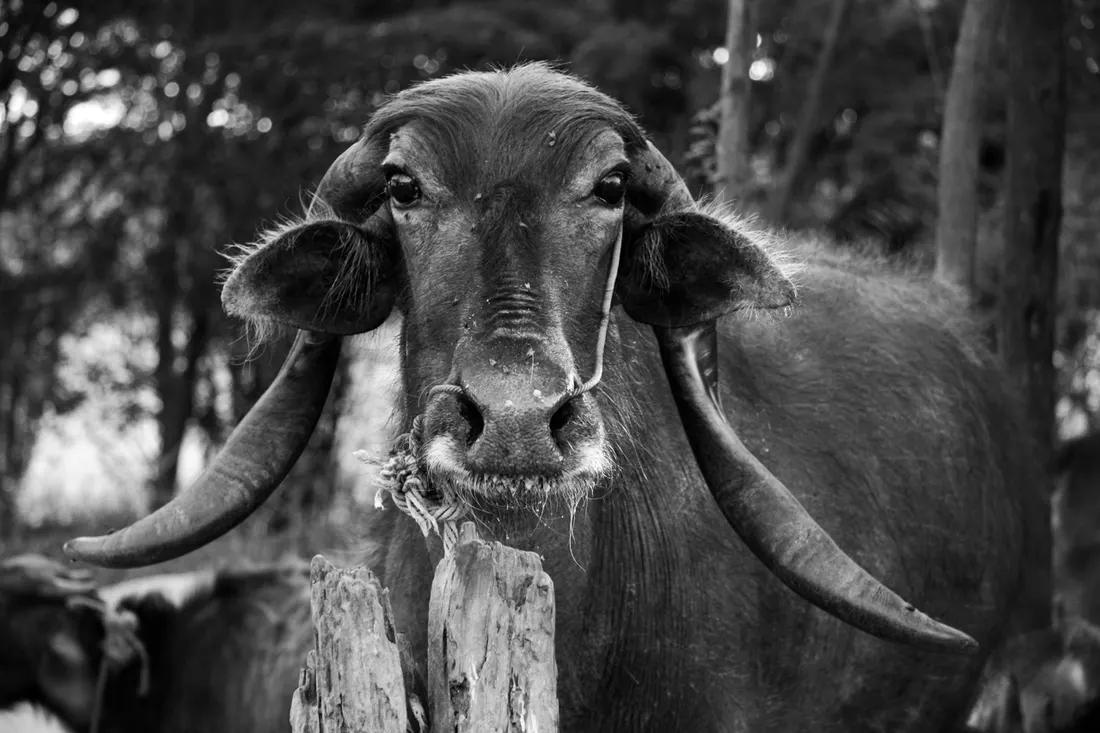
A water buffalo, one of the animals behind India's milk. Fodder and feed for animals like this are the costs the dairies say jumped most. Photo: Vinoth Chandar, CC BY 2.0.
Think of a dairy farmer like a small shop that sells only one product. If the cost of stock (here, fodder) jumps 20% and the selling price barely moves, the shop runs at a loss. A price hike at the city end is how the cooperative model lets the farmer's selling price rise.
The detour through Karnataka
Amul and Mother Dairy are not alone. Two weeks ago, on November 1, Karnataka raised the price of Nandini milk, sold by the state's milk federation, by ₹8 a litre. Of that, ₹7 goes to farmers and ₹1 to the dairy cooperatives, UNI reported. The price paid to farmers went from ₹35 to ₹42 a litre, with the state's ₹5 incentive on top.
That decision came after farmer protests, and farmers had asked for at least ₹10, according to Oneindia. In Karnataka, the state cabinet decides. At Amul and Mother Dairy, the dairies themselves do. Either way, the pressure starts on the farm.
The last stop: the inflation number
Milk is bought almost every day in most homes, so these hikes will feed into India's inflation figures.
In September, retail inflation was 5.54% and food inflation was 7.74%, per the official MoSPI release. We covered why onions led that jump in four myths about India's inflation. October's number comes out today at 4 PM. The milk hike starts today, so it will only show up from November's data.
Higher inflation matters beyond the kitchen. It is one reason the RBI raised its key rate in October, which pushed up many home loan EMIs. If that link is new to you, our post on the repo rate and your EMI walks through it. Fuel is part of the same story too: both dairies listed fuel and transport among their rising costs. Our story on who pays when crude jumps explains why fuel prices in India do not simply follow oil.
What the dairies did not say
The companies did not publish a new nationwide price list for every Amul pack, and shelf prices differ by city and shop, so check the rate printed on your packet. The 80% figure is the company's own claim about all its sales, and how much of today's increase reaches each farmer will only show when unions announce their next purchase prices.
This is a news summary, not financial advice.
Sources
Watch on Qrio
One-minute reels on this and related topics.



More business stories
Business
Razorpay plans to list for a third less than its 2021 value, after paying $150 million to come home
Razorpay, the Bengaluru company behind the checkout page on many Indian websites, has reportedly received SEBI's approval for its IPO. Reports put the issue at roughly ₹5,000 to 6,500 crore and the valuation at about $5 billion, with a listing expected between January and March 2027. That is about a third below the $7.5 billion it was valued at in 2021. Razorpay had first moved its parent company from the US to India, a switch reported to have cost about $150 million in taxes. It grew revenue 65% in FY25 to ₹3,783 crore but booked a loss tied to one-time costs. Neither Razorpay nor SEBI has confirmed the approval publicly.
5 November 2026 · 7 min read

Business
Affle is paying $420 million for Perion. More than half of it is already in Perion's bank
Indian adtech company Affle has agreed to buy Perion, an Israeli advertising technology firm listed on Nasdaq, for about $420 million in cash, or $11.70 a share. The surprise sits inside Perion's own accounts: at the end of September it held $228.3 million in cash, deposits and marketable securities and no financial debt. That is about 54% of the price. Three years ago Perion was worth more than $1 billion, until Microsoft's Bing cut off the search deals that brought in roughly half its revenue. Affle's shares rose about 9% on the news. The deal still needs Perion shareholders, US antitrust clearance and a 40-day window in which a rival bidder can step in.
3 November 2026 · 6 min read