Business
Affle is paying $420 million for Perion. More than half of it is already in Perion's bank
By Ashish Kumar · 3 November 2026 · 6 min read

Digital billboards in Times Square, New York, the kind of out-of-home advertising Perion sells. Photo: Jakub Hałun, CC BY 4.0, via Wikimedia Commons, resized.
An Indian company just bought a once billion-dollar Israeli tech firm, and one number in the fine print tells you most of what you need to know about the deal.
On Sunday, 1 November, Indian adtech company Affle signed an agreement to buy Perion Network, an advertising technology company listed in New York and Tel Aviv. The price is $11.70 a share in cash, which values all of Perion's shares at about $420 million, according to Perion's own announcement filed with the US securities regulator.
Most headlines stopped there. The more interesting number is a few paragraphs further down.
The number: $228.3 million
As of 30 September, Perion held $228.3 million in cash, short-term bank deposits and marketable securities (easy-to-sell investments such as bonds). It has no financial debt, as Angel One also noted.
Put that next to the price and you get this:
Think of buying a second-hand shop for ₹42 lakh and finding ₹22.8 lakh in the safe that comes with it. The shop itself, the shelves, the staff, the customers, really cost you closer to ₹19 lakh.
By the same simple arithmetic (ours, not the companies'), Affle is paying roughly $192 million for Perion's actual business: its technology, its clients and its people. Finance people call this the gap between "equity value" (the price of all the shares) and "enterprise value" (the price of the business once you strip out cash and add debt).
A fair warning on that shortcut: the cash figure is from 30 September, the deal will not close until early 2027, and some of that money will go on running the company, advisers' fees and the like. So treat $192 million as a rough guide, not an exact bill.
Why would anyone sell that cheaply
Because Perion has had a brutal three years. Calcalist, an Israeli business daily, reports that the company was worth more than $1 billion three years ago.
Its problem was one customer. Perion made a lot of its money from search advertising, ads that appear around search results, and the search engine behind most of it was Microsoft's Bing. In 2023, search was 46% of Perion's revenue and Microsoft accounted for 85% of that search business, per Calcalist.
Then Microsoft changed the rules.
The April fall is from Globes, and the June one from The Motley Fool, which reported that Bing traffic had made up roughly half of Perion's revenue. Since then Perion has tried to rebuild around newer kinds of advertising: ads on smart TVs (called CTV, for connected TV), screens in public places like the billboards on this page's cover (called DOOH, digital out-of-home), and ads inside online shops (retail media).
There is one more twist. Under its buyback programme, Perion spent $196.8 million buying back 21.3 million of its own shares by 30 October, according to a second filing. That works out to an average of about $9.24 a share (our arithmetic), below the $11.70 Affle is now paying.
What Affle gets out of it
Affle is much smaller than the giants of online advertising, but it makes money. For July to September it reported revenue of ₹783.59 crore, up 21% from a year earlier, and a profit of ₹129.78 crore, per Trade Brains.
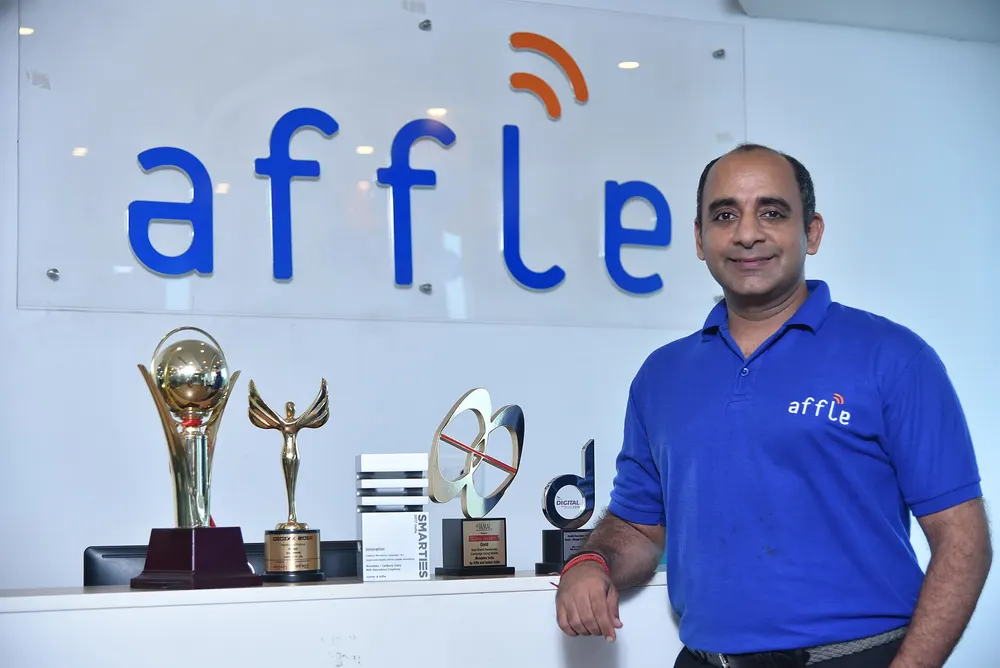
Anuj Khanna Sohum, Affle's chairperson, managing director and CEO, says the deal strengthens its AI-powered advertising technology. Photo: Sandip.acharyya, CC BY-SA 4.0, via Wikimedia Commons, resized.
Affle's speciality is mobile ads, mostly in emerging markets, sold on a "cost per converted user" basis. In plain words, the advertiser pays only when someone actually does the thing the ad asks for, such as installing an app or buying something. Perion's clients are mostly big brands and agencies in North America, AdExchanger reports. So Affle is buying a door into rich-country advertising budgets and into TV and billboard screens it does not reach today.
Perion's CEO Tal Jacobson put the fit simply to AdExchanger: "We never had good performance-driven technology for mobile. Affle has pure technology just for that." He also said all of Perion's roughly 500 staff are staying, and that the combined company will have just over 1,000 people.
Affle says the combined business should reach a yearly revenue run rate above $700 million in the year to March 2028, and that the deal should add to its earnings per share by the end of the first year after closing. Those are the company's targets, not results.
Investors liked it on day one. Affle's shares were up 9.2% at ₹1,465.20 around 1 pm on Monday, per Angel One. Perion's shares jumped about 30% before the US market opened, close to the offer price.
Where the deal could still wobble
Three things stand between signing and closing. Perion's shareholders must vote yes. US competition authorities must let a waiting period pass. And Perion has a 40-day "go-shop", a window to actively hunt for a better offer, which ends on 11 December. If a higher bid arrives, Affle could be outbid.
The money side looks less shaky. Citibank is lending Affle part of the price, with the rest from Affle's own cash, and the deal is not conditional on raising funds.
The bigger lesson is the one Perion found out the hard way: a business built on one powerful partner can lose most of its value with a single policy change it never controlled. Sharp falls in value are a familiar story in tech, from Unacademy selling for 94% less than its peak value to Zepto, whose IPO valuation was cut nearly in half even as revenue doubled. If you track deals like these, our guide on how to follow Indian startup news is a good place to start.
This is a news summary of an announced deal that has not yet closed, not investment advice.
Sources
More business stories
Business
Jio Platforms listed at a 21% premium. Here is what 1.38 crore applicants actually bought
Jio Platforms opened at ₹1,358 on 28 October 2026, 21% above its IPO price of ₹1,119, and closed the day near ₹1,417. It was India's biggest IPO ever at ₹30,213 crore, and more than 1.38 crore people applied. But every rupee raised went to the company, not to early investors like Meta and Google, and most of it is going straight into paying off debt. Five plain questions about what just happened, and what it means if you got shares or missed out.
29 October 2026 · 5 min read
Business
IndiGo earned 26% more and still lost ₹1,879 crore. One bill explains it
IndiGo, India's biggest airline, just reported a net loss of ₹1,879 crore for July to September 2026, even though its revenue jumped 25.9% to ₹23,364 crore. Ticket prices per kilometre went up by a third. So where did the money go? Mostly into one line of its accounts: jet fuel, which cost 67% more than a year ago as the conflict in West Asia pushed oil prices up. Here is the money, followed line by line.
29 October 2026 · 5 min read