Business
IndiGo earned 26% more and still lost ₹1,879 crore. One bill explains it
By Ashish Kumar · 29 October 2026 · 5 min read
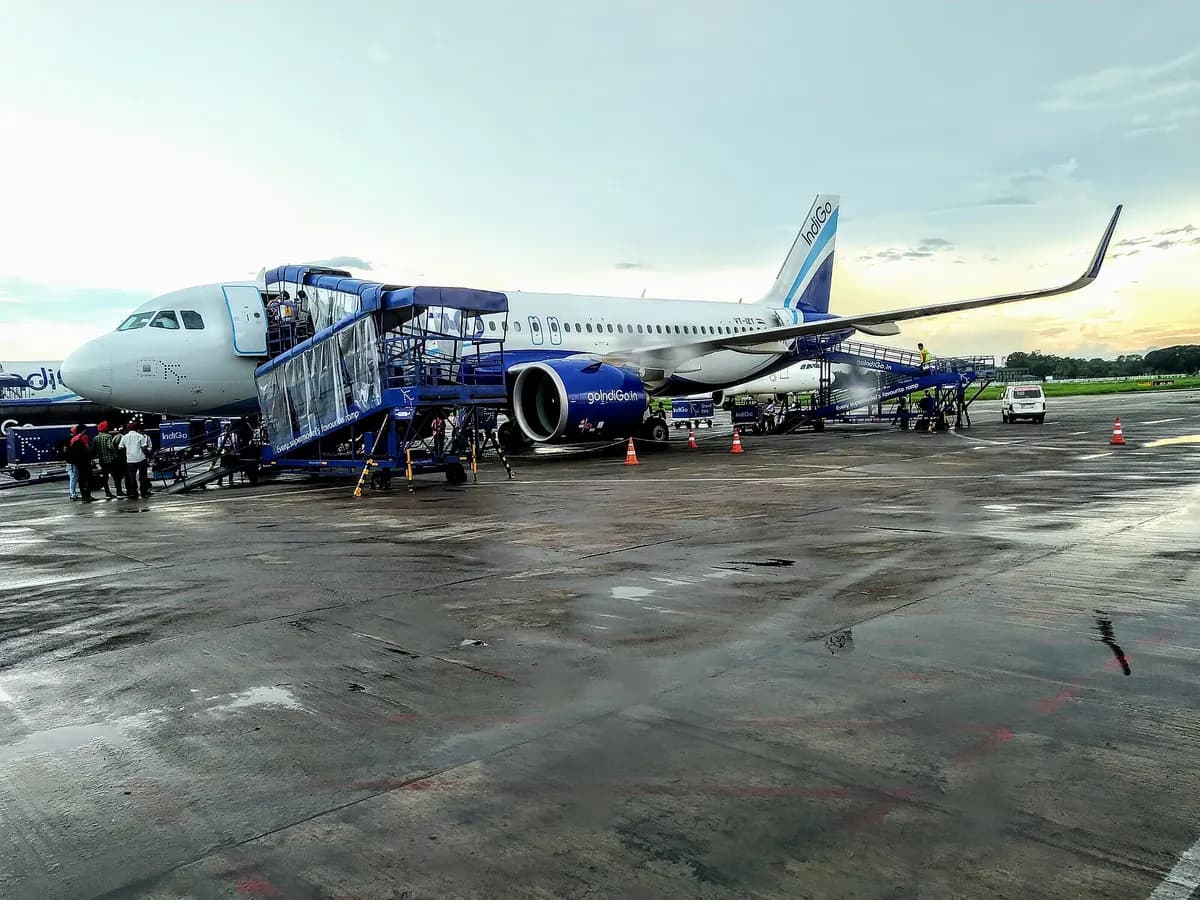
An IndiGo Airbus A320neo boarding at Guwahati airport. Photo: SlowPhoton, CC BY-SA 4.0, via Wikimedia Commons, resized.
If you flew IndiGo this monsoon and felt the fare was steep, you were right. You paid about a third more per kilometre than a year ago. The airline still lost money. Follow the rupees and you find out why.
On Thursday, InterGlobe Aviation, the company that runs IndiGo, reported its results for the July to September quarter. The headline looks like a contradiction:
How does a company bring in a quarter more money and still end up deep in the red? Let us walk through the money the way you would check a household budget: what came in, what went out, and which bill broke it.
What came in: you paid more, but fewer of you flew
IndiGo carried 27.5 million passengers in the quarter, 4.7% fewer than a year earlier, according to Newsdrum. It also flew slightly less: its capacity, measured in seats multiplied by kilometres flown, fell 1% to 40.8 billion. Planes were a little emptier too, with 80.3% of seats filled compared with 82.5% a year ago.
So how did revenue go up 26%? Price. Airlines measure this as "yield", the average amount a passenger pays to fly one kilometre. IndiGo's yield rose 34.3%, from ₹4.69 to ₹6.30.
On a 1,000 km trip, that is the difference between paying roughly ₹4,690 and ₹6,300 in fare (a simplification, but it shows the scale). Ticket revenue climbed 29.3% to ₹20,652 crore. Extras like seats, meals and baggage added another ₹2,481 crore.
In short: fewer people flew, and the ones who did paid a lot more.
What went out: one bill ate the increase
Total expenses rose 18.6% to ₹26,188 crore. That is less than revenue grew, which sounds like good news. The problem is where the extra spending went.
The jet fuel bill alone went up by about ₹4,005 crore in a year. Revenue went up by about ₹4,809 crore. So fuel swallowed more than four out of every five extra rupees that the higher fares brought in. Fuel cost per seat kilometre rose 68.9% to ₹2.44, per Business Today.
Why did fuel cost so much more? Oil. The conflict in West Asia has disrupted shipping through the Strait of Hormuz, and crude prices have spent much of 2026 far above last year's levels. CEO Willie Walsh said the quarter saw "exceptionally elevated fuel costs and continued geopolitical turmoil", and that cutting capacity and managing fares only partly made up for it.
There is a policy twist too. From April to early June, the government capped aviation fuel prices at 25% above their March level. From 9 June it moved to a Price Stabilisation Fund scheme, and IndiGo chose not to join it, according to Newsdrum.
The bill that was not about flying at all
There is one more line, and it has nothing to do with planes. IndiGo leases many of its aircraft and pays for them in dollars. When the rupee weakens, those dollar bills cost more rupees, and the accounts show a "foreign exchange loss".
This quarter that loss was ₹1,333 crore. Strip it out, and IndiGo's loss from actually running the airline was about ₹724 crore. A year ago, on the same basis, it made a profit of ₹104 crore.
Here is the strange part. The forex loss a year ago was much bigger, ₹2,892 crore. That is why the headline loss looks smaller this year (it was ₹2,582 crore last year) even though the airline business itself went from a small profit to a real loss. A "narrower loss" headline can hide a worse quarter.
So is IndiGo in trouble?
Not in the way that word usually means. IndiGo had about ₹52,685 crore in cash at the end of September, including about ₹39,929 crore it is free to use. Its total debt, including the lease payments it owes on planes, was about ₹87,303 crore. It added 10 aircraft in the quarter and now flies 442, with a peak of 2,020 flights a day.
But it is now two loss-making quarters in a row. The April to June quarter lost ₹237.6 crore, so this one is about eight times worse. July to September is usually the weakest season for Indian airlines because of the monsoon, which helps explain part of it. The company expects capacity to grow only in the low single digits from October to December, and it announced no dividend.
What this means for your next ticket
When an airline's single biggest cost jumps two thirds and it is already losing money, it has two levers: fly less, and charge more. IndiGo has already pulled both. As long as oil stays high, cheap fares are unlikely to be the norm.
The same oil shock is reaching your life in other ways, some of them hidden. We followed it to the petrol pump in why your petrol price has not moved while crude sits above $110. And if you have ever wondered why prices feel higher than the official numbers say, read why everything feels more expensive than India's inflation rate.
This is a news summary based on IndiGo's reported results, not investment advice.
Sources
More business stories
Business
Jio Platforms listed at a 21% premium. Here is what 1.38 crore applicants actually bought
Jio Platforms opened at ₹1,358 on 28 October 2026, 21% above its IPO price of ₹1,119, and closed the day near ₹1,417. It was India's biggest IPO ever at ₹30,213 crore, and more than 1.38 crore people applied. But every rupee raised went to the company, not to early investors like Meta and Google, and most of it is going straight into paying off debt. Five plain questions about what just happened, and what it means if you got shares or missed out.
29 October 2026 · 5 min read
Business
Unacademy sold for 94% less than what it was once worth. Its CEO said so himself
India's edtech firm Unacademy has officially been acquired by rival upGrad in an all-stock deal closing at just over $200 million (₹19.55 billion), roughly 94% below Unacademy's peak private valuation of $3.44 billion in 2021. Unacademy had raised nearly $880 million across 13 funding rounds from SoftBank, Tiger Global, and General Atlantic. Co-founder and CEO Gaurav Munjal didn't dress it up: "We raised at a peak, but sold at a fraction of that." No layoffs are planned for Unacademy's roughly 1,000 employees. The deal closes a five-year arc for one of India's most-funded startups, and it began with the opposite problem entirely.
3 September 2026 · 3 min read