The Strait of Hormuz reopened this week. The ships still won't go.
5 min read · by Qrio · 21 Jun 2026
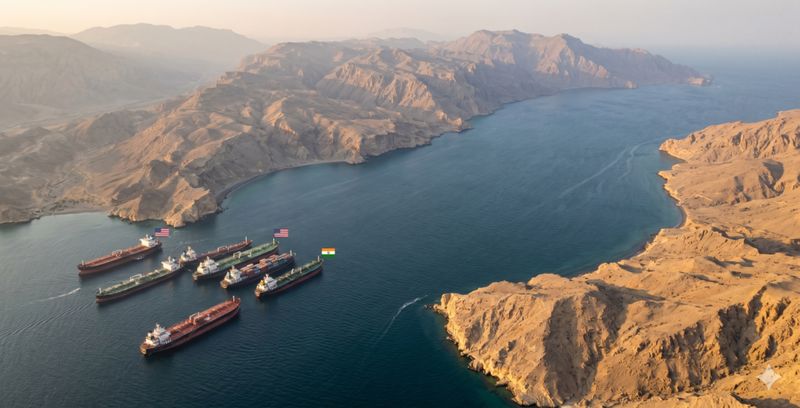
Iran shut the world's most important oil route without sinking a single tanker. That trick is the reason a signed peace deal cannot simply switch it back on.
The blockade made of paperwork
Here is the thing almost no one tells you about the Strait of Hormuz. To close the channel that carries a fifth of the world's oil, Iran never had to sink a fleet or mine the water. It barely had to fire. It did something quieter and far more effective. It struck a handful of tankers with drones, broadcast a simple warning that any ship approaching would be a target, and then went silent on the radio when captains asked if it was safe to pass. That was enough. The world's marine insurers, who quietly underwrite almost every oil cargo afloat, looked at the risk and pulled their coverage.
And an oil tanker without insurance does not sail. No company will gamble a $200 million ship and two million barrels of crude on hope. So the tankers simply stopped. Many switched off their tracking signals and vanished for two months. Traffic through one of the planet's busiest waterways fell by around 80 percent, and at the worst moment only about 15 ships crept through where 60 normally would. Iran had found the cheapest weapon in modern geopolitics: not blocking the strait, but making everyone too afraid to use it.
The scale of what froze:
- The strait carries about 20 percent of the world's oil through a channel just 33 km wide.
- Daily traffic fell from around 60 tankers to near zero.
- War-risk insurance jumped to roughly 16 times normal, and the disruption cost the world over $4 billion a day.
Why a peace deal couldn't switch it back on
Now the part that is genuinely strange, and the real story of this week. On 18 June 2026, the US and Iran signed a deal to end the war and reopen the strait. Iran promised safe passage and waived all transit fees for 60 days. President Trump announced flatly that the strait was reopened. For a moment it looked true. Three Saudi tankers carrying six million barrels switched their signals back on and crossed. More than twenty tankers followed.
Then it stalled again. Within days the strait was functionally shut once more: warning shots reported, ships told not to approach, radios going unanswered. Here is why permission was not enough. A government can declare a road open, but it cannot force anyone to drive on it.
Shipowners do not move on announcements, they move on insurance, and insurers move on certainty.
Even when an international monitoring group downgraded the danger from "critical" to merely "severe," the ships stayed put. As the head of one large tanker company explained, owners are still waiting for the risk to genuinely fall, because the threat remains near its highest level, and "severe" is exactly the kind of warning you expect to come true.In shipping, "you are allowed to cross" and "you are safe to cross" are two completely different sentences. The deal delivered the first. It has not delivered the second.
There is no escape hatch
What makes this so dangerous is that the oil has almost nowhere else to go. The Gulf's pipelines can carry only a small fraction of what the strait moves, perhaps five million barrels a day against Hormuz's twenty-one. The one real alternative is to sail all the way around Africa, which adds about two weeks to every voyage and has tripled shipping rates for the Gulf-to-Asia route. So the fear cannot simply be rerouted around. When Hormuz freezes, the cost lands on the whole world, fast. Oil prices jump within days, and the bill arrives at petrol pumps far from the Gulf. In India, which buys most of its oil through this very strait, the government grew worried enough that the Prime Minister urged citizens to conserve fuel, a quiet measure of how exposed the country is to a channel it does not control.
The lesson hiding in plain sight
The strait teaches something most coverage misses. A chokepoint's real power was never the ability to block ships. It is the ability to make everyone afraid to sail, and fear is far harder to switch off than a blockade. You can sign a ceasefire in an afternoon. You cannot sign away an insurer's caution, or a captain's memory of a burning tanker. That is why this story is not over, even with a deal on paper. The strait is technically open and practically empty, and it will stay that way until confidence, not paperwork, returns.
Iran proved that to control the world's oil, you do not need to sink a single ship. You only need to make the world unsure. The strait has been pulled back from the edge, but its calm is borrowed, and the country most at its mercy, importing most of its oil through this one narrow gap, is India. A waterway it cannot defend now sits between its growth and the next price shock.
Frequently Asked Questions
What is "The Strait of Hormuz reopened this week. The ships still won't go." about?
This week, after months of war, the US and Iran signed a deal to reopen the Strait of Hormuz, the narrow channel that carries a fifth of the world's oil. President Trump declared it open, and a few tankers crossed. Then almost everything stopped again. The strange truth is that Iran never physically blocked the strait to close it, and now that it has agreed to reopen it, it cannot simply switch the traffic back on. Permission and safety, it turns out, are very different things.
Why does this geopolitics topic matter?
This topic covers a significant development in geopolitics that affects economies, industries, and everyday people. Qrio breaks it down in plain English so you can understand the implications without needing specialized knowledge.
How long does it take to read this explainer?
The brief takes about 30 seconds. The full deep dive takes just a few minutes. You can choose how deep you want to go.
More from Qrio
Oura wants $16 billion for a ring, and one number explains why

India's biggest stock exchange is finally going public and it has to list on its rival