India's biggest stock exchange is finally going public and it has to list on its rival
4 min read · by Qrio · 7 Sept 2026
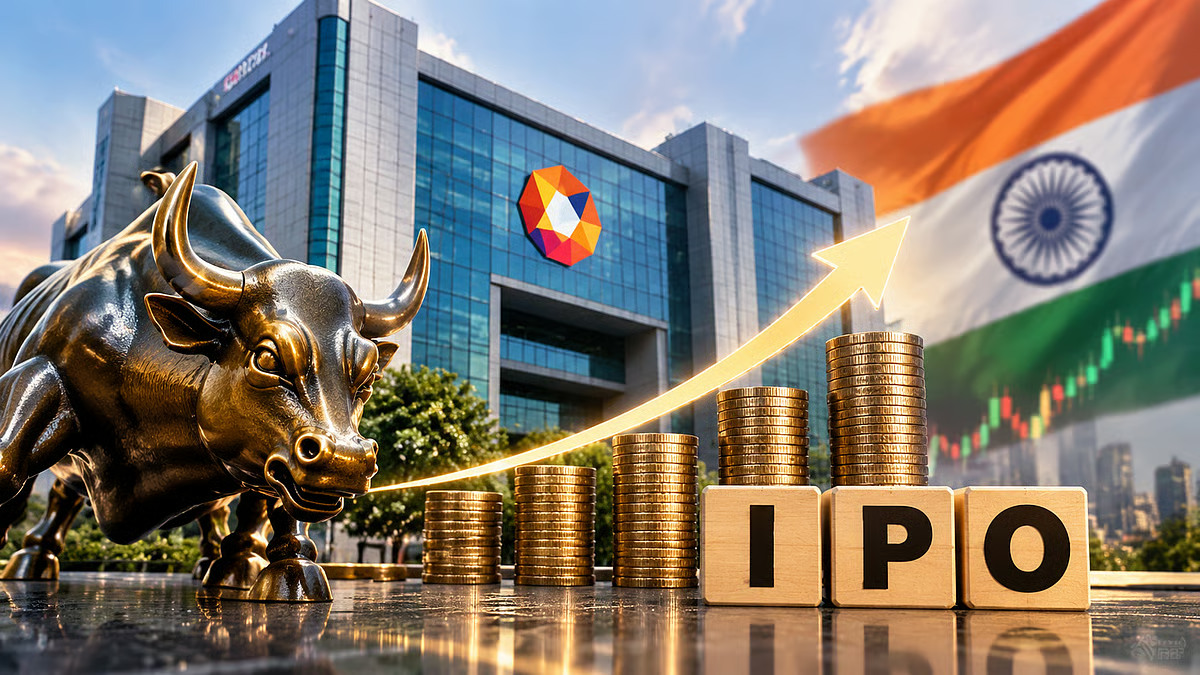
The most powerful company in Indian finance is about to be priced, regulated and hosted by the competitor it beat.
Start with the oddity, because it is the whole story in miniature. The National Stock Exchange handles the overwhelming majority of India's equity and derivatives trading. If you have ever bought a share in India, it almost certainly moved through NSE's systems. And when its own shares start trading, they will not trade there. They will trade on the BSE, the 150 year old Bombay exchange that NSE overtook in the 1990s and has outgrown ever since.
This is not a snub. It is Rule 45 of SEBI's Stock Exchanges and Clearing Corporations Regulations, 2018, and it exists for an obvious reason. An exchange does three jobs: it runs the trading system, it polices the companies listed on it, and it surveils for manipulation. An exchange listed on itself would be refereeing a match it was playing in. NSE managing director and chief executive Ashishkumar Chauhan has been matter of fact about it.
"It's a regulation of India, and we have to abide by that." Ashishkumar Chauhan, managing director and CEO, National Stock Exchange of India
The non-obvious part: what actually unblocked this.
Most coverage treats the September 4 approval as the end of a bureaucratic queue. It was not a queue. It was a scandal.
In 2015 a whistleblower alleged that some brokers using NSE's co-location facility, where trading firms rent rack space next to the exchange's own servers to shave milliseconds off order times, were getting preferential access to market data feeds. In markets where speed is money, milliseconds are money. A parallel case concerned dark fibre, dedicated high speed cable links. SEBI opened proceedings. NSE's IPO, first attempted with draft papers in 2016, was frozen for the duration.
It did not end in a verdict. It ended in a cheque.
Under SEBI's settlement rules, a company can pay to close proceedings without admitting or denying guilt. NSE first offered Rs 1,387.39 crore in June 2025, revised it to Rs 1,491.21 crore in March 2026, and paid it off in two instalments, the last Rs 714.74 crore in July. Of the total, Rs 1,223.56 crore covered co-location and Rs 267.65 crore covered dark fibre. On September 3, the Supreme Court disposed of SEBI's remaining pleas. The next day the IPO was cleared.
Who is actually selling.
This is entirely an offer for sale, which means not one rupee goes to NSE itself. Existing shareholders are cashing out about 6%. State Bank of India is selling up to 2.48 crore shares and MS Strategic (Mauritius) up to 1.60 crore. NSE shares have traded in India's unlisted market for years, and a formal listing finally gives thousands of those holders a real exit at a public price.
The honest catch.
Three things deserve scepticism. First, the Rs 30,000 crore figure is derived from unlisted market prices, and unlisted prices for a scarce, hyped asset are not the same as prices a public book will bear. Second, NSE's earnings depend heavily on derivatives volumes, and SEBI has spent the last two years tightening rules on retail options trading precisely because it thinks small investors are losing money there. A regulator that can shrink your biggest revenue line is an unusual kind of risk. Third, a settlement is not an acquittal. Paying Rs 1,491 crore to close a matter without admitting fault removes a legal overhang without answering the underlying question.
India's stock market is about to do something it has never done: put a price tag on the machine it runs on.
Frequently Asked Questions
What is "India's biggest stock exchange is finally going public and it has to list on its rival" about?
On September 4, the Securities and Exchange Board of India cleared the National Stock Exchange to launch its IPO, ending a wait of nearly a decade. The issue is an offer for sale of 14.89 crore shares, about 6% of the company, worth roughly Rs 30,000 crore. That would make it the largest public issue in Indian history, ahead of Hyundai Motor India's Rs 27,870 crore in October 2024, and implies a valuation above Rs 5 lakh crore. Subscription is expected to open September 15. The shares will trade on the BSE, the rival NSE has spent thirty years leaving behind.
Why does this india macro topic matter?
This topic covers a significant development in india macro that affects economies, industries, and everyday people. Qrio breaks it down in plain English so you can understand the implications without needing specialized knowledge.
How long does it take to read this explainer?
The brief takes about 30 seconds. The full deep dive takes just a few minutes. You can choose how deep you want to go.
More from Qrio

Oura wants $16 billion for a ring, and one number explains why
India grew at 7.8% and its stock market shrugged