Unacademy sold for 94% less than what it was once worth. Its CEO said so himself.
4 min read · by Qrio · 3 Sept 2026
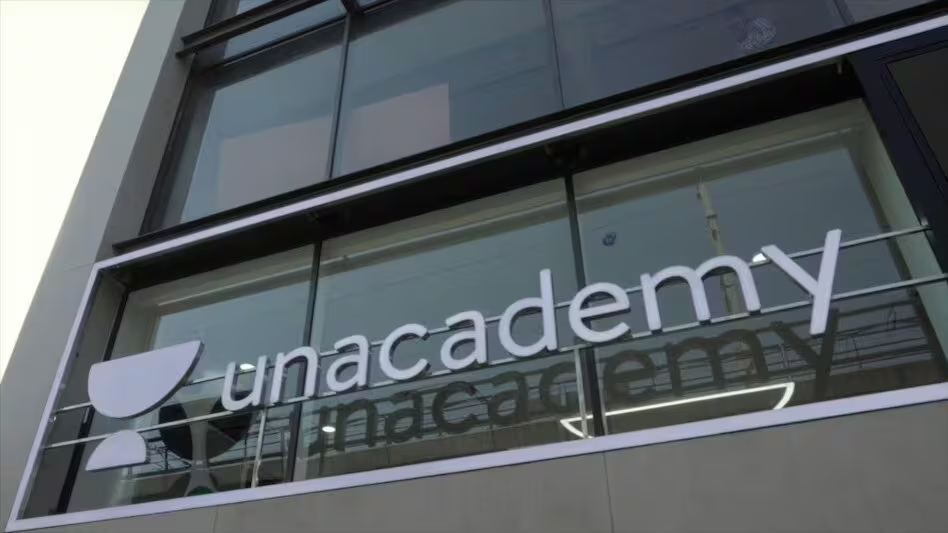
Most startup founders who lose 94% of their company's value spend years explaining it away. This one just said it out loud.
On September 1, 2026, upGrad completed its all-stock acquisition of Unacademy, first announced back in March, closing at a valuation of roughly $206 million. Unacademy shareholders received upGrad shares in the deal, while the company's angel investors were cashed out at closing. It is, on paper, a fairly ordinary consolidation between two Indian edtech companies. What makes it notable is the gap between where Unacademy is landing and where it once stood: at its 2021 peak, private investors valued the company at $3.44 billion. This deal values it at $206 million, a decline of about 94%.
What Unacademy actually built.
Founded in 2015 as a YouTube channel before becoming a full learning platform, Unacademy went on to raise close to $880 million across 13 funding rounds from marquee investors including SoftBank, Tiger Global, and General Atlantic. At its height, it was one of the most talked-about consumer startups to come out of India's post-2020 edtech boom, a period when pandemic lockdowns pushed tens of millions of students online almost overnight and investors poured money into any platform that could capture them.
Where the company stands today.
Unacademy is not being sold as a distressed asset in the way that some of its edtech peers have been. The company holds roughly ₹9 billion (about $95 million) in cash, generates annual revenue near ₹4 billion (about $42 million), and most of its individual business lines are described as at or near profitability. Around 1,000 employees remain on staff, and upGrad has said no layoffs are planned as part of the integration. This is a company that could plausibly have kept operating independently. It chose consolidation instead.
The non-obvious part.
The easy headline here is "edtech unicorn collapses," and that framing exists everywhere in coverage of Byju's, once valued at $22 billion before entering insolvency proceedings in 2024. Unacademy's story is a genuinely different one, and the giveaway is in how its own CEO chose to talk about it. Munjal didn't spin the 94% markdown as a strategic pivot or bury it in corporate language. He said it plainly, on the record, in the same breath as confirming the deal closed. That kind of candor is rare in Indian startup culture specifically because so much of the ecosystem's public narrative still runs on unbroken growth stories. Munjal effectively chose to be the exception, and in doing so, turned an acquisition that could have been framed as a quiet retreat into a moment that other founders are now discussing as a model for how to exit honestly.
Gaurav Munjal, Unacademy co-founder and CEO: "We raised at a peak, but sold at a fraction of that. I'm not going to dress these facts up."
The honest catch.
A 94% valuation cut is still a 94% valuation cut, and investors who backed Unacademy at or near its 2021 peak are very likely sitting on substantial losses regardless of how candidly the founder discusses it now. Munjal's transparency doesn't undo that outcome, it just changes how the exit is remembered. It's also worth noting that Unacademy's own independence, by its CEO's account, was never really in doubt financially; the deal reflects a strategic bet that scale matters more than solo survival for an eventual IPO, not a company being forced to sell.
Unacademy raised money like it was going to be worth billions. It sold for a fraction of that. The part worth remembering isn't the number. It's that its founder said the number out loud.
Frequently Asked Questions
What is "Unacademy sold for 94% less than what it was once worth. Its CEO said so himself." about?
India's edtech firm Unacademy has officially been acquired by rival upGrad in an all-stock deal closing at just over $200 million (₹19.55 billion), roughly 94% below Unacademy's peak private valuation of $3.44 billion in 2021. Unacademy had raised nearly $880 million across 13 funding rounds from SoftBank, Tiger Global, and General Atlantic. Co-founder and CEO Gaurav Munjal didn't dress it up: "We raised at a peak, but sold at a fraction of that." No layoffs are planned for Unacademy's roughly 1,000 employees. The deal closes a five-year arc for one of India's most-funded startups, and it began with the opposite problem entirely.
Why does this business topic matter?
This topic covers a significant development in business that affects economies, industries, and everyday people. Qrio breaks it down in plain English so you can understand the implications without needing specialized knowledge.
How long does it take to read this explainer?
The brief takes about 30 seconds. The full deep dive takes just a few minutes. You can choose how deep you want to go.
More from Qrio
Oura wants $16 billion for a ring, and one number explains why
India's biggest stock exchange is finally going public and it has to list on its rival