Business
Flipkart's CEO is leaving after ten years, here is what it means if you shop, sell or wait for its IPO
By Ashish Kumar · 26 November 2026 · 6 min read
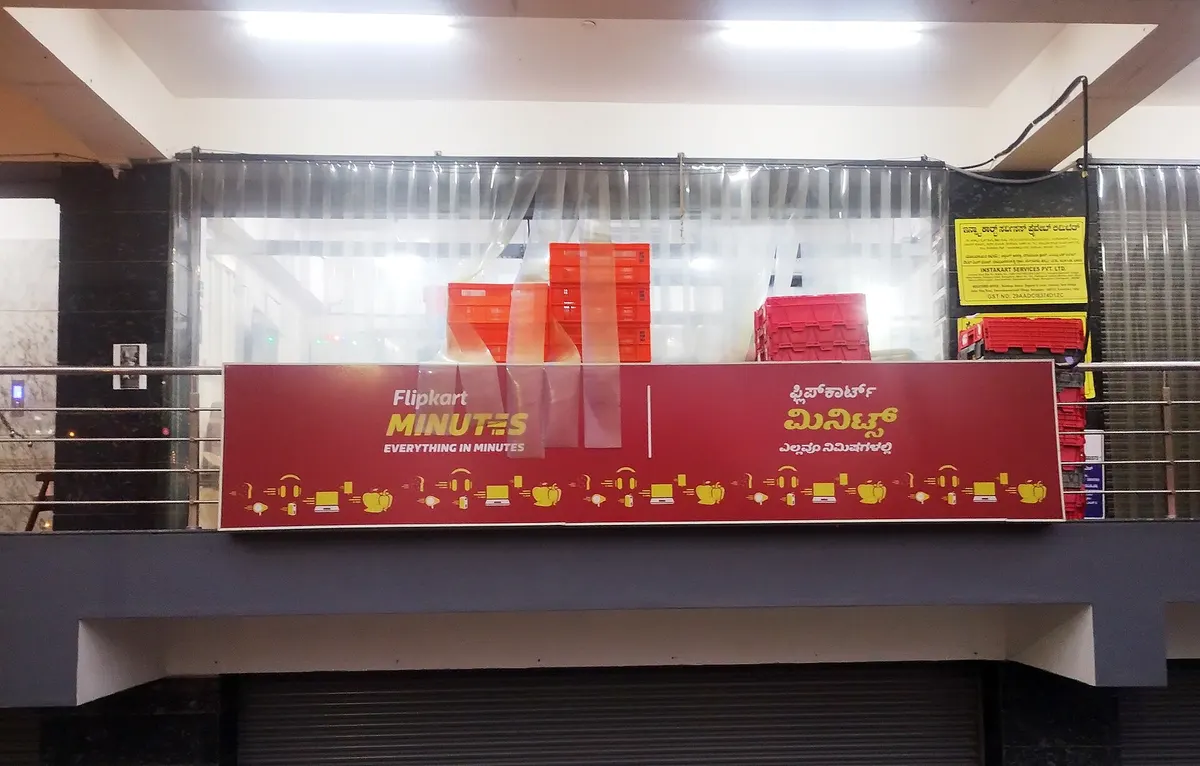
A Flipkart Minutes quick commerce store in RR Nagar, Bengaluru. Photo: Gpkp, CC BY-SA 4.0, via Wikimedia Commons, resized.
The man who ran India's biggest online store through the Walmart takeover is leaving, and the company has not said why.
On Wednesday, November 25, Flipkart Group said its CEO Kalyan Krishnamurthy will step down. He became CEO in January 2017, the first person outside the founding team to run the company, and stayed on as group CEO after Walmart bought about 77% of Flipkart for roughly $16 billion in 2018, as Forbes India and Reuters both recount. His last day is December 4, according to an internal memo seen by Inc42.
Chief product and technology officer Balaji Thiagarajan will lead the company with the board until a successor is named "in the coming weeks". Flipkart gave no reason for the exit. Three sources told Inc42 that Walmart asked him to step down. Neither company has confirmed that.
A CEO change at a company you do not own shares in can feel far away. It is not, because Flipkart touches a lot of people in different ways. So instead of one story, here are four short ones, depending on who you are.
If you shop on Flipkart
Nothing changes on your phone today. Orders, returns and the Flipkart Minutes quick delivery service keep running, and nobody has announced any change to prices or policies.
What could change is direction. Walmart, sources told Inc42, was unhappy with costly bets on side businesses like food delivery and microdramas (very short, phone sized TV serials), and with how the Big Billion Days sale went. Flipkart had been testing food delivery, as we covered when it first announced its plan. A boss told to cut losses usually cuts experiments first. So if you were hoping for one more app to order dinner from, that hope is shakier than it was a week ago.
If you sell on Flipkart
This is where the story gets uncomfortable. In late October, Moneycontrol reported that Walmart had opened an investigation after whistleblower complaints. The claim is that some Flipkart employees took more than ₹150 crore, about $16 million, from vendors in return for favours such as better visibility on the platform. A kickback is simply a secret payment to an insider to tilt a decision your way. Think of a shopkeeper paying the mall guard to send customers to his shop and not the one next door.
The first reports named the smartphone and the luggage and travel accessories teams. Inc42's sources now say the probe has spread to Myntra and Cleartrip, two other group companies. Moneycontrol called it Walmart's third such investigation at Flipkart in under three years. The earlier two led to at least three dismissals and one resignation. The full amount has not been established, and no findings have been made public.
Flipkart told Inc42 it "has robust governance processes and controls" and takes concerns seriously. For honest sellers, a crackdown could be good news: visibility you cannot buy under the table is visibility you compete for fairly.
Here is how the year built up to this week.
If you hold Flipkart stock options
Thousands of current and former Flipkart staff were paid partly in ESOPs, or employee stock options. These are rights to buy company shares cheaply, which only turn into real money when someone buys those shares from you, usually after a listing.
That is the problem. In October, more than 1,000 former employees approached Walmart's board asking for equal access to the share buybacks offered to current staff, as Inc42 and Startup Fortune report. Sources say some senior people left partly because they saw no clear way to cash out. At least 14 vice presidents and senior vice presidents have left in about a year, per Moneycontrol figures cited by Reuters and Inc42.
A new CEO does not fix this by itself. Only a listing or a fresh buyback does, and both now depend on the next point.
If you are waiting to buy Flipkart shares
Flipkart moved its parent company home to India in March, a step it needed before listing here. It was expected to list in late 2026 or early 2027. That now looks unlikely. Walmart reportedly paused a pre-IPO funding round of about $2.5 billion in May and wants the listing pushed to at least 2028, according to reports cited by Inc42. Walmart has also reportedly brought in consultants McKinsey to check whether Flipkart is ready to list.
The condition Walmart has reportedly set is EBITDA break even by March 2027, per Moneycontrol as cited by BW Retail World and Inc42. EBITDA is profit before interest, tax and the slow write down of assets, roughly the money the business makes from running itself. Here is the gap it has to close:
Revenue grew by about a fifth, yet the loss barely moved. Part of the reason, per BW Retail World, is that interest and other finance costs nearly doubled. If you plan to judge the IPO when it finally comes, our guide on how to read an IPO prospectus shows where these numbers hide. And if you want a sense of how a delay can reshape a startup's price, Zepto's valuation story is a useful comparison.
And if you are Walmart
On the way out, the tone stayed warm. "Both Flipkart and Walmart are better because of Kalyan," said Chris Nicholas, who runs Walmart International, praising "the governance he instilled". Krishnamurthy said "strong ethics, integrity and high standards of governance" had been central to Flipkart's growth, and Flipkart says the business grew more than fivefold on his watch.
Walmart now has to find someone who can cut losses, finish a messy investigation and keep a platform of more than 500 million registered users, per Reuters, loyal against Amazon, Meesho and the quick commerce apps, all at once. As Redseer founder Anil Kumar told Reuters, "it's going to be difficult for anyone to come and step in so easily." For now, the one thing Flipkart has promised is a name in the coming weeks.
This is a summary of company statements and published reports, many citing unnamed sources, and not investment advice.
Sources
Watch on Qrio
One-minute reels on this and related topics.
 ▶ 2:27
Startups
How a founder gets fired by his own board
by PeterStewieStartup
 ▶ 2:26
Business
Nvidia was 30 days from bankruptcy in 1996
by yieveberlins
 ▶ 2:51
Finance
How Berkshire Hathaway really makes money
by Dulma 🦋
 ▶ 2:07
Startups
How Y Combinator went from a summer experiment to Airbnb and Stripe
by yieveberlins
More business stories

Business
Tata Steel is selling APL Apollo ₹28,000 crore of business, then buying APL Apollo with it
Tata Steel and APL Apollo Tubes shares crashed on November 23 because of one circular deal. APL Apollo will pay Tata Steel ₹28,000 crore, mostly borrowed, for its steel tubes and colour coated sheet businesses. Tata Steel will then spend ₹15,510 crore buying the APL Apollo promoters' stake at ₹2,100 a share, and up to ₹16,756 crore more in an open offer at ₹2,301.40. APL Apollo fell more than 21%, its worst day in 20 years per CNBC TV18, as investors balked at a bill worth about 60% of its own market value. Tata Steel fell over 8% as investors weighed what it gives up. Here is where every rupee goes.
24 November 2026 · 6 min read
Business
Mahanadi Coalfields makes ₹10,698 crore a year, so why is its IPO half empty
After two of its three bidding days, the ₹8,981 crore Mahanadi Coalfields IPO was only 0.49 times subscribed, and retail investors had bid for just a quarter of their shares. That is odd for a company that earned ₹10,698 crore in FY26 and is priced at about 8.4 times that profit. The case for buying rests on low cost mines, huge reserves and big dividends. The case against points to falling profits, a coal market expected to peak in about a decade, a board with no independent directors, and the fact that all the money goes to Coal India, not the company. Bidding closes on November 23.
21 November 2026 · 6 min read