Business
Tata Steel is selling APL Apollo ₹28,000 crore of business, then buying APL Apollo with it
By Ashish Kumar · 24 November 2026 · 6 min read
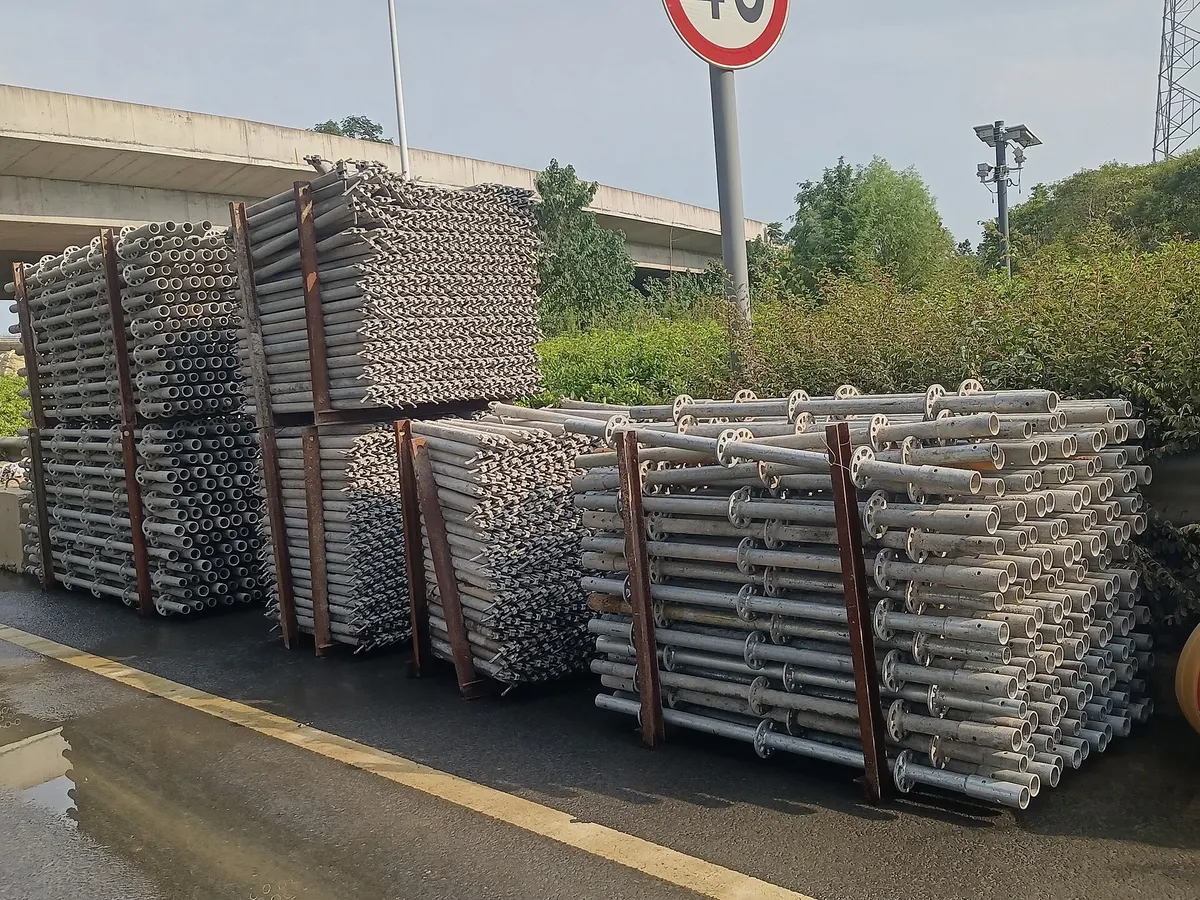
Steel pipes stacked by a roadside, the kind of product at the heart of this deal. Photo: Fumikas Sagisavas, CC0, via Wikimedia Commons, resized.
Two companies agreed on Sunday to swap money and businesses, and on Monday the market punished both of them, for opposite reasons.
On Monday, November 23, the Sensex fell 1,483.72 points, or 1.77%, to close at 82,435.99, as IndiaBlooms reported. The single biggest loser in the Nifty 50 was Tata Steel, down over 8%. Outside the index, APL Apollo Tubes, India's best known maker of steel pipes and hollow sections, fell more than 21%, which CNBC TV18 called its steepest single day fall in 20 years.
Both drops came from one deal. To see why it scared investors in both companies, it helps to follow the money as it moves, one transfer at a time.
Transfer one: APL Apollo pays Tata Steel ₹28,000 crore
Tata Steel is selling two businesses to APL Apollo. The first is its steel tubes business, the pipes used in buildings, fences, solar panel frames and furniture. The second is Tata Steel Colors, which makes colour coated steel sheets, the bright roofing you see on warehouses and factory sheds.
The combined price is ₹28,000 crore, according to Tata Steel's press release. IIFL and INDmoney both split it as about ₹11,700 crore for tubes and ₹16,300 crore for Colors.
Here is the catch. APL Apollo does not have that money lying around. Brokerage Emkay Global noted it had about ₹1,150 crore in cash and a net worth of about ₹5,740 crore at the end of September, as quoted by Univest. Tata Steel's release says APL Apollo will first use "acquisition financing", a polite word for a big loan, and later replace it with long term capital, which could mean selling new shares.
Think of a family that owns a ₹50 lakh flat buying the ₹30 lakh flat next door, with almost all of it on a loan. After Monday's fall, APL Apollo's whole stock market value was under ₹46,100 crore, per Moneycontrol. By our arithmetic, the ₹28,000 crore bill is about 60% of that.
Transfer two: Tata Steel pays the APL Apollo founders ₹15,510 crore
Now the money flows back. Tata Steel is buying the APL Apollo promoters' stake, held through S Gupta Holding, at ₹2,100 a share, for about ₹15,510 crore. The press release calls it a 26.6% stake. The exchange filings, measured against the company's slightly larger future share count, put it at 26.38%, and split it into three slices, as Moneycontrol and IIFL both reported:
The first slice changed hands on Monday itself. The founding promoter group has said it intends to be reclassified as ordinary public shareholders, according to Moneycontrol.
Transfer three: Tata Steel offers you ₹2,301.40 a share
A stake this large triggers a mandatory open offer under SEBI's takeover rules. That is a standing invitation to every other shareholder to sell to the buyer at a fixed price. Tata Steel's offer is for another 26% of APL Apollo at ₹2,301.40 a share, worth up to ₹16,756 crore. If it is fully taken up, Tata Steel would own 52.38% and control the company. Kotak Mahindra Capital is managing the offer.
That price looks generous. APL Apollo closed Monday at about ₹1,659, per Moneycontrol, so the offer is roughly 39% higher, by our arithmetic. Why would anyone sell on the market at ₹1,659 when Tata will pay ₹2,301?
Two reasons. First, the offer is limited. If promoters held about 26% of APL Apollo, the public holds roughly three quarters. If every one of them tendered, only about one share in three would be accepted, by our rough arithmetic, and the rest would go back to the owner at whatever the market price is then. Second, it is slow. The offer can only be completed after regulatory approvals, and we could not find a confirmed date for it.
Where the money ends up
Put the three transfers side by side and something striking appears.
That last line is our own arithmetic: ₹15,510 crore plus ₹16,756 crore is ₹32,266 crore, minus the ₹28,000 crore Tata Steel receives. If few shareholders accept the open offer, Tata Steel could even end up with more cash than it started with. In plain words, a large part of the price of APL Apollo is being paid with APL Apollo's own borrowed money.
Why APL Apollo shareholders ran
From their side, the company is taking on a huge loan to buy businesses whose price works out to about 24.8 times their yearly operating profit before interest and depreciation (EBITDA), per INDmoney. That is expensive for steel. IIFL reports Tata Steel Colors made a profit of about ₹85 crore in FY26 on revenue of about ₹4,680 crore, and is being sold for ₹16,300 crore. Higher interest costs, or a fresh share sale to repay the loan, could both hurt existing owners. If you want to check numbers like these yourself, our guide on how to read quarterly results shows where to look.
Not everyone is gloomy. Emkay called the deal transformational and said it could expand APL Apollo's revenue base by about 70%. JM Financial kept an "Add" rating with a target of ₹2,300, while flagging funding needs, per Univest.
Why Tata Steel shareholders ran too
Tata Steel gets a big cheque, but gives up businesses that brought in about ₹16,100 crore of revenue in FY26, roughly 11% of its India revenue, according to Emkay. It also commits up to ₹32,266 crore of its own cash before the APL Apollo money arrives. JM Financial saw a bright side: the ₹28,000 crore equals about 31% of Tata Steel's consolidated net debt of ₹91,423 crore. CNBC TV18 also cited weak metal prices as pressure on the stock that day.
Tata Steel's CFO Koushik Chatterjee said in the release that this is "not just an acquisition of a very profitable and efficient company", and the group is targeting 15.5 million tonnes of tubes and colour coated capacity by 2035, up from 7.5 million tonnes once the deal closes. The company expects to finish within FY2027, though one slice of the promoter stake can move as late as March 2028.
It is a little like the Affle and Perion deal, where half the headline price was already sitting in the target's bank. Here, the money goes round in a circle, and Monday's fall was the market saying it is not yet sure who comes out ahead.
This is a news summary of company announcements and published reports, not investment advice.
Sources
Watch on Qrio
One-minute reels on this and related topics.
 ▶ 2:28
Finance
Angels, VCs, hedge funds and family offices explained
by PeterStewieStartup
 ▶ 1:46
Business
Anthropic's IPO filing: a profit and a $66 billion loss
by Finance Explained in 90 Seconds
 ▶ 1:12
Startups
How Mark Cuban went from fired salesman to a $5.7 billion sale
by The Venture
 ▶ 1:54
Business
Anthropic's IPO paperwork, explained
by PeterStewieStartup
More business stories
Business
Flipkart's CEO is leaving after ten years, here is what it means if you shop, sell or wait for its IPO
Flipkart Group CEO Kalyan Krishnamurthy is stepping down, the company said on November 25, and neither Flipkart nor its owner Walmart gave a reason. Three sources told Inc42 that Walmart asked him to go, as an internal probe into alleged kickbacks of over ₹150 crore from sellers widened and its IPO kept slipping. Chief product and technology officer Balaji Thiagarajan will lead with the board until a successor is named "in the coming weeks". Flipkart lost ₹8,468 crore in FY26 on ₹1,45,880 crore of revenue, and Walmart has reportedly asked for break even on EBITDA by March 2027. Here is what changes for shoppers, sellers, employees holding stock options and anyone waiting to buy its shares.
26 November 2026 · 6 min read
Business
Mahanadi Coalfields makes ₹10,698 crore a year, so why is its IPO half empty
After two of its three bidding days, the ₹8,981 crore Mahanadi Coalfields IPO was only 0.49 times subscribed, and retail investors had bid for just a quarter of their shares. That is odd for a company that earned ₹10,698 crore in FY26 and is priced at about 8.4 times that profit. The case for buying rests on low cost mines, huge reserves and big dividends. The case against points to falling profits, a coal market expected to peak in about a decade, a board with no independent directors, and the fact that all the money goes to Coal India, not the company. Bidding closes on November 23.
21 November 2026 · 6 min read