Flipkart announces it's plan to enter food delivery market
5 min read · by Qrio · 27 Jul 2026
Flipkart hasn't hired a rider, signed a restaurant, or delivered a single plate of food. An interview was enough to move two stock prices.
The announcement
Flipkart Group Chief Executive Kalyan Krishnamurthy confirmed in an interview with Moneycontrol on July 24 that the Walmart-owned e-commerce giant will enter India's food delivery market, taking on the country's dominant duo, Zomato and Swiggy, along with newer entrants like Rapido. "Like everything else we do, we will launch food delivery first, test the value proposition with customers, take feedback and continue improving the product until it really appeals to the customer," Krishnamurthy said. "After that, we'll start scaling it." No restaurants had been signed, no riders hired, and no orders delivered at the time of the announcement. It did not matter to the market.
The plan itself
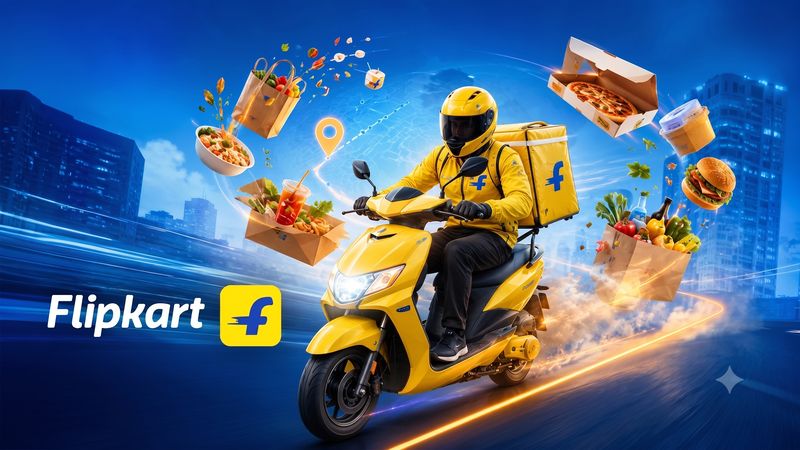
Flipkart intends to pilot the service in Bengaluru within roughly 30 days, using what Krishnamurthy described as a hybrid approach, a standalone food delivery app alongside a version built into the main Flipkart app. The bigger strategic decision is underneath the surface. Flipkart's food delivery push will lean on the Open Network for Digital Commerce, or ONDC, a government-backed digital infrastructure project that works like a shared set of roads for online commerce, letting any buyer app connect to any seller or delivery network through common open protocols instead of each company building its own closed network from scratch. For Flipkart, that means it can plug into restaurants and delivery riders already active on ONDC rather than spending years and enormous capital recruiting both sides of the marketplace the way Zomato and Swiggy once had to.
The market's answer, before a single delivery
Reported figures vary by exchange and time of day, but the direction was unmistakable. Swiggy shares fell as much as 7% intraday before recovering slightly, other trackers put the drop closer to 5.5%. Eternal, Zomato's parent company, fell somewhere between 2.5% and 3.4% depending on the source. To be fair to both companies, some of Swiggy's slide that day was reportedly tied to a separate, unrelated factor, an index-rebalancing issue pulling out an estimated $270 million to $330 million in passive foreign investment. But even accounting for that, a chief executive's interview about a pilot that hasn't launched yet moved two of India's most closely watched consumer stocks in the same direction, on the same day.
What Flipkart is actually walking into
The food delivery market Flipkart is entering is already splintering into new formats before its first order ships. Rapido, the ride-hailing company, has spent the past year building Ownly, a zero-commission model that charges restaurants a flat delivery fee of Rs 30 instead of the usual 18 to 35 percent cut, and requires menu prices to match what customers would pay walking in. It already has more than 20,000 restaurant partners after a full launch in Bengaluru in March and is expanding into Delhi, Mumbai, Hyderabad, Pune and Chennai. Swiggy itself has launched Toing, a budget-focused tier, and Zomato has Bistro, its own value play. India's food delivery market is worth roughly $9 billion today and Jefferies projects it could reach $25 billion by 2030, big enough, on paper, to have room for more than two winners. Krishnamurthy himself is not so sure. Asked directly, he said the market "may not sustain six or seven players long-term."
"There are other aspects of a customer's experience than price that contribute to value, such as selection, service, reliability, and the whole thing." Kalyan Krishnamurthy, Group CEO, Flipkart
Why this fits Flipkart's playbook
Food delivery is not really a new muscle for Flipkart to build. Flipkart Minutes, its quick-commerce arm, has already crossed 1,000 dark stores, small warehouses built for fast local delivery, across more than 130 cities. Krishnamurthy has been careful to frame food delivery the same way he frames quick commerce, "just a category for Flipkart," one more addition alongside Myntra, Cleartrip, the fintech app super.money, and Flipkart Minutes, rather than a company-defining bet. He has also explicitly ruled out buying his way into the category through an acquisition of an existing player.
The honest catch
An announcement is not an operation. Neither Zomato nor Swiggy has issued any public response to Flipkart's plans as of this writing, and a Bengaluru pilot, even a successful one, is a long way from a national logistics network capable of matching two companies that have spent nearly a decade building theirs. Krishnamurthy's own words suggest even Flipkart expects some entrants in this fight to lose.
Frequently Asked Questions
What is "Flipkart announces it's plan to enter food delivery market" about?
Flipkart Group CEO Kalyan Krishnamurthy confirmed that Flipkart will enter food delivery, piloting first in Bengaluru within weeks, built on the government-backed ONDC network so it can plug into an existing restaurant and logistics network rather than build one from scratch. Flipkart hasn't delivered a single order yet. Its rivals' stocks already have moved. Swiggy shares fell by 7% and Zomato's dropped nearly 3%.
Why does this business topic matter?
This topic covers a significant development in business that affects economies, industries, and everyday people. Qrio breaks it down in plain English so you can understand the implications without needing specialized knowledge.
How long does it take to read this explainer?
The brief takes about 30 seconds. The full deep dive takes just a few minutes. You can choose how deep you want to go.
More from Qrio
Oura wants $16 billion for a ring, and one number explains why
India's biggest stock exchange is finally going public and it has to list on its rival