An Indian seafarer tragically lost his life to a missile fired by a traditional strategic ally
4 min read · by Qrio · 14 Jul 2026
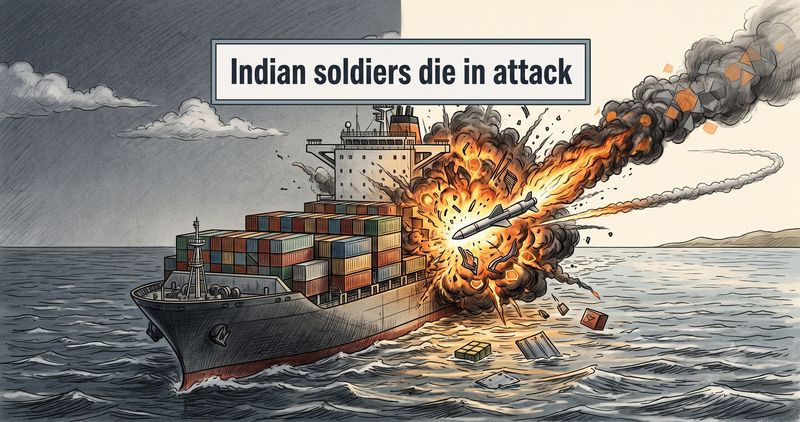
The sudden escalation of diplomatic friction following maritime casualties in the Gulf proves that emerging economies must prioritize active citizen sovereignty over abstract cross-border energy alliances.
The diplomatic collision at the external affairs headquarters
The geostrategic landscape across West Asia fractured sharply on July 14, 2026, when India faced an immediate humanitarian crisis inside international waters. Official maritime monitoring logs confirmed that Iranian missiles executed direct hits on commercial oil tankers transiting the strategic Strait of Hormuz. The kinetic interception claimed the life of an Indian-origin crew member and inflicted severe injuries on eight other sailors. The strike coincided with intense, renewed military action by the United States against Iranian installations, sending war-risk insurance premiums surging and leaving global logistics networks in complete operational chaos.
A few numbers show the scale:
- The unexpected missile strikes directly targeted commercial vessels transiting a chokepoint that controls over 20% of global oil shipments.
- The kinetic incident resulted in 1 tragic fatality alongside 8 serious injuries among the regional maritime workforce.
- Foreign fund managers reacted immediately to the regional instability, offloading over ₹3,062 crore from emerging market equities in a single session.
- The localized escalation forced Brent crude oil benchmarks to climb rapidly toward a high of $85 per barrel.
Why the currency of diplomatic friendship cannot buy a free pass at sea
Here is the part most people get wrong. They look at the historic, multi-decade partnership between New Delhi and Tehran, anchored by massive joint investments in transit networks meant to bypass overland trade blockades and assume that India will always minimize collateral damage to protect its energy import lines. They believe that macroeconomic resource dependencies will force state diplomats to keep their grievances behind closed doors.
The reality introduces an institutional parameter we can call The Citizen Sovereignty Threshold. While securing long-term trade infrastructure is a key sovereign goal, a country's global standing depends entirely on its visible capacity to protect its citizens operating in volatile international corridors.
Indian seafarers form the absolute backbone of global merchant shipping, representing an immense slice of the international maritime labor pool. If a state permits a regional partner to launch unguided strikes that injure its nationals without triggering an immediate, heavy diplomatic response, it breaks the domestic trust required to sustain its global labor remittance networks, making an aggressive public stand completely mandatory regardless of pipeline politics.
The Dutch convoy wars of the Baltic sea
This strategic rebalancing directly duplicates how Republic of the Netherlands managed its delicate trading relationships with northern European empires during the intense maritime conflicts of the early seventeenth century. Back then, the Dutch economy relied completely on maintaining uninterrupted merchant shipping access through the narrow Sound channels controlled by the Kingdom of Denmark to import vital Baltic timber and grain.
Publicly, both nations maintained a necessary diplomatic alliance to resist external military campaigns on the European mainland. However, when Danish naval vessels began arbitrarily stopping Dutch grain ships, confiscating cargo, and injuring merchant sailors under the guise of local tax collection, the Dutch parliament did not look the other way. They immediately paused their joint funding, deployed an elite war fleet to escort their commercial convoys, and forced Copenhagen to sign a strict treaty protecting merchant lives, proving that protecting the transit safety of your working citizens always overrides abstract political handshakes.
True geopolitical leverage is never achieved by sacrificing the safety of your frontline workforce to protect an abstract, long-term infrastructure investment.
The economic friction of a sustained shipping embargo
The primary structural risk to this aggressive diplomatic posturing is the extreme vulnerability of India's domestic energy import bill. If the relationship with West Asian suppliers hits a point of complete operational gridlock, or if the Strait of Hormuz faces a prolonged closure, the country faces an immediate macroeconomic squeeze. A sustained energy price spike past eighty-five dollars a barrel will instantly push retail inflation past delicate thresholds, expanding the current account deficit and forcing the central bank to maintain higher interest rates that could paralyze domestic manufacturing growth.
What to actually watch with concrete metrics
Watch the weekly war-risk insurance premium surcharges applied by international underwriting syndicates to Indian-flagged container vessels over the next month. If these specialized commercial insurance rates surge past a baseline threshold of 0.50% of hull value, it will confirm that the maritime corridor has transitioned from a localized friction point into a permanent commercial block, forcing a massive rerouting of domestic energy logistics.
The ultimate metric of national sovereignty is not found in the grand wording of an infrastructure treaty, but in the speed at which a state can force an ally to respect the lives of its workers.
Frequently Asked Questions
What is "An Indian seafarer tragically lost his life to a missile fired by a traditional strategic ally" about?
Open any strategic defense tracker right now and the entire space looks crowded with multi-billion-dollar maritime treaties, economic pipelines, and joint deep-water infrastructure investments meant to bypass land blockades. But an explosive, high-stakes military event finalized over the last 24 hours completely shattered that peaceful corporate matrix. Indian Computer Emergency Response Team and maritime intelligence networks confirmed that an Iranian missile strike executed direct hits on commercial tankers inside the Strait of Hormuz, claiming the life of an Indian seafarer and critically injuring eight others.
Why does this geopolitics topic matter?
This topic covers a significant development in geopolitics that affects economies, industries, and everyday people. Qrio breaks it down in plain English so you can understand the implications without needing specialized knowledge.
How long does it take to read this explainer?
The brief takes about 30 seconds. The full deep dive takes just a few minutes. You can choose how deep you want to go.
More from Qrio

Oura wants $16 billion for a ring, and one number explains why

India's biggest stock exchange is finally going public and it has to list on its rival