A melting glacier just erased Nepal's escape route from India
4 min read · by Qrio · 31 Aug 2026
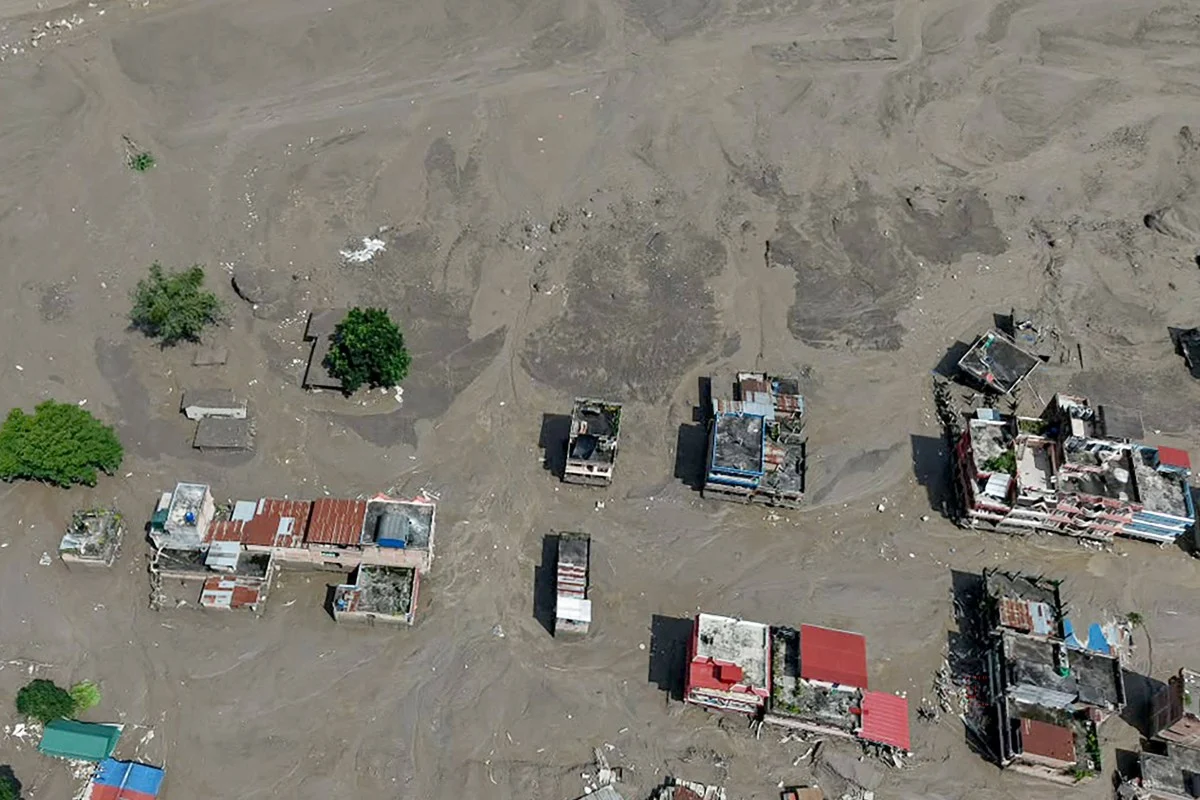
A chunk of ice broke off a Himalayan glacier and slid into a valley. Within hours, it had killed hundreds of people and erased the border crossing Nepal was counting on to escape its dependence on India.
At around 5,200 metres up the Langtang range, on the Nepal side of the Nepal-Tibet border, a section of glacier gave way on the morning of August 26, 2026. It fell roughly 1,200 metres down the mountainside, gathering rock and glacial moraine as it went, and by the time it reached the valley floor it had turned into a debris flow powerful enough to register on seismometers as a magnitude 5.2 event. Scientists initially mistook the signal for an earthquake. It wasn't one. It was ice, rock, and mud moving fast enough to look like the ground itself had shifted.
What the flood actually destroyed.
The debris flow tore through Rasuwa, Nuwakot, Dhading, and several other Nepali districts before slamming into Gyirong Port, the main overland border crossing between Nepal and China's Tibet Autonomous Region. Nepal's government has confirmed at least 390 deaths, with hundreds more still missing; China has confirmed a smaller number of deaths on its side but reports more than 550 people unaccounted for in Tibet, including 260 foreign nationals. A survivor described watching "around nine trucks being swept away by the floods, including people," calling it "a heartbreaking incident." Chinese Premier Li Qiang traveled to the Tibetan side of the disaster zone to oversee emergency response.
Why Gyirong Port mattered more than its size suggests.
Gyirong is not a large facility by global standards, but it carried outsized weight for Nepal. It handled close to a third of all trade between Nepal and China as of 2024, an estimated $600 million a year, and it was also the main overland gateway for Indian pilgrims traveling into Tibet. More importantly, it was the physical anchor of Kathmandu's long-running strategy to reduce its near-total dependence on India for trade access to the outside world, a dependence that has repeatedly left Nepal vulnerable to border blockades and diplomatic pressure from Delhi. Gyirong was the clearest proof that an alternative route existed.
Senior engineer Guo Zhaocheng, of China's Aero Geophysical Survey and Remote Sensing Centre, said the collapsing ice "rushed down the channel at high speed, swept up vast glacial moraine," and transformed into the debris flow that struck the border crossing.
The non-obvious part.
Most coverage of this disaster, understandably, has stayed focused on the human toll, which is still rising as search teams work through debris fields. But the destruction of Gyirong Port is its own separate story, one with consequences that will outlast the search-and-rescue effort by years. Nepal spent roughly a decade building this crossing into a genuine alternative to Indian-controlled trade routes, part of a broader hedge against being squeezed by any single neighbor. That hedge is now gone, at least for however long reconstruction takes, and Kathmandu is back to relying almost entirely on India for the kind of overland access that keeps a landlocked country's economy moving.
What to actually watch next.
Watch how quickly China and Nepal move to rebuild Gyirong Port, since the speed of reconstruction will determine how long Nepal's trade diversification strategy stays sidelined. And watch whether the scientific investigation into the glacier's collapse produces a clearer verdict on the role warming played, since that finding will shape how seriously other unstable Himalayan glaciers get monitored going forward.
The mountain didn't care about trade routes or geopolitics when it let go. It just happened to fall on the one crossing that mattered most.
Frequently Asked Questions
What is "A melting glacier just erased Nepal's escape route from India" about?
A glacier collapse near the Nepal-Tibet border on August 26, 2026 triggered flash floods that have killed at least 390 people, with more than 1,500 still missing across Nepal and the Tibet Autonomous Region. The most important part: floodwaters wiped out Gyirong Port, the border crossing that handled nearly a third of all China-Nepal trade, worth roughly $600 million a year. Chinese Premier Li Qiang personally visited the disaster site. The death toll keeps climbing, but the quieter casualty is a decade-long Nepali plan that just washed away with it.
Why does this geopolitics topic matter?
This topic covers a significant development in geopolitics that affects economies, industries, and everyday people. Qrio breaks it down in plain English so you can understand the implications without needing specialized knowledge.
How long does it take to read this explainer?
The brief takes about 30 seconds. The full deep dive takes just a few minutes. You can choose how deep you want to go.
More from Qrio

Oura wants $16 billion for a ring, and one number explains why

India's biggest stock exchange is finally going public and it has to list on its rival