Fundamental problem in NEET exam, full story explained
4 min read · by Qrio · 29 Jul 2026
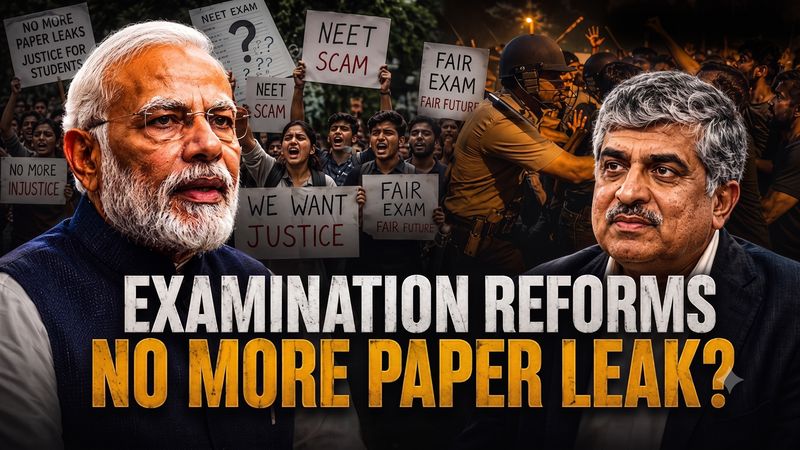
A leaked exam paper brought down India's education minister. The uncomfortable maths underneath says fixing the leak was never going to fix the exam.
What actually happened
On May 3, 2026, 22.76 million candidates sat for NEET-UG, India's single entrance test for undergraduate medical seats. Within days, a chemistry teacher in Sikar, Rajasthan, Shashikant Suthar, noticed that a "guess paper" circulating on WhatsApp in local coaching centres matched nearly 140 of the exam's 180 questions. The National Testing Agency cancelled the exam on May 12 and handed the case to the CBI, which arrested a string of coaching-centre teachers and subject experts, professors, a school headmistress, even a pediatrician, accused of leaking or buying questions, and found the 2025 paper had been compromised by the same network. A re-exam followed on June 21, with question papers flown to centres by Indian Air Force aircraft and Telegram blocked nationwide for a week. When results came on July 16, only 110,000 candidates had qualified, and more than 270,000 who had appeared in May skipped the re-test entirely, dragging attendance down from 96.72% to 87.72%.
The protest that followed
Demonstrations at Delhi's Jantar Mantar began June 6, led by a group called the Cockroach Janta Party, demanding Pradhan's resignation. On June 28, environmental activist Sonam Wangchuk joined with an indefinite hunger strike. Delhi Police forcibly hospitalised him after 21 days on health grounds, and a "Sansad Chalo" march on Parliament on July 20 drew over 10,000 students before police used tear gas, water cannons and lathi charges to break it up. Wangchuk ended his fast after 26 days on July 24, following meetings with Union Ministers J.P. Nadda and Jitendra Singh. Pradhan resigned the next day, July 25, replaced by Prahlad Joshi. On July 26, Modi named Nandan Nilekani to chair a six-member task force, including former ISRO chief S. Somanath and IIT Madras director V. Kamakoti, to redesign the exam system with tools like blockchain verification. Through all of it, at least 13 students are reported to have died by suicide, a toll rarely mentioned alongside the political headlines.
What the resignation doesn't fix
Here is the number that neither a resignation nor a task force touches. India has roughly 129,000 MBBS seats nationwide, and only 55,600 of those are at government colleges affordable to most families. Against 22.76 million applicants, that's about 20 candidates for every seat, and 41 for every affordable one. Since 2014, India has added nearly 78,000 MBBS seats, a real expansion, but applications have roughly tripled in the same period, so the odds facing any individual student haven't meaningfully improved. A leak-proof exam would still be sorting 22.76 million applicants into 129,000 slots. It would just be doing the rejecting more fairly.
The parallel that should worry policymakers
India has run this experiment before, in engineering. Tamil Nadu spent years aggressively expanding engineering college capacity, and the state now produces far more engineering graduates than its economy can absorb into engineering jobs. Capacity alone didn't fix the mismatch between how many seats exist and how many employable outcomes those seats actually produce. Adding more MBBS seats without the faculty, hospitals and clinical training to back them risks the same trade, a scarcity crisis for a quality crisis a decade from now.
"Even a perfect NEET would still reject about 21 lakh of 22 lakh students." - writing in Swarajya
"A breach in the command chain." - Dharmendra Pradhan, then Union Education Minister, on the leak
The honest catch
None of this argues against reform. A leak-proof exam is a genuine improvement, students deserve to trust the test hasn't already been compromised by someone with better WhatsApp contacts than them. But that fixes a different problem from the one actually driving the anxiety, the suicides and the protests, which is that most students sitting NEET were always going to fail it, leak or no leak.
Modi fixed the exam's security. Nobody has yet fixed the maths that makes 21 out of 22 students fail even when nothing goes wrong.
Frequently Asked Questions
What is "Fundamental problem in NEET exam, full story explained" about?
India's NEET-UG medical entrance exam was cancelled in May 2026 after a massive paper leak, re-held under armed escort in June, and turned into a national crisis. At least 13 students died by suicide amid the chaos. A 26-day hunger strike by activist Sonam Wangchuk and a 10,000-strong march on Parliament forced Education Minister Dharmendra Pradhan to resign on July 25. Prime Minister Narendra Modi has since named Infosys co-founder Nandan Nilekani to reform the exam system. But the leak was never the real problem. Even a flawless NEET would still turn away 21 out of every 22 students who sit it.
Why does this india macro topic matter?
This topic covers a significant development in india macro that affects economies, industries, and everyday people. Qrio breaks it down in plain English so you can understand the implications without needing specialized knowledge.
How long does it take to read this explainer?
The brief takes about 30 seconds. The full deep dive takes just a few minutes. You can choose how deep you want to go.
More from Qrio
Oura wants $16 billion for a ring, and one number explains why

India's biggest stock exchange is finally going public and it has to list on its rival