For 50 years, India rewarded states that had fewer children. That reward is about to be taken away.
6 min read · by Qrio · 24 Jun 2026
A fairness problem buried inside every democracy is about to surface in India, and it could reshape the country's politics for a generation.
The promise that is about to expire
In the 1970s, India had what it saw as a population crisis, and it asked every state to bring its birth rate down. The southern states, Tamil Nadu, Kerala, Karnataka and Andhra Pradesh, did it remarkably well, through education, health programmes, and family planning.
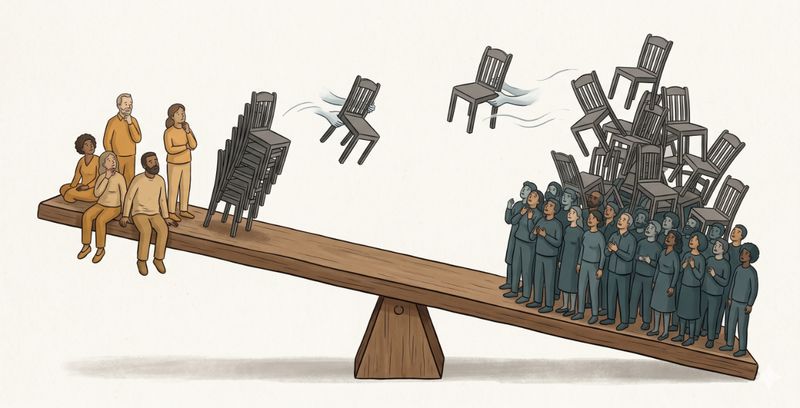
But this created an awkward problem. In a democracy, political power is usually handed out by population: more people means more seats in parliament, which means more say in how the country is run and more money from the central government. So the states that successfully had fewer children would automatically end up with fewer people, and therefore fewer seats, than the states that did not. They would be punished for doing exactly what the nation asked. To prevent that injustice, India made an unusual promise in 1976: it froze the number of parliamentary seats each state holds, so no state would lose power for shrinking its population. That freeze was meant to be temporary. It expires in 2026. And now the bill for 50 years of success is coming due.
The numbers behind the reckoning:
- India has not changed the share of parliamentary seats between states since they were frozen based on the 1971 census.
- By population today, some northern states are dramatically underrepresented: in parts of the north, over 30 lakh people elect one MP, while in Kerala it is around 18 lakh.
- One analysis projects northern states could gain around 43 seats while southern states lose around 24 in a population-based redraw.
- Kerala could lose nearly 30 percent of its seats and Tamil Nadu around 23 percent, while Uttar Pradesh alone could gain close to what three southern states lose combined.
Why this is a genuine fairness puzzle, not a simple villain story
It is tempting to see one side as wronged and the other as greedy, but the honest truth is that both sides have a real point, and that is what makes this so hard. The southern argument is about fairness over time: we did what the country asked, we lowered our birth rates, we built strong economies, and we contribute far more to the national treasury than we take out, so it would be unjust to now strip us of political power simply because we succeeded. The northern argument is about fairness in the present: democracy is built on one person, one vote, and right now a voter in Uttar Pradesh or Bihar has far less representation than a voter in the south, because the north's growing population is squeezed into the same frozen number of seats. A citizen in the north is, in effect, getting a weaker vote than a citizen in the south. Both of these are legitimate ideas of fairness, and they point in opposite directions. That is the trap.
One side is asking for fairness over time. The other is asking for fairness right now. Both are right, and that is why there is no easy answer.
How money makes it worse
The fight is not only about seats. It is also about money, and this is where it cuts deepest. India shares its tax revenue with states using a formula in which population is a major factor, so a state with more people gets a larger slice of the national pot. The southern states already feel they are on the losing end of this: they generate a large share of India's wealth and taxes, but because their populations are smaller, they receive proportionally less back. Now, if delimitation also cuts their number of parliamentary seats, they lose political power at the exact moment they feel they are already losing financial power. From the southern view, it is a double penalty: contribute more, have fewer children, and end up with both less money and less voice. This is why the issue has moved from academic debate to genuine anger, with black-flag protests in Tamil Nadu and southern leaders describing the coming exercise as a "Damocles' sword" hanging over their future.
What the government is trying, and why it may not be enough
The central government is aware of the danger and has tried to defuse it. In a special parliamentary session in April 2026, it introduced bills proposing to expand the total size of the Lok Sabha, India's lower house, from around 543 seats to as many as 850.
The logic is clever: if the whole pie grows large enough, the northern states can gain seats to reflect their population without the southern states losing any seats in absolute terms. Everyone keeps what they have, and the north simply gets more.
It sounds like a solution, but it does not fully resolve the deeper fear. Even if the south keeps its current number of seats, its share of the total, and therefore its influence over national decisions, still shrinks if the north gains many more. A bloc that once could block or shape national policy might no longer be able to. Southern leaders have proposed an alternative: a weighted formula that rewards states not just for population but for development, economic contribution, and yes, for successfully controlling their birth rates. Whether the centre adopts anything like that remains the open, contested question.
Why this matters beyond India
Step back, and India's delimitation fight is a vivid example of a tension hidden inside every democracy that ties power to population. The principle of one person, one vote sounds simple and fair, but it quietly contains a perverse incentive: it rewards growth and penalises restraint. A region that uses resources carefully, educates its people, and has fewer children will, over decades, see its political voice fade relative to regions that did the opposite.
India is simply the largest and clearest place this paradox has ever played out, because the gap between its fast-growing north and its stabilised south is so wide and the stakes so high.
The freeze gave India 50 years to avoid one hard question: when doing the responsible thing costs you power, how do you keep people willing to do the responsible thing at all? The time to answer it has arrived.
Frequently Asked Questions
What is "For 50 years, India rewarded states that had fewer children. That reward is about to be taken away." about?
India once asked its states to control their populations, and the south did it best. To protect those states from losing political power for shrinking, India froze the number of parliamentary seats each state holds. That freeze ends in 2026. Now the south faces a painful reversal: the regions that had fewer children may lose seats to the faster-growing north, with one southern state potentially losing nearly a third of its voice. Success, it turns out, came with a hidden bill.
Why does this india macro topic matter?
This topic covers a significant development in india macro that affects economies, industries, and everyday people. Qrio breaks it down in plain English so you can understand the implications without needing specialized knowledge.
How long does it take to read this explainer?
The brief takes about 30 seconds. The full deep dive takes just a few minutes. You can choose how deep you want to go.
More from Qrio

Oura wants $16 billion for a ring, and one number explains why

India's biggest stock exchange is finally going public and it has to list on its rival