China is secretly shipping missiles to Iran through a Hong Kong shell company, while playing peacemaker
5 min read · by Qrio · 31 Jul 2026
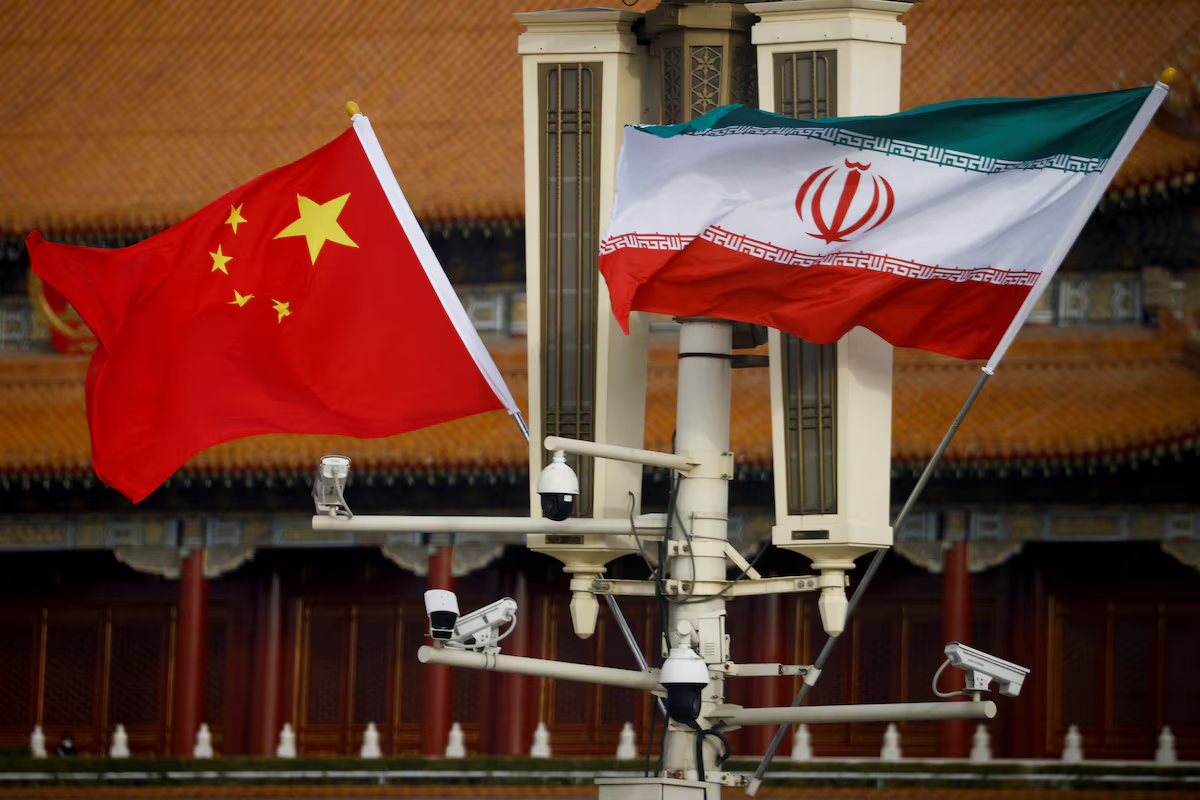
China has spent months publicly styling itself as the reasonable adult in the room on Iran. Reuters just reported a weapons deal that undercuts that story entirely, and almost nobody outside the region has noticed yet.
A deal that surfaced through unnamed sources, not a press conference
On July 28 and 29, 2026, Reuters reporters John Irish and Jonathan Saul published a story citing sources familiar with the matter: Iran has contracted to buy 300 to 400 man portable air defense systems, better known as MANPADS, shoulder fired missiles that lock onto the heat signature of low flying aircraft, helicopters, and drones. The specific models are China's QW-12 and FN-16, and the price tag comes to roughly $60 to $70 million, with delivery expected within weeks of the report. The intermediary named in the deal is Zhongqing Baoshang International Investment, a firm based in Hong Kong and tied to the Zhong Qing Bao Shang Group. A separate report from Anadolu, carried by Middle East Monitor, claimed the shipment plan involves flying initial batches out of Urumqi in western China and transiting Pakistani airspace en route to Iran, though this routing detail did not appear in the original Reuters reporting and should be treated as less confirmed.
Two governments, two denials, on the record
Both governments named as facilitators pushed back hard. China's Foreign Ministry called the reports "completely groundless," adding that "China has consistently played a role in promoting peace and ending the conflict." Pakistan's Inter-Services Public Relations, its military media wing, was even blunter: "Speculations of Pakistan being involved in the supply of Air Defence weapons to Iran from China are absolutely concocted and false." Pakistan's Foreign Ministry did not respond to requests for comment. Neither denial addresses whether the underlying weapons deal exists, only whether their own governments are involved in facilitating it.
Why the timing makes this awkward for Beijing
Here's the detail most coverage of the war has missed. Weeks before this report, President Trump publicly warned that China and Russia had "pledged not to sell arms to Iran," and that doing so "would be very bad for them." China has spent the same period positioning itself as a neutral party pushing for de-escalation, including publicly criticizing a separate US move to restrict Chinese humanoid robot imports as security overreach. A government that wants to be seen globally as the reasonable broker between Washington and Tehran does not usually want to be caught, even by anonymous sourcing, quietly restocking one side's air defenses through a shell company in Hong Kong. It is the geopolitical equivalent of a mediator who keeps handing one side notes under the table. Whether or not every detail holds up, the mere plausibility of the story damages the image China has been building.
The bigger picture: a war that keeps almost ending
This surfaces five months into a war that began around February 28, 2026 between the United States, Israel, and Iran. The conflict's ceasefire history reads like a series of false stops. Trump declared the April truce "over" at the July 8 NATO summit, then Israeli and US strikes on Iran ran for 13 consecutive nights, from July 11 to July 24, before pausing again. That pause has held for less than a week as of this report. Iran, meanwhile, is separately negotiating with Oman over how to manage shipping through the Strait of Hormuz, the waterway that carries roughly a fifth of the world's oil and gas. Iran's Deputy Foreign Minister Kazem Gharibabadi rejected Oman's proposal for splitting the strait's shipping lanes 50-50, insisting instead that "the inbound shipping lane must be entirely under Iran's control," and warning the strait "will remain closed if Oman rejects" Iran's counterproposal.
"The relevant reports are completely groundless. China has consistently played a role in promoting peace and ending the conflict." China's Foreign Ministry, responding to the Reuters report
The honest catch
None of this is proven in the way a signed contract or a customs manifest would prove it. The entire story rests on Reuters' unnamed sources, and both named governments have issued flat denials on the record. The Urumqi to Pakistan routing, in particular, comes from a single outlet and was not corroborated elsewhere. It is entirely possible some details get revised or walked back as more reporting emerges. But an allegation this specific, naming an exact company, exact missile models, and an exact price, rarely appears from nowhere, and Reuters is not a tabloid prone to inventing weapons deals.
A war that keeps almost ending just picked up a rumor about who might be quietly re-arming one side. Whether or not every detail survives scrutiny, the fact that it's plausible at all tells you how little anyone currently trusts the ceasefire to hold.
Frequently Asked Questions
What is "China is secretly shipping missiles to Iran through a Hong Kong shell company, while playing peacemaker" about?
Reuters reported on July 28 and 29, 2026 that Iran has agreed to buy 300 to 400 Chinese made shoulder fired missiles, the QW-12 and FN-16 models, for $60 million to $70 million, arriving within weeks. The deal reportedly runs through **Zhongqing Baoshang**, a Hong Kong based intermediary, with one report claiming the route crosses Pakistani airspace. China's Foreign Ministry called the reports "completely groundless." Pakistan's military called the transit claim "concocted and false." The news lands weeks after President Trump warned China that arming Iran "would be very bad for them," and in the middle of fragile talks over the Strait of Hormuz.
Why does this geopolitics topic matter?
This topic covers a significant development in geopolitics that affects economies, industries, and everyday people. Qrio breaks it down in plain English so you can understand the implications without needing specialized knowledge.
How long does it take to read this explainer?
The brief takes about 30 seconds. The full deep dive takes just a few minutes. You can choose how deep you want to go.
More from Qrio
Oura wants $16 billion for a ring, and one number explains why

India's biggest stock exchange is finally going public and it has to list on its rival