Britain changed its prime minister today and not a single voter was asked
5 min read · by Qrio · 23 Jul 2026
Two years ago Keir Starmer won one of the biggest majorities in British history. This morning he handed the keys to a man who, until recently, did not even have a seat in Parliament.
A very British handover
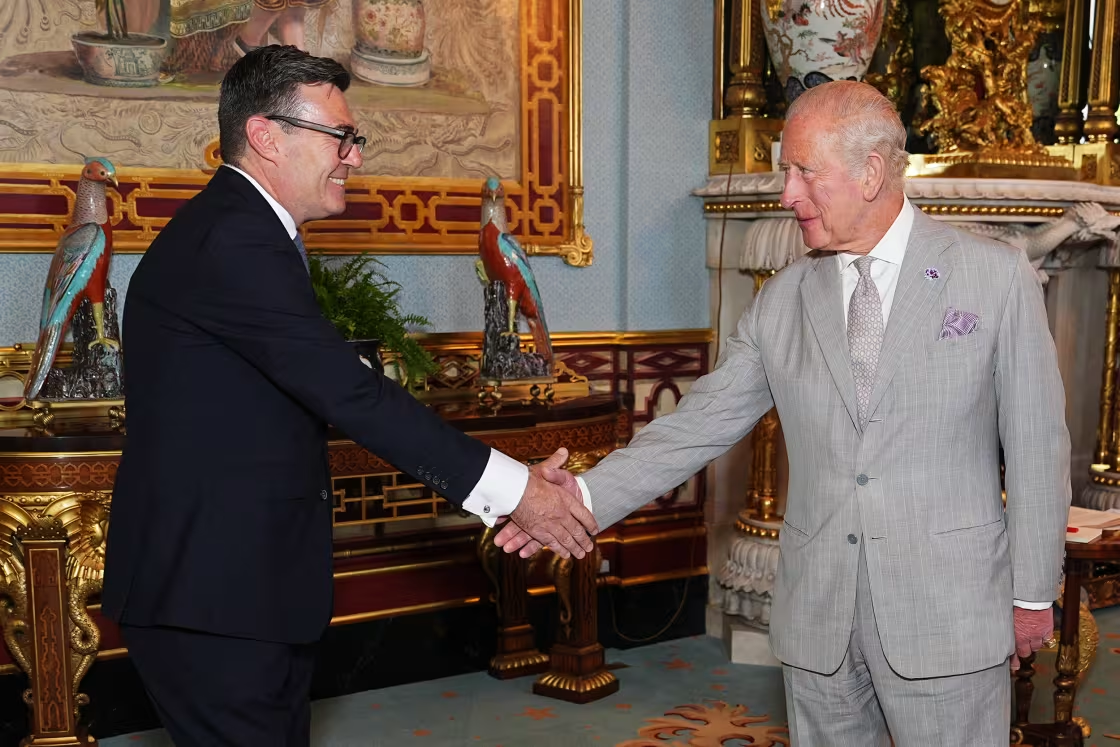
The mechanics took barely an hour. On Monday morning, Keir Starmer travelled to Buckingham Palace and tendered his resignation to King Charles III. Shortly afterwards, Andy Burnham made the same short drive and was invited by the King to form a government. No general election, no public vote, and constitutionally nothing improper. In Britain's parliamentary system, voters elect a party, and the party chooses its leader.
Burnham becomes the UK's seventh prime minister in ten years, following Cameron, May, Johnson, Truss, Sunak and Starmer. For perspective, in the fifty years before 2016, Britain went through just nine. The country that once smirked at Italy's revolving-door governments has now out-revolved Rome.
Why the merry-go-round keeps spinning
It is tempting to blame the leaders. Six prime ministers have failed in a row, so surely Britain just keeps picking the wrong people. But the real problem is simpler and harder. Britain has barely gotten richer since the 2008 financial crisis. The average worker's pay, after inflation, has been stuck for more than fifteen years, the longest stretch in modern British history. When a country stops getting richer, there is no new money for anything. Taxes are already near **post-war highs, **hospitals and trains are visibly struggling, and every new leader makes promises the budget cannot pay for. Brexit made it worse by splitting both big parties into camps that fight each other more than the opposition. And Britain's rules make it easy to swap a failing leader without holding an election, so the party in power just changes the face and hopes. That is the whole cycle. A new leader promises change, hits the same empty wallet within a year or two, and gets thrown out by the same frustrated voters. Until Britain figures out how to grow again, it will keep changing drivers on a car that has run out of fuel.
How Starmer fell
Starmer's collapse is the more remarkable story. In July 2024 he won a landslide. By mid 2026 his approval ratings had sunk, with voters telling pollsters he had failed to deliver visible change. The appointment of Peter Mandelson, a friend of the late Jeffrey Epstein, as ambassador to Washington became a lasting stain. Then came the May 2026 local elections, where Labour lost badly to a populist anti-immigration party, and Starmer's own MPs turned on him. He announced his resignation as Labour leader on June 22.
His farewell to Parliament last week was defiant.
"My work is done. I go with good grace, I go with a smile, and I go proud," Starmer told MPs.
The coronation nobody contested
Here is the detail most headlines skip. Burnham did not win a leadership battle. He ran unopposed. Not one Labour MP mounted a challenge against a man who spent the last decade outside Westminster as mayor of Greater Manchester, only recently returning to the Commons through a special election. A party that fought viciously over its soul for years simply parted like a curtain.
That tells you two things. First, Labour MPs believe Burnham is their best shield against the populist surge, because his brand is northern, plain-spoken and detached from the Westminster machine voters have learned to despise. Second, the party was too exhausted and too scared for a public fight.
Burnham is no outsider by resume. He spent 16 years as an MP and held Cabinet posts under Tony Blair and Gordon Brown, including Health Secretary. He ran for the Labour leadership twice and lost both times. His comeback is the political equivalent of leaving a company, running a successful regional office for a decade, and returning as CEO.
The rough sleeping test
His first words in Downing Street were deliberately humble.
"I want to be honest with you: We have not been good enough," Burnham said, before promising that his first instruction would be "to end rough sleeping in our country."
It is a shrewd opening. Grand promises destroyed his three predecessors. A specific, visible, checkable pledge is the opposite of Starmerism, which voters experienced as managerial fog. Burnham's early agenda leans the same way, cost of living measures expected as early as Tuesday, scrapping the digital ID card plan, reversing parts of transport and utility privatisation, and pushing power out of London to regional mayors, the job he knows best.
The honest catch
Burnham inherits the same trap that consumed Starmer. Britain's growth is weak, taxes are already near post-war highs, borrowing is expensive, and the populist right is setting the agenda on immigration. A new face does not change the arithmetic. And because he was crowned rather than elected, his opponents will hammer the legitimacy question every single day until the next general election, which is expected in roughly three years.
Seventh prime minister in a decade is a statistic. Whether there is an eighth before 2030 is the question. Britain keeps changing the driver. The road has not changed at all.
Frequently Asked Questions
What is "Britain changed its prime minister today and not a single voter was asked" about?
Andy Burnham, the mayor of Greater Manchester, became the United Kingdom's prime minister today, its seventh in ten years. Keir Starmer resigned at Buckingham Palace this morning, just two years after winning a landslide. Burnham won the Labour leadership by running completely unopposed, and his first promise as PM was strikingly small and specific, an instruction to end rough sleeping. How does a man who was not even an MP a year ago end up in 10 Downing Street without a general election?
Why does this geopolitics topic matter?
This topic covers a significant development in geopolitics that affects economies, industries, and everyday people. Qrio breaks it down in plain English so you can understand the implications without needing specialized knowledge.
How long does it take to read this explainer?
The brief takes about 30 seconds. The full deep dive takes just a few minutes. You can choose how deep you want to go.
More from Qrio
Oura wants $16 billion for a ring, and one number explains why
India's biggest stock exchange is finally going public and it has to list on its rival