America nearly launched its biggest attack since World War Two, over a deal Iran says doesn't exist
4 min read · by Qrio · 3 Aug 2026
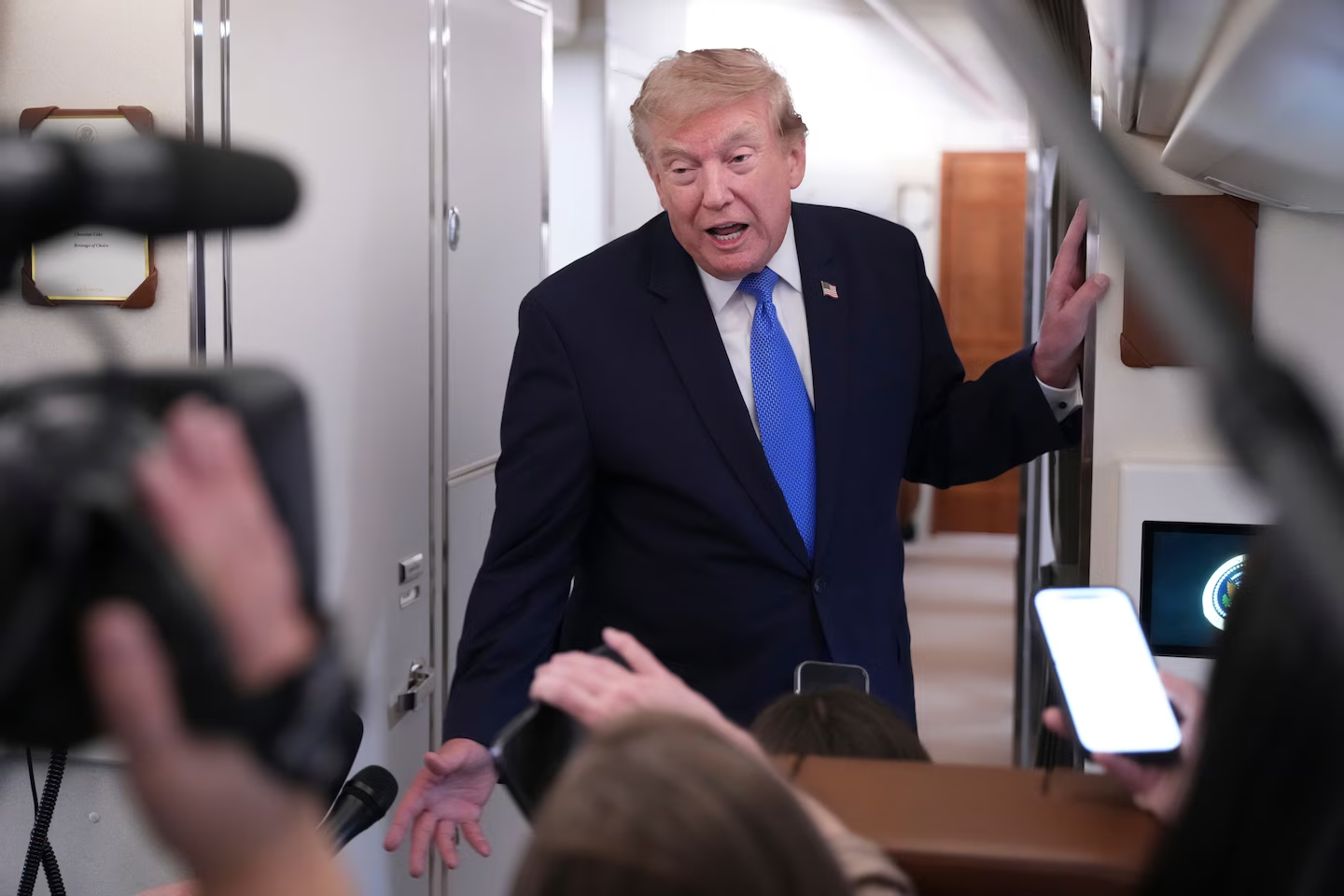
A president said he pulled back from the most destructive strike of his term because a deal was hours away. The country on the other side of that deal says the meeting he described does not exist.
This war did not start last week. On February 28, 2026, the United States and Israel launched nearly 900 coordinated strikes in twelve hours against Iranian missiles, air defenses, military infrastructure and leadership, after concluding, in Washington's telling, that diplomacy had been exhausted and a nuclear armed Iran was an unacceptable risk. Forty days of combat followed before a ceasefire took hold on April 8, reopening the Strait of Hormuz to commercial shipping. On June 14, mediators announced a memorandum of understanding, a 60 day framework meant to turn that pause into a formal end to the war.
It did not hold. The MOU broke down over who would control the Strait of Hormuz, the narrow waterway through which roughly a fifth of the world's oil passes. On July 13, the US resumed strikes after Iran hit commercial vessels that had bypassed an approved shipping route, and Iran said it had disabled two tankers in the strait, one belonging to the UAE, killing a crew member. Oil prices jumped more than 9% that day alone. By July 26, both sides had quietly paused attacks for two straight days, the kind of silence that in this war has repeatedly turned out to be temporary.
The sentence that should have been reassuring, and wasn't
Speaking to reporters aboard Air Force One on August 2, Trump said he had planned "the biggest attack since World War Two" against Iran that weekend, one he said would have been "disastrous" for Tehran, before calling it off. His reason was specific: "I was asked to by Saudi Arabia, UAE and by Qatar and by Iran," he said, adding that "the perimeters of a deal" covering the Strait of Hormuz and "the denuclearization of Iran" had been agreed, with talks due to resume Monday, August 3.
Iran's response should have been the easy part, a government confirming its own diplomatic breakthrough. Instead, Foreign Minister Abbas Araghchi split the story in two. He confirmed that talks with Oman over the Strait of Hormuz were in their "final stages" and "on the way to being finalized." But he denied that any negotiations with the United States were scheduled to resume at all, and instead warned that "any aggression or hostile act... would be met with a decisive and proportionate response."
A useful way to picture it
Imagine two people who both say they are close to signing the same contract, except one of them describes it as a meeting scheduled for Monday morning and the other says no such meeting was ever booked. Both can be telling the truth about the parts they control, Iran's own talks with Oman, Trump's own decision to stand down, while still describing two different deals. The gap between them is not a lie so much as two governments each managing their own audience, one reassuring markets and allies that an attack has been avoided, the other reassuring its own public that it has not quietly agreed to American terms.
"We had an attack that would be the biggest attack since World War Two, and it would have been disastrous for them." - Donald Trump, US President, speaking to reporters on August 2, 2026
The honest catch
None of this proves either side is negotiating in bad faith. Wars this long running tend to produce exactly this kind of asynchronous messaging, since de-escalation usually happens in separate rooms, with separate translators and separate incentives to claim credit or avoid blame. It is entirely possible a real, narrow deal on Hormuz shipping is close, even as a broader US-Iran negotiation remains stuck, and that Araghchi's denial is about the specific claim of Monday talks rather than a rejection of any progress at all. Trump has also, in this same war, previously announced ceasefires and frameworks that later collapsed, so skepticism from Tehran, and from outside observers, is not unreasonable.
A ceasefire this many months in the making usually ends with both sides describing the same handshake. This one ended its latest chapter with each side describing a different room.
Frequently Asked Questions
What is "America nearly launched its biggest attack since World War Two, over a deal Iran says doesn't exist" about?
On August 2, 2026, President Donald Trump said he called off what he described as "the biggest attack since World War Two" on Iran, after Saudi Arabia, the UAE, Qatar and Iran itself asked him to hold off because "the perimeters of a deal" on the Strait of Hormuz and Iran's nuclear program had been agreed. Iran's Foreign Minister Abbas Araghchi confirmed Hormuz talks with Oman were in their "final stages," but flatly denied any US talks were scheduled, and warned of "a decisive and proportionate response" to further aggression. Same war, two governments, two different stories about what happens next.
Why does this geopolitics topic matter?
This topic covers a significant development in geopolitics that affects economies, industries, and everyday people. Qrio breaks it down in plain English so you can understand the implications without needing specialized knowledge.
How long does it take to read this explainer?
The brief takes about 30 seconds. The full deep dive takes just a few minutes. You can choose how deep you want to go.
More from Qrio

Oura wants $16 billion for a ring, and one number explains why

India's biggest stock exchange is finally going public and it has to list on its rival