India's biggest oil city is quietly becoming its AI capital.
5 min read · by Qrio · 26 Jun 2026
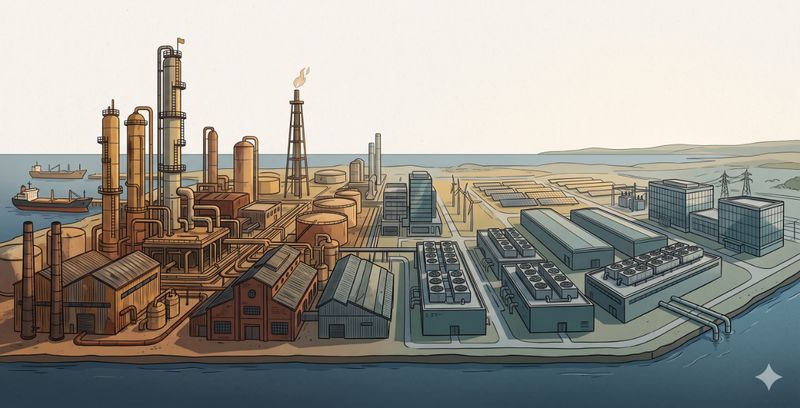
The city that refined India's oil is being rebuilt to refine its intelligence. The reason is bigger than one data center.
Same city, a new kind of refining
For decades, Jamnagar did one thing on a colossal scale: it turned crude oil into fuel. That made it the heart of India's energy story and the foundation of Reliance's rise. Now the same ground is being used for a different kind of refining. Instead of turning crude into petrol, the plan is to turn electricity, chips and cooling into computing power. The inputs are different, but the idea is identical: take raw resources, concentrate them in one place at enormous scale, and convert them into something the rest of the economy cannot run without.
Jamnagar is moving from refining fuel to refining intelligence.
Data centers are the new factories
This matters because data centers are the factories of the digital age. They do not look like factories, but they do the same job. They gather capital, power, land and technology in one spot and convert it into a product everything else depends on.
The catch is that building one at AI scale is brutally hard. A modern AI data center needs:
- A massive, uninterrupted electricity supply
- Heavy-duty cooling to stop thousands of chips from overheating
- Large secured land and fast network links
- Capital at a level most companies simply cannot raise
That is why only a handful of players can build at this level, and why Reliance is one of them. It already owns the rare combination these projects demand: land, energy access, infrastructure, and the habit of thinking in giant systems rather than small pilots.
Why Jamnagar, specifically
Jamnagar has a structural head start. It already sits inside Reliance's industrial ecosystem, so the company is not starting from zero. It has scale, connectivity, and a long record of running enormous, complex operations. The clever part is how it solves the two problems that usually choke big data centers: power and water. The plan leans on renewable energy for electricity and desalinated seawater for cooling. That is not just a green talking point. Data centers devour power and can drain local freshwater, so using solar energy and the sea is what makes a project this size physically possible in the first place.
Why the Meta deal is the real signal
The Meta partnership matters because it changes what India represents to global tech. Meta is leasing capacity in a roughly 168 MW AI-enabled facility, which is industrial scale, not a symbolic pilot. For years, the story was that foreign tech firms came to India to sell to Indian users, apps, phones, services. This is different. Big Tech is now looking at India not for its customers but for its infrastructure, as a place to put serious computing power. That is a genuine shift in India's role, from the market where products are sold to the place where the machines that make those products live.
The real idea: sovereign AI
Underneath all of it is one phrase that explains everything: sovereign AI.
In plain terms, it means a country should not depend entirely on foreign companies for the computing power that runs its economy, its government and its businesses. If the servers, chips and models all sit abroad, a country may use AI, but it does not truly control it.
The logic mirrors energy almost exactly. India spent decades learning that leaning too heavily on imported oil left it exposed to shocks far beyond its control. It is now realizing that leaning too heavily on foreign compute could be just as risky. This is not about shutting the world out. It is about control, resilience and bargaining power, the ability to set the pace, cost and availability of AI inside its own borders.
India cannot afford to rent intelligence forever.
Why this is the part most people miss
We tend to talk about AI as if it were purely software, a story of code, models and clever apps. But the real race is physical: chips, power, fiber, cooling and land. Whoever owns that foundation controls how fast, how cheap and how freely AI can be used on top of it.
That is what makes Jamnagar more than a construction project. It is a test of whether India can build the foundation, not just rent space on someone else's. And it shows how countries reuse their strongest physical advantages when a new technology wave arrives: industrial land becoming AI land, energy assets becoming compute assets, an old refinery town becoming a template for the next economy.
India built energy sovereignty so it would never be held hostage by oil. Jamnagar is now its bet on compute sovereignty, so it is never held hostage by intelligence. The same city that powered one era of India's growth is being asked to power the next, and whether it can will say a lot about where India stands in the AI age, as an owner or merely a customer.
Frequently Asked Questions
What is "India's biggest oil city is quietly becoming its AI capital." about?
Jamnagar is known as India's oil city, home to one of the world's largest refineries. Now Reliance is building a giant data center campus there, and Meta is leasing a slice of it. The bigger idea is simple but ambitious: India does not want to stay a customer of AI, buying intelligence built elsewhere. It wants to own the physical machinery that makes AI possible, the way it once fought to stop depending on imported oil. Why a refinery town, and what India is really trying to escape, is the story underneath.
Why does this business topic matter?
This topic covers a significant development in business that affects economies, industries, and everyday people. Qrio breaks it down in plain English so you can understand the implications without needing specialized knowledge.
How long does it take to read this explainer?
The brief takes about 30 seconds. The full deep dive takes just a few minutes. You can choose how deep you want to go.
More from Qrio

Oura wants $16 billion for a ring, and one number explains why

India's biggest stock exchange is finally going public and it has to list on its rival