India was almost level with the world on chips in 1987. Then the factory caught fire.
5 min read · by Qrio · 22 Jun 2026
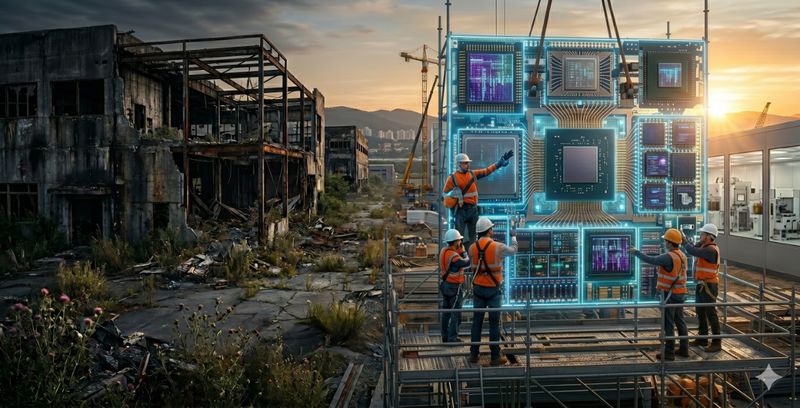
India is finally building chip factories after 50 years of trying. The real story is not that it is happening, but why it is happening now, and what these factories actually do.
The factory that burned
In the 1980s, India was only a few years behind the global frontier in chips. Its Semi-Conductor Laboratory in Mohali was meant to put the country at par with the best. Then, in 1989, a mysterious fire gutted the complex. Production halted, and because this industry moves so fast, India was thrown back two decades.
Why every comeback collapsed
The fire was bad luck. The deeper problem was structural. The heart of the industry is the "fab", short for fabrication plant, the ultra-advanced factory that actually prints circuits onto silicon wafers to create chips. A single fab costs $10 to $30 billion and needs a whole ecosystem around it: pure water, constant power, special gases, and thousands of specialists. India never built that. It put its best engineers into software instead, building Infosys and TCS while Taiwan built fabs. So every new announcement died, the latest being the Vedanta-Foxconn project, which collapsed before a brick was laid. Indians learned to ignore chip headlines, and they were right to.
What is finally different this time
So why does 50 years of failure suddenly turn real? The honest answer is not a breakthrough inside India. It is a shift outside it. Every past attempt died for the same quiet reason: the countries and companies that owned chip technology had no reason to share it. India could offer land and money, but the actual know-how stayed locked abroad, and partners kept walking away. Then the world changed its mind. The COVID chip shortage froze car factories everywhere and taught governments that chips are national security, not just business. The US-China chip war then left every major player desperate for a manufacturing base that was not China. Almost overnight, India stopped chasing chip technology and became a country the world wanted as a backup. For the first time, the technology came to it. Taiwan's Powerchip is anchoring the flagship Tata fab, Japan's Renesas and America's Micron are setting up here, and even ASML, the Dutch firm whose machines are essential to advanced chipmaking and which almost never spreads its bets, has partnered in. None of that interest existed during the earlier failures.
For 50 years India begged for chip technology and was refused. This time, the technology showed up at its door.
What these factories actually make
Here is where most coverage misleads you. People hear "India is building a chip plant" and picture the processor in the newest iPhone, India going toe to toe with Taiwan's TSMC. That is not what is being built.
- The flagship Tata-Powerchip fab in Dholera, around ₹91,000 crore, will make mature-node chips (roughly 28 to 110 nanometres), not cutting-edge 3nm or 2nm.
- Most of the other plants, Micron, Tata in Assam, CG Power, Kaynes, are not fabs at all. They handle assembly, testing and packaging, the stage that comes after a chip is made.
- In total, around 10 projects worth $18 billion have been approved.
India, in other words, is starting at the lower and middle rungs of the chip ladder, not the top.
Why that "old tech" is the smart move
It is tempting to call this a letdown. It is the opposite. Most chips on earth are not bleeding-edge. The chip in your car, your fridge, your power adapter, a missile's guidance system, a solar inverter, nearly all of it runs on mature nodes, exactly what India is choosing to make, and that market is enormous and steady. Trying to leap straight to 3nm would be like a country that has never built a car deciding its first vehicle will be a Formula 1 racer. After half a century of failed moonshots, starting with reliable, profitable everyday chips is the most disciplined thing about the plan.
The advantage no one is talking about
And there is a deeper strength India already holds. Roughly a fifth of the world's chip-design engineers are Indian, and giants like Nvidia, Intel and Qualcomm run vast design centres here. For years, India has quietly helped draw the brains of the world's chips. It simply never built the bodies. This entire push is really an attempt to finally join the two, turning a country that designs chips into one that also makes them.
The honest verdict
None of this is guaranteed. Subsidies can attract factories, but they cannot buy competitiveness, and the real test comes after the incentives expire. India is up against rivals with decades of practice, it still imports nearly all its equipment and materials, and execution already wobbles, with Micron's plant slipping its opening by months. The country's chip import bill of around ₹1.7 lakh crore a year will not shrink meaningfully for years. So the realistic prize is not India becoming the next Taiwan. It is India becoming a solid second-tier chipmaking hub, which after this history would itself be remarkable.
The factories are finally real, and this time the world helped build them. Whether India can run them, on time, long after the subsidies stop, is the one chapter still unwritten.
Frequently Asked Questions
What is "India was almost level with the world on chips in 1987. Then the factory caught fire." about?
In 1987, India was nearly level with the world in making computer chips. A fire at its main lab changed that, and the country fell decades behind. Every comeback attempt since has collapsed, to the point where Indians stopped believing the headlines. This time the factories are genuinely being built. The question worth sitting with is what is finally different now, when every earlier attempt turned to dust.
Why does this business topic matter?
This topic covers a significant development in business that affects economies, industries, and everyday people. Qrio breaks it down in plain English so you can understand the implications without needing specialized knowledge.
How long does it take to read this explainer?
The brief takes about 30 seconds. The full deep dive takes just a few minutes. You can choose how deep you want to go.
More from Qrio
Oura wants $16 billion for a ring, and one number explains why

India's biggest stock exchange is finally going public and it has to list on its rival