Tech & AI
CoinDCX says your crypto is safe, but the leaked data is what phishing scammers look for
By Ashish Kumar · 19 November 2026 · 6 min read
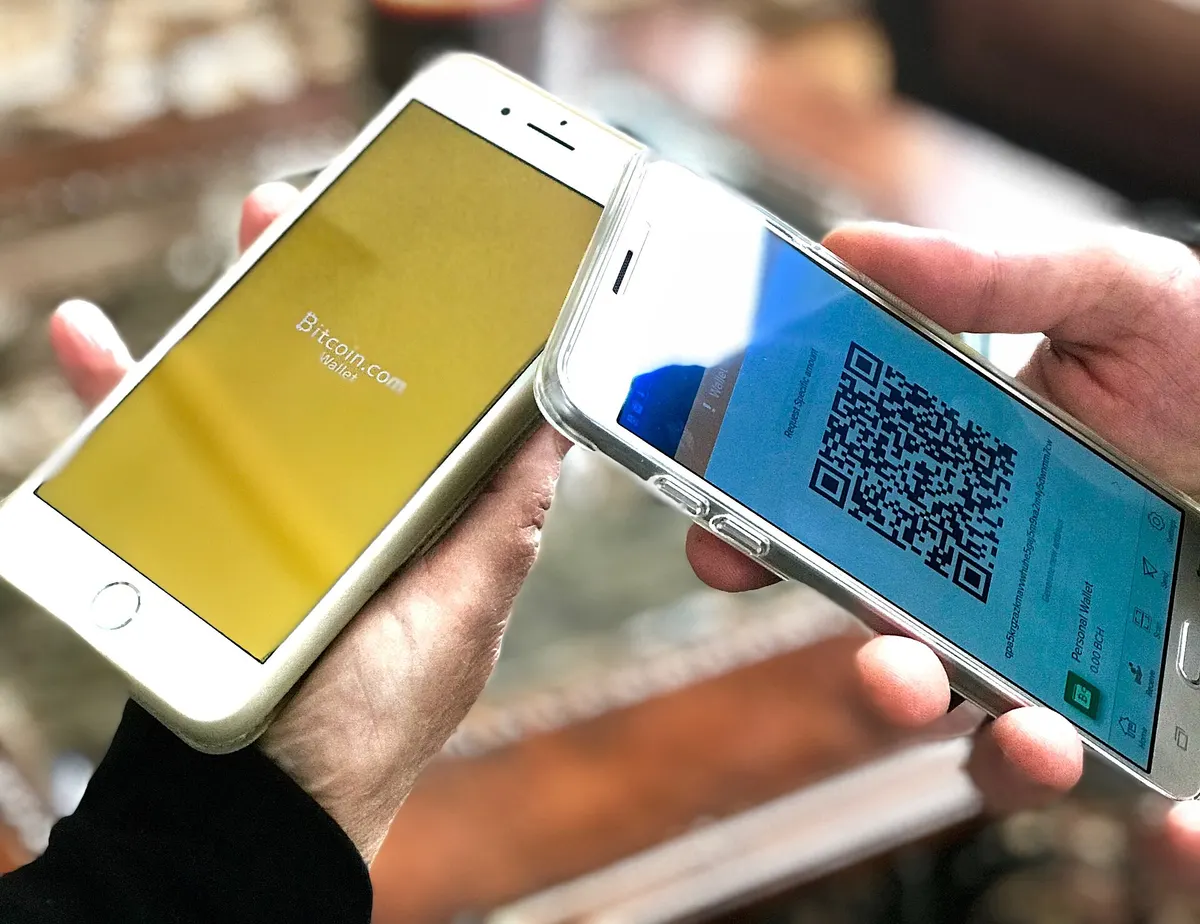
Two people holding phones open on crypto wallet apps, one showing a QR code for receiving payment. Photo: Hyena and thecryptokidd, CC0, via Wikimedia Commons, resized.
No coins left CoinDCX this time, but a list of names, emails and bank names did, and that is the raw material of a convincing scam.
If you use CoinDCX, one of India's biggest crypto exchanges, you may have seen the email this week. The short version: an outside company that sent CoinDCX's app notifications was broken into, and some customer details were taken. Your coins, the company says, are where you left them.
That sounds like the end of it. It is not quite. Let us go through what is confirmed, what is still unknown, and what the leak actually makes possible.
What CoinDCX has confirmed
The breach happened at Plotline, a company CoinDCX used to show in-app messages and pop-ups, as Inc42 and crypto.news report. Firms like this are called vendors: outside companies that a business hires for one job, the way a restaurant might hire a delivery service.
According to CoinDCX's notice, three pieces of customer data were exposed:
- your name
- your email address
- the name of the bank linked to your CoinDCX account
The bank account number was not on that list, both crypto.news and CoinGabbar note. Nor were passwords, private keys or wallet balances.
Someone without permission got into Plotline's systems twice: October 24 to 26 and October 30 to 31, 2026. Plotline told CoinDCX on October 31. CoinDCX posted its public notice on X on November 17, per crypto.news. Inc42 says affected users were also emailed, but the date of those emails is not public.
CoinDCX says Plotline "has no access to CoinDCX internal databases, trade execution engines, or user wallets," and that customer funds are "entirely secure and untouched." A spokesperson told Inc42 the vendor "experienced a security incident that exposed limited user contact details." The exchange says it has confirmed with Plotline that the incident is contained and has started reviewing Plotline's security and its own vendor checks.
What nobody has told us yet
How many people. CoinDCX says a "small number" of customers. It has not given a figure. For scale, TechCrunch reported in July 2025 that the exchange had more than 16 million users.
What the attacker did with the data. Inc42 notes CoinDCX has not said whether the data was copied, downloaded or passed on, or who was behind the access.
Whether the odd login alerts are linked. Some users posted screenshots of "sudden login alert" messages from CoinDCX, one referencing a new login on November 16 at 10:48 pm. crypto.news says it could not establish any link between those alerts and the Plotline breach. That question is still open.
Why a name and a bank name matter
On its own, your name and email are not secret. Plenty of companies have them. What changes here is the combination.
A random scam email says "Dear customer, your account is blocked." This one can say "Hi Priya, your CoinDCX withdrawal to your bank is on hold, verify your KYC here." It knows who you are, where you trade and where your money lands. Think of it like a stranger at your door who already knows your name and your landlord's name: you are far more likely to open up.
That is why the useful question is not "was my money stolen?" but "will I be targeted next?" If you were on the list, the honest answer is: possibly, and the scam will look real.
This is not CoinDCX's first warning
By our count, this is the fourth security incident at the exchange in about 16 months. Two cost the company real money. Two exposed customer details through vendors.
The July 2025 attack hit an account "used only for liquidity provisioning on a partner exchange," CEO Sumit Gupta said, as reported by TechCrunch. The company said no customer funds were affected and it would absorb the loss.
In November 2025, CoinDCX said a breach at Mixpanel, a vendor that tracks how people use apps, exposed some user data. That incident hit Mixpanel's customers broadly, not CoinDCX alone.
The October 2026 loss is the messiest. After the 2025 attack, CoinDCX stopped using some wallet addresses, but some users kept sending deposits to them. A background process meant to sweep those deposits into safe wallets stopped working, so money piled up, and about 15.99 million USDT (USDT is a crypto token meant to track the US dollar) was taken, per Blockonomi. On the morning the reports spread, Gupta said CoinDCX wallets "had not been breached," CryptoSlate reported, before the company later confirmed the loss and said it "could have been more proactive" in telling people. CoinDCX says it covered the loss and customer balances were credited. Tether, the company behind USDT, froze about $2.2 million of it, per Blockonomi.
In every case, CoinDCX says customer money was protected, and it absorbed the losses itself. The pattern people are questioning is not lost savings. It is how many doors keep opening, and how many of them belong to other companies.
The vendor problem, in plain words
A modern app is not one company's code. It is a stack of outside services: one sends notifications, one tracks clicks, one handles support chat. Each one needs some of your data to do its job, and each one is another door a thief can try. A Plotline case study cited by crypto.news describes more than 20 campaigns it ran inside the CoinDCX app over three months.
India's data protection rules, notified in November 2025, require a company to tell each affected person about a breach "without delay" and in plain language, PTI reported via The Week. The rules become fully operational about 18 months after notification. We covered what those rules mean for your data in our story on India's plan to train AI on bank and hospital records.
If you have a CoinDCX account, do this
No need to panic. A few habits go a long way:
- Do not click links in emails or SMS about CoinDCX, your bank or KYC. Open the app or type the website yourself.
- Never share an OTP, password or seed phrase (the secret words that unlock a crypto wallet). No genuine exchange or bank needs them from you.
- Turn on two-factor authentication and check your recent logins. If one looks unfamiliar, change your password.
- If you lose money to a scam, call 1930, India's cyber fraud helpline, or file at cybercrime.gov.in. The helpline is toll-free, as The Tribune reported.
If you are curious why stablecoins like USDT matter well beyond one exchange, read why America wants the world hooked on crypto.
This is a news summary, not investment advice.
Sources
Watch on Qrio
One-minute reels on this and related topics.
 ▶ 2:28
Finance
Angels, VCs, hedge funds and family offices explained
by PeterStewieStartup
 ▶ 2:31
Tech & AI
The six layers of the AI stack
by PeterStewieStartup
 ▶ 2:29
Startups
A founder pitch: why most AI agents are built wrong
by Elevator Pitch by Masters’ Union
 ▶ 1:29
Finance
What happened in 1971?
by Jake Explains
More tech & ai stories

Tech & AI
Nvidia's CEO admitted an affair on Sunday. On Monday the company was worth $200 billion less
Nvidia shares fell about 4.3% on November 9, wiping out almost $200 billion in market value, after CEO Jensen Huang admitted to an affair and the company's board opened an independent investigation. The woman, Alice Huang, is a former executive of Singapore-based Megaspeed, an Nvidia customer that has been investigated over chip exports to China. US officials reportedly believe she is a Chinese spy. China calls that a smear, and she has not commented. Nvidia's board says it has no reason to believe secrets or national security were compromised. Here is how the week unfolded, and why one person's private life moved the world's second most valuable company.
10 November 2026 · 6 min read

Tech & AI
India wants your bank and hospital data to train AI without anyone seeing it
On 30 October 2026, India's IT ministry unveiled a draft plan called DEPA for AI Training that would let startups train AI models on data held by banks, hospitals and government agencies, without ever seeing the raw records. The data stays locked inside a secure "sealed room"; developers send their model in and get only the trained model back. The government says this could add $500 billion of AI-driven value to India's economy by 2030. The draft is not legally binding yet, and big questions remain: how data owners get paid, who is liable if something leaks, and where your own consent fits in. Here is what we know, and what we do not.
31 October 2026 · 6 min read