Why the world's biggest software company just became a services firm
5 min read · by Qrio · 4 Jul 2026
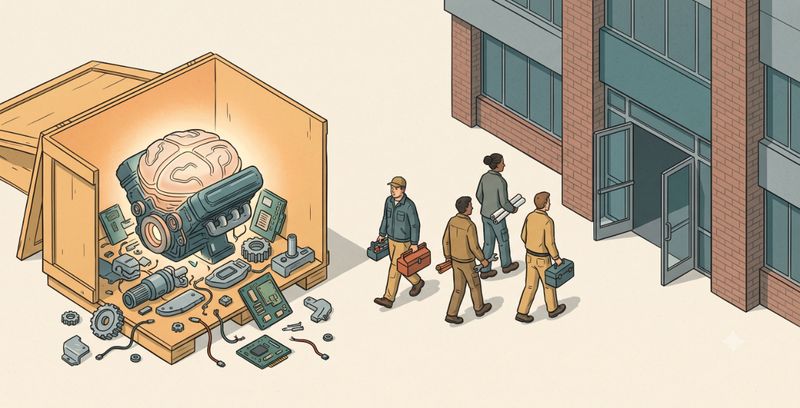
When every seller starts offering free hand-holding, it means the product is not selling itself anymore.
Imagine buying a fancy car that arrives at your home as a box of loose parts. The engine is world-class. But you cannot put it together. That is what AI feels like for most big companies today. This week, the companies that sell the engines decided to send their own mechanics to your house.
What Microsoft announced
On July 2, 2026, Microsoft launched Microsoft Frontier Company (MFC). It is a new business unit with $2.5 billion in funding and 6,000 engineers. These engineers will physically sit inside customer companies, like Unilever and Novo Nordisk, and help them make AI work in their daily business. A senior leader named Rodrigo Kede Lima will run it. One more thing makes this interesting. MFC will help customers use AI tools from Microsoft and even from Microsoft's rivals. And whatever gets built stays with the customer. The timing is the real story. Amazon announced almost the same thing two days earlier, with $1 billion. The AI labs Anthropic and OpenAI built similar teams in May. Four rivals. One identical move. One quarter. That is never an accident.
A few numbers show the scale:
- $2.5 billion is Microsoft's bet. That is roughly the yearly profit of Infosys, one of India's biggest companies.
- Research from MIT found that around 95% of company AI projects fail to make any real money impact. That means 19 out of 20 projects go nowhere.
- Amazon's rival plan came just 48 hours earlier. Like two runners diving for the same finish line.
The real problem has moved
Here is a simple idea to keep. In any new technology, money flows to wherever the biggest problem sits. In 2023, the problem was building smart AI models, so the AI labs won. In 2024 and 2025, the problem was computing power (the giant machines that run AI), so chipmakers like Nvidia won. In 2026, smart models are everywhere and easy to get. The new problem is deployment. That is just a fancy word for making AI actually work inside a company's messy old systems and daily routines.
This hands-on style of work has a name: forward deployed engineering. It simply means the seller's engineers work inside the buyer's office, on the buyer's real problems. A company called Palantir built its whole business this way for fifteen years. People in Silicon Valley laughed at it and called it "a consulting shop pretending to be a software company." Palantir's share price since 2023 stopped the laughing. Now everyone is copying its homework.
But why would Microsoft do this? Selling software earns fat profits. Sending engineers to client offices earns thin profits, like a consulting firm. The answer: the $2.5 billion is bait. When a company finally gets AI working, it buys much more of Microsoft's cloud computing (renting Microsoft's machines over the internet). That is where the real money is.
This happened once before
In the 1990s, IBM was in trouble. Computers had become cheap and IBM's machines were no longer special. Its new boss,** Lou Gerstner, saved it by changing the pitch: stop selling machines, start sending experts to fix customer problems.** That services business became more than half of IBM. It saved the company. But there is a catch. It also ended IBM's days as an exciting product company. Microsoft is betting it can copy the trick without copying the ending. For India, this hits close to home. Sitting inside client offices and fixing their tech is exactly what TCS, Infosys and Wipro do for a living. Now the product makers themselves are doing that job, with 6,000 of their own engineers and better tools.
The first lap of the AI race was about who builds the smartest model. The second lap is about who shows up at your office on Monday.The other side of the story
This plan has real risks. Consulting work grows only when you add more people. One engineer can serve only so many clients. So $2.5 billion buys a limited number of projects, not endless growth. Also, Microsoft says it will happily set up rivals' tools. Easy to say, hard to do when your own company sells the competing tool. Customers may also worry this is a trap to lock them into Microsoft forever.
What to actually watch
Watch two things. First, does Microsoft share any client numbers for MFC in its October 2026 results? Second, listen to Indian IT company results this month, starting with TCS around July 10. If TCS or Infosys announce their own "embedded AI engineering" teams within six months, you will know the threat was real.
Smart AI models became cheap and common. Understanding a customer's business stayed rare. The trillion-dollar companies just admitted which one they were missing.
Frequently Asked Questions
What is "Why the world's biggest software company just became a services firm" about?
On July 2, Microsoft put $2.5 billion and 6,000 engineers into a new team. These engineers will sit inside customer offices, like Unilever, and help them use AI properly. Amazon did the same thing two days earlier with $1 billion. Two AI labs did it in May. Software companies avoided this kind of hands-on work for decades. So why are all of them suddenly doing it at once? The answer shows where AI's real problem is now.
Why does this tech & ai topic matter?
This topic covers a significant development in tech & ai that affects economies, industries, and everyday people. Qrio breaks it down in plain English so you can understand the implications without needing specialized knowledge.
How long does it take to read this explainer?
The brief takes about 30 seconds. The full deep dive takes just a few minutes. You can choose how deep you want to go.
More from Qrio

Oura wants $16 billion for a ring, and one number explains why

India's biggest stock exchange is finally going public and it has to list on its rival