Tech & AI
The man who inspired "3 Idiots" is on a hunger strike. This is what he is fighting for
By Ashish Kumar · 16 July 2026 · 4 min read
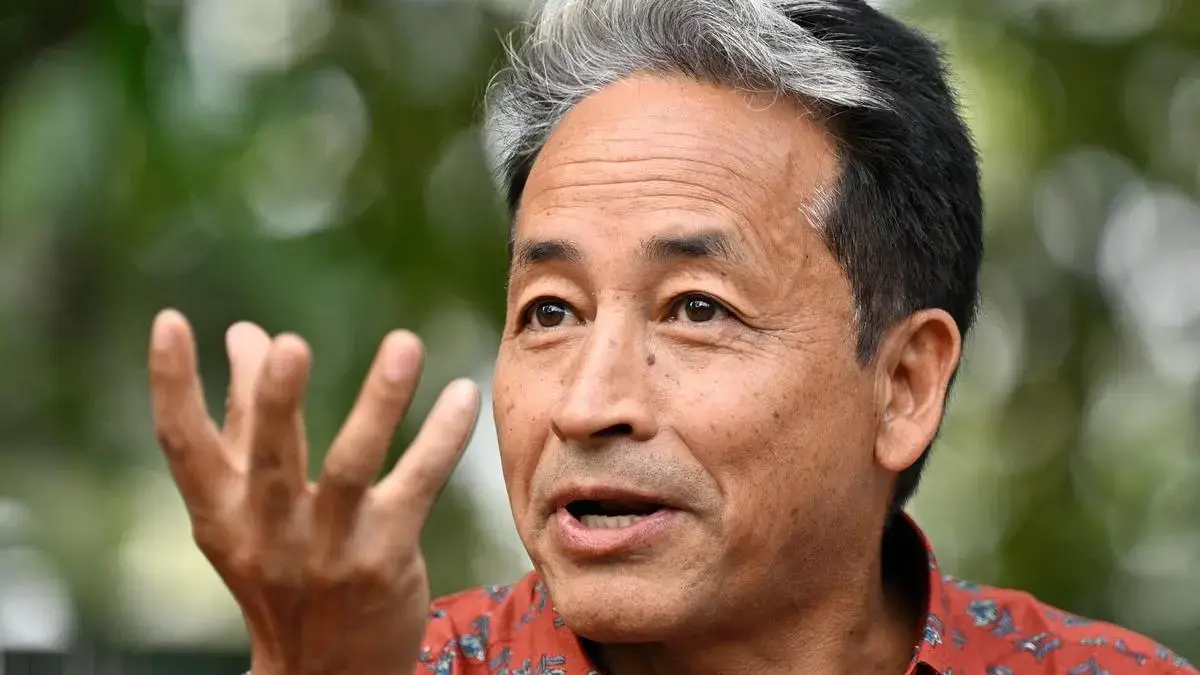
A famous teacher is slowly starving himself on a Delhi pavement. To understand why, you have to understand both the man and the anger of an entire generation of students.
Who is Sonam Wangchuk?
Most Indians know his story without knowing his name. The film "3 Idiots" had a character called Phunsukh Wangdu, an inventor who loved learning by building things instead of memorising books. That character was inspired by a real person: Sonam Wangchuk.
He grew up in a tiny village in Ladakh, high in the mountains, and hated school as a child because teachers taught in languages he could not understand. That pain shaped his whole life. As an adult he became a teacher, engineer and inventor. He built a school that runs entirely on sunlight, warm inside even when it is freezing outside. He invented the "Ice Stupa," a cone of frozen water that stores winter ice and melts in spring to give farmers water. He has won some of the world's biggest awards for his work. For years, he was simply an Indian hero.
Why is he protesting?
Two things brought him to that mattress in Delhi.
The first is his long fight for Ladakh, his home. In 2019, Ladakh became a region run directly by the central government, with no local government of its own. People there fear that outsiders will take their land and harm their fragile mountains. Wangchuk has fought for years for Ladakh to get more powers and stronger protections. In 2025, after a protest turned violent and people died, the government blamed him and jailed him for nearly six months. He was released in early 2026.
The second is the anger of India's students. In 2026, the country's exam system fell apart. A major medical entrance test, NEET, was leaked, forcing millions to retake it. School board results were a mess, with papers wrongly marked or mixed up. Students were devastated, and tragically, some took their own lives under the stress. When a top judge described unemployed youth using the word "cockroaches," furious students turned the insult into a movement called the "Cockroach Janta Party," a peaceful, youth-led protest demanding a fix. Wangchuk, who has fought for young people his whole life, joined them.
What exactly is the protest?
On June 28, 2026, Wangchuk sat down at Jantar Mantar, Delhi's famous protest ground, and began an indefinite hunger strike. He is drinking only water. Several students are fasting alongside him.
His body is failing. By day 18, he had lost close to nine kilograms. His blood pressure and blood sugar are dangerously low, and he needs help just to walk. A lawyer has gone to the Delhi High Court asking that he be moved to a hospital before it is too late. Through it all, Wangchuk stays calm, telling students: don't ask me to stop, ask the government why it won't even talk.
What is he asking for?
The protesters have five clear demands:
- The Education Minister should resign for failing to protect students.
- The government should compensate the families of students who died.
- A strict new law to stop exam paper leaks for good.
- Shut down the exam agency, the NTA, and replace it with a cleaner one.
- Keep the promises made to Ladakh, including statehood and special protections.
What are the two sides saying?
The government has stayed silent at the protest itself. No minister has visited the tent in nearly three weeks. Away from it, ruling-party leaders have been harsh, dismissing the youth movement in strong words. The government says it is already fixing the problem by arresting those behind the leaks and moving to safer, computer-based exams, and it refuses to let the minister resign.
The opposition has rushed to support him, but with worry more than celebration. Leaders like Arvind Kejriwal, Uddhav Thackeray, Akhilesh Yadav and Mahua Moitra have backed the cause, yet almost all of them are begging Wangchuk to eat, saying his life is too valuable to lose. Notably, the largest opposition party, the Congress, has largely stayed away, wary of a movement that calls itself strictly non-political.
What to watch next
The key date is July 20, when Parliament opens for its monsoon session. The students plan a huge, peaceful march from their tents to Parliament, and say tens of thousands have signed up to join. The other thing to watch is the court, which is now pushing the government to respond to the plea over his failing health.
For now, one frail man lies on a wet mattress, drinking only water, while the country waits to see who blinks first: a powerful government, or a starving mountain teacher fighting for India's young.
Watch on Qrio
One-minute reels on this and related topics.
 ▶ 1:30
Psychology & Ideas
Jadav Payeng: the man who planted a forest for 40 years
by Rahul Reddy
 ▶ 1:38
Geopolitics
Middle East, Central, South and Southeast Asia explained
by GeoGlobeTales
 ▶ 1:12
History
Why Virginia split into two states
by GeoGlobeTales
 ▶ 1:09
Business
Sumner Redstone: from a hotel fire to owning MTV
by The Venture
More tech & ai stories
Tech & AI
Nvidia's CEO admitted an affair on Sunday. On Monday the company was worth $200 billion less
Nvidia shares fell about 4.3% on November 9, wiping out almost $200 billion in market value, after CEO Jensen Huang admitted to an affair and the company's board opened an independent investigation. The woman, Alice Huang, is a former executive of Singapore-based Megaspeed, an Nvidia customer that has been investigated over chip exports to China. US officials reportedly believe she is a Chinese spy. China calls that a smear, and she has not commented. Nvidia's board says it has no reason to believe secrets or national security were compromised. Here is how the week unfolded, and why one person's private life moved the world's second most valuable company.
10 November 2026 · 6 min read

Tech & AI
India wants your bank and hospital data to train AI without anyone seeing it
On 30 October 2026, India's IT ministry unveiled a draft plan called DEPA for AI Training that would let startups train AI models on data held by banks, hospitals and government agencies, without ever seeing the raw records. The data stays locked inside a secure "sealed room"; developers send their model in and get only the trained model back. The government says this could add $500 billion of AI-driven value to India's economy by 2030. The draft is not legally binding yet, and big questions remain: how data owners get paid, who is liable if something leaks, and where your own consent fits in. Here is what we know, and what we do not.
31 October 2026 · 6 min read