The AI Race Has Quietly Become a Fight Over Electricity, Not Chips
5 min read · by Qrio · 3 Jun 2026
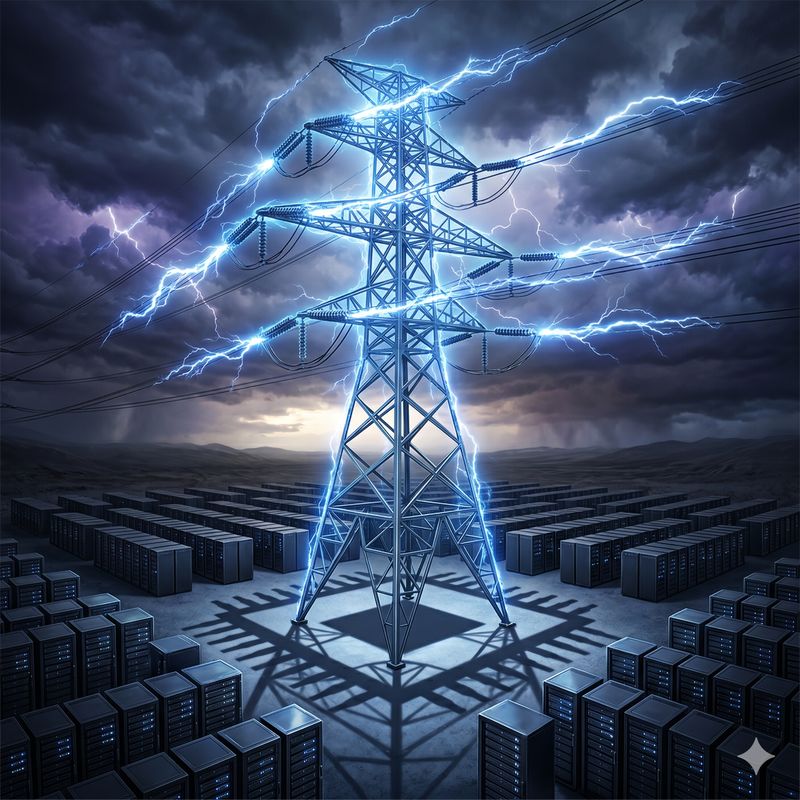
What an AI data centre really needs
An AI data centre is not a room full of servers. At today's scale it is closer to a small industrial town. The machines that train and run AI are extraordinarily hungry for power, far more than the computers that ran the old internet. A single AI task can use up to a thousand times more electricity than a traditional web search. A large AI cluster draws fifty to a hundred megawatts of power, enough to light up a small city, and it needs a constant supply that never dips. It also needs huge volumes of water for cooling, and special plumbing to carry that water directly to the chips, because the latest hardware runs too hot for ordinary air cooling to handle.
A few numbers show how fast this has grown:
- US data centres now draw about 41 gigawatts of power, roughly equal to every nuclear plant in the country combined.
- That demand has risen about 150 percent in just five years and is still climbing 15 to 20 percent a year.
- US utilities have planned around $1.4 trillion of spending to keep up, and every revision has been upward.
- Residential electricity bills in the US are expected to rise 15 to 25 percent by 2030 partly because of this demand.
Why money stopped being the constraint
For most of tech history, the limit on what a company could build was money and talent. Software scaled almost for free, with no physical footprint to speak of. AI broke that pattern. Training the most advanced models now requires energy on the scale of a small nation. The big companies have plenty of cash and can buy plenty of chips. What they cannot easily buy is the one thing every data centre needs in enormous, uninterrupted quantities: electricity, delivered to a specific place, at a scale the local grid was never designed to provide.
The bottleneck nobody can rush
Here is the timing problem that has changed everything. A data centre building itself takes about 18 to 36 months to design, permit and finish. But hooking that building up to the electricity grid is far slower. The wait to connect a new power project to the US grid has stretched from two or three years a decade ago to five years or more today, and thousands of projects are stuck in the queue. A company can pour billions into a finished data centre and then watch it sit half-idle, waiting for power that is years away. Building new transmission lines, the high-voltage cables that carry electricity across regions, is even slower, tangled in permits and local opposition.
A company can finish a data centre in a year, then wait five years for the electricity to run it.
Why everyone is suddenly buying nuclear
This explains a wave of deals that would have seemed bizarre a few years ago. Rather than wait for the public grid, the big companies are securing their own dedicated power. Microsoft struck a landmark agreement to restart the Three Mile Island nuclear plant, one of the most famous names in American nuclear history. It has signed a two-gigawatt nuclear commitment running through 2040, the largest corporate nuclear deal ever made. Amazon and Google are making similar moves, including deals with a new generation of small nuclear startups that do not yet have a single working commercial plant. The industry has shifted from optimising software to a strategy of bring your own power, plugging straight into reactors and gas plants and bypassing the clogged public grid entirely.
Where India fits in
This is where India has a quiet advantage that most coverage misses. Microsoft has already invested $15.2 billion in the power-rich United Arab Emirates, signalling that companies will move to wherever electricity is available rather than wait for it. India's biggest players are positioning themselves to be that destination. Reliance is anchoring its AI plans at its industrial complex in Gujarat, next to power it already generates, with land, water and grid connections already in place. Adani is building along the same logic, pairing its data centre ambitions with its own energy. The companies that own power, or sit right next to it, can build years faster than rivals stuck in a grid queue, and that head start is becoming the whole game. The popular picture of the AI race is two tech giants competing to build a smarter model. The real picture, increasingly, is a contest to lock up gigawatts of electricity before anyone else can. The cleverest model in the world is useless if there is no power to run it. The next decade of artificial intelligence will be shaped less by the engineers writing the code and more by the utilities, regulators and energy deals that decide where the electricity actually flows.
Frequently Asked Questions
What is "The AI Race Has Quietly Become a Fight Over Electricity, Not Chips" about?
The biggest US tech companies will spend over $500 billion on AI this year. India's Reliance and Adani have each announced plans worth over $100 billion. But the real bottleneck isn't money or chips. It's electricity. A single AI task can use a thousand times more power than a normal web search. A data centre takes about a year to build. Connecting it to the power grid takes five years or more. Whoever locks up the electricity first wins the AI race.
Why does this tech & ai topic matter?
This topic covers a significant development in tech & ai that affects economies, industries, and everyday people. Qrio breaks it down in plain English so you can understand the implications without needing specialized knowledge.
How long does it take to read this explainer?
The brief takes about 30 seconds. The full deep dive takes just a few minutes. You can choose how deep you want to go.
More from Qrio

Oura wants $16 billion for a ring, and one number explains why

India's biggest stock exchange is finally going public and it has to list on its rival