The ₹6,650 crore IPO where nobody is selling a single share
4 min read · by Qrio · 3 Jul 2026
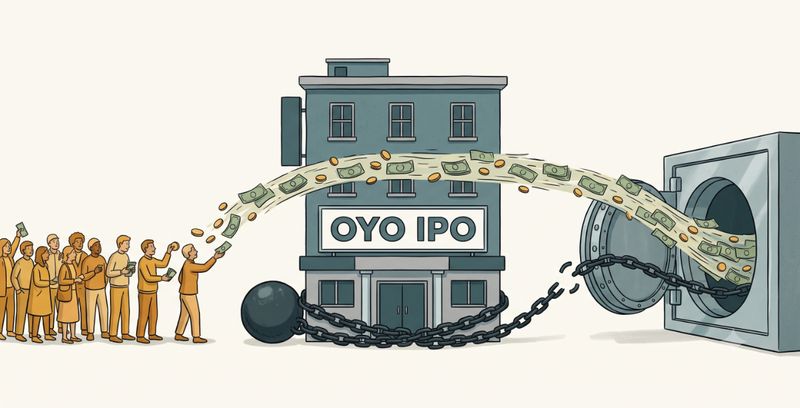
To understand any IPO, ask one simple question: where will the money go?
Imagine a friend throws a big housewarming party. Everyone brings gift money. Then the friend uses all that gift money to pay off his home loan. The party was never really about the house. It was about the loan. Oyo's big share sale works a lot like this.
Third try at going public
An IPO means a company sells its shares to the public for the first time. After an IPO, anyone can buy a piece of the company on the stock market. On June 30, 2026, Prism, the parent company of Oyo, filed papers with SEBI (the government body that watches over India's stock markets) for a ₹6,650 crore IPO. This is Oyo's third try. It tried in 2021 and again in 2024, and pulled back both times. Two things in the papers stand out. First, big investors like SoftBank, Microsoft and Airbnb are not selling any of their shares. All the shares sold will be brand new ones. Second, out of the ₹6,650 crore raised, ₹4,987.5 crore will go to paying off the company's loans.
A few numbers show the scale:
- 75% of all the IPO money, goes to paying off loans. That is enough money to build a few large hospitals.
- Oyo earned revenue of ₹6,941 crore in nine months of FY26. So the IPO is raising almost one full year of sales.
- Oyo's profit tripled to ₹748 crore from ₹245 crore last year. That is real progress.
- Oyo now wants a company value of $7 to 8 billion. Back in 2019, SoftBank valued it at $10 billion. So the price tag has dropped by about a third.
One table tells you the truth
Every IPO is one of three things wearing a costume. One, a fundraise: new money goes into growing the business. Two, an exit: old investors sell their shares and walk away with cash. Three, a refinance: new money is used to pay off old loans.
Oyo's table says: refinance. The public is being asked to give money so Oyo can pay back its lenders. That is not a bad thing by itself. Less loan means less interest to pay, which means more profit later. But it is very different from "give us money to grow."
Why are the big investors not selling? There are two ways to read it. The hopeful way: they think the price is too low, so they are holding on. The doubtful way: if a giant like SoftBank sold a big chunk on day one, the share price would crash, so they simply cannot sell yet.
We have seen this movie before
Zomato did something similar in 2021. It sold mostly new shares in its IPO. Being a listed company gave it respect and a currency (its own shares) that it later used to buy Blinkit. In America, a pet store chain called Petco listed mainly to pay off its loans. In both cases, the market did not punish the structure. It judged the business that came after.
The IPO advertisement tells you the dream. The money table tells you the truth.The other side of the story
Some caution is fair here. Part of Oyo's profit jump came from cutting costs, not from a boom in hotel bookings. The papers also mention an old court case with Zostel (a rival it once tried to buy) as a risk. And the asking price is high: about 7 to 8 times its yearly sales, which is more than what many big hotel companies with real buildings get. Also, two failed IPO attempts tell you big investors said no twice before.
What to actually watch
Watch the share price band when it comes out, likely in late 2026. If the company value comes in below $7 billion, it means big buyers were not excited. Also watch what SoftBank does six months after listing. That is when the lock-in ends (a rule that stops old investors from selling right away). If SoftBank starts selling then, that is the real signal.
Before you buy any IPO, ask one thing: is my money paying for the company's future, or for its past?
Frequently Asked Questions
What is "The ₹6,650 crore IPO where nobody is selling a single share" about?
Oyo's parent company Prism wants to sell shares to the public for the first time via IPO. It wants to raise ₹6,650 crore. But here is the odd part. Big investors like SoftBank and Microsoft are not selling even one of their own shares. And 75% of the new money will go to paying off old loans, not growing the business. One simple table in the paperwork explains everything and it's dicey.
Why does this business topic matter?
This topic covers a significant development in business that affects economies, industries, and everyday people. Qrio breaks it down in plain English so you can understand the implications without needing specialized knowledge.
How long does it take to read this explainer?
The brief takes about 30 seconds. The full deep dive takes just a few minutes. You can choose how deep you want to go.
More from Qrio
Oura wants $16 billion for a ring, and one number explains why
India's biggest stock exchange is finally going public and it has to list on its rival