SpaceX is the largest IPO ever. But is the hype bigger than the business?
5 min read · by Qrio · 14 Jun 2026
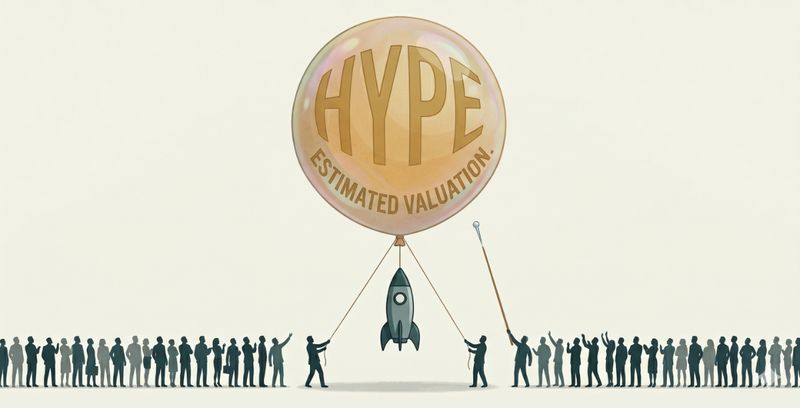
Everyone is talking about the first trillionaire. Almost no one is talking about what investors actually bought.
On June 12, Elon Musk stood in front of a cheering crowd at SpaceX's company town in Texas and admitted that, in the early days, he had given the company "less than a 10 percent chance of succeeding." Hours later it was worth more than $2 trillion, the sixth most valuable company in America, and Musk had become the first trillionaire in human history.
The numbers are staggering, and a little absurd:
- SpaceX priced its IPO at $135 and told investors to take it or leave it, no negotiation. The stock opened near $150, closed around $160,** up 19 percent.**
- It raised $75 billion, roughly three times the previous record, Alibaba in 2014. The largest IPO ever, by a mile.
- The company lost $4.9 billion last year and over $41 billion since it was founded. At its closing price it trades at about 112 times revenue.
A company that loses billions, priced higher than almost any business on earth. As one Los Angeles investment banker put it: "This was not a deal priced on market forces. This was what one man wanted. And when that man is Elon Musk, one man gets it."
What investors actually bought
Here is the part the headlines skipped, and it changes everything. SpaceX is no longer really a rocket company.
Buried in its own prospectus is a claim that its future market is worth $28.5 trillion. Of that, $26.5 trillion, about 93 percent, is artificial intelligence. Rockets and satellites together make up barely $2 trillion of the story Musk is selling. Months before the IPO, Musk quietly folded his AI company, xAI, into SpaceX. So the $2 trillion price tag is not a bet on rockets. It is an AI bet wearing a rocket's clothes. Not everyone is convinced. The NYU valuation expert Aswath Damodaran looked at that $28.5 trillion figure and said it read like it was written by a chatbot, not a banker. "This is a hallucination," he said. "I would be embarrassed to even put that number out."
The only part that actually makes money
Strip away the AI dream and what is left? Mostly Starlink, the satellite internet business. It earned $11.4 billion last year, up 50 percent, with over 10 million users and 9,600 satellites, roughly three-quarters of everything currently orbiting Earth. It is genuinely dominant, and it is the only profitable piece.
But investors do not pay 112 times revenue for a broadband company, however good. The rocket division burns cash and is betting everything on Starship. And the AI unit is, for now, a money pit, leasing out computing power to the likes of Anthropic and Google. One major research firm CFRA slapped a sell rating on the stock minutes after it listed.
Investors did not value SpaceX on what it earns. They valued it on what they believe Musk will become. Analysts have a name for it: the Elon premium.
The one number that decides everything
Here is the concrete thing to watch. To justify this price, one analysis estimates SpaceX would need around $1.5 trillion in annual sales by 2035. For scale, Amazon, the biggest seller on the planet, does not earn that much today. Morningstar pegs SpaceX's fair value at roughly half the IPO price and gives its best-case future only a 7 percent chance of happening. So the bull case is not impossible. It is just historically rare. Everything rides on whether the AI business, the 93 percent, turns into real revenue, because the rockets and Starlink alone cannot get there.
Why this lands in your lap even if you never buy a share
This is the part that makes it personal. A company this large gets fast-tracked into major stock indexes, which means index funds and retirement accounts start buying it automatically, whether the people who own those funds want it or not. As one US network bluntly warned viewers: an IPO is the most volatile moment in a stock's life, and "there's often the downslide after." You can end up holding a piece of this bet without ever choosing to.
It also minted real fortunes, not just Musk's. Over 4,400 employees became millionaires overnight, including a welder who had been there ten years. Alphabet's old $900 million investment is now worth close to $100 billion. That mix, one man crossing a trillion while ordinary workers cash out, is exactly why critics are calling it a wealth transfer as much as a market event.
So do not watch the trillion-dollar headline or Musk's net worth. Watch whether SpaceX's AI business starts earning real money, because that is the 93 percent nobody has actually proven yet. The rockets already work. The real question is whether the much bigger bet bolted on top of them ever will, or whether June 12 becomes the day the market paid full price for a future still under construction.
Frequently Asked Questions
What is "SpaceX is the largest IPO ever. But is the hype bigger than the business?" about?
On June 12, SpaceX pulled off the biggest IPO in history. It raised $75 billion, closed worth over $2 trillion, and made Elon Musk the first person ever worth a trillion dollars. The headlines called it a rocket triumph. But SpaceX's own filings say 93 percent of its future is AI, not space. Investors did not buy a rocket company. They bought a bet on Musk. Whether that bet is genius or madness comes down to a single number.
Why does this business topic matter?
This topic covers a significant development in business that affects economies, industries, and everyday people. Qrio breaks it down in plain English so you can understand the implications without needing specialized knowledge.
How long does it take to read this explainer?
The brief takes about 30 seconds. The full deep dive takes just a few minutes. You can choose how deep you want to go.
More from Qrio
Oura wants $16 billion for a ring, and one number explains why
India's biggest stock exchange is finally going public and it has to list on its rival