One strategy has quietly made more billionaires than almost any other
4 min read · by Qrio · 11 Jun 2026
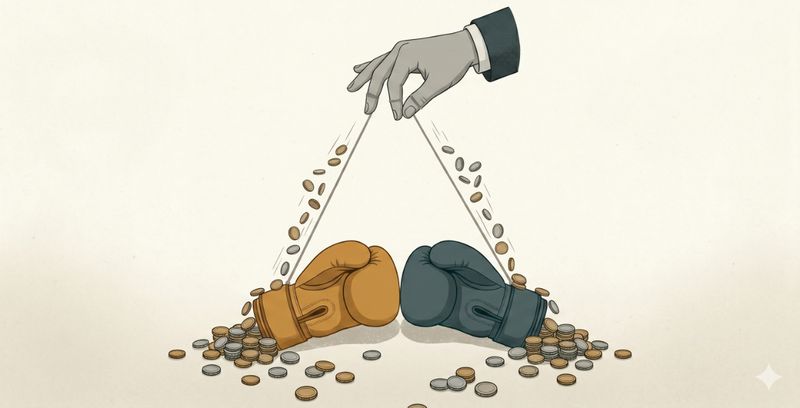
The brands fight. The ads attack each other. The customers pick sides. And one company collects from all of them.
Before we name it, look at what it does
OnePlus and Realme have spent years tearing into each other. They mock each other's specs, undercut each other's prices, sponsor rival cricket teams, and their fans argue for hours online. Pick up one, and someone will swear the other is better. Here is the twist that ends the argument: both are built by the same company, a Chinese firm called BBK Electronics that you have probably never heard of. Add Oppo and Vivo, also BBK, and the group controls close to half the phones sold in India, more than Samsung and Apple combined.
Once you see it, you see it everywhere.
- Soap: Dove sells itself as affordable luxury. Lifebuoy sells safety for the family. Different prices, different ads, same owner, Hindustan Unilever.
- Shirts: Louis Philippe is what you wear to impress a client. Peter England is what you wear when money is tight. Both belong to the Aditya Birla Group.
- Cars: a Skoda costs about ₹10 lakh, a Lamborghini ₹4 crore. Different showrooms, different dreams, one owner, the Volkswagen Group.
- Cold drinks: Coke and Thums Up battle for the same thirsty customer, and Coca-Cola owns them both.
You almost certainly bought from both sides of one of these fights today, and handed your money to an owner whose name you never saw.
The strategy has a name
In business this is called a house of brands. Instead of building one brand and stretching it across every price, the company creates many separate brands, each with its own name, look, personality and story, then lets them fight for different slices of the same market. The customer sees a meaningful choice. The parent sees one cash register.
A few numbers show the scale:
- HUL's 50-plus brands reach 9 out of 10 Indian homes every single day, and 19 of them earn over ₹1,000 crore a year each.
- Volkswagen sold more than 9 million cars last year, from budget hatchbacks to supercars.
- Marriott runs over 30 hotel brands and 8,000-plus properties, from an $80 Fairfield room to a $2,000 Ritz-Carlton suite.
It is not an Indian quirk either. In Africa, three phone brands, Tecno, Infinix and itel, dominate the market, and all three belong to one little-known company called Transsion.
Why it beats one strong brand
The obvious question is why not just build one great brand and own everything. Because a brand is a promise about where you stand, and stretching it too far breaks that promise. If Dove launched a ₹20 soap, no one would pay ₹80 for it again. If OnePlus launched an ₹8,000 phone, its premium buyers would feel cheated. The cheap end always poisons the expensive end. Separate brands fix this cleanly. Realme can knife-fight at ₹10,000 without touching OnePlus at ₹40,000, because no shopper links them. The parent gets the whole market, each brand keeps a clean identity, and you get what feels like a real choice between rivals.
Why it is almost impossible to beat
Here is what makes the strategy airtight. Once a company plants a different brand at every price point, there is no empty space left for a newcomer to stand in. A startup with a brilliant new shampoo looks at the shelf and finds the premium slot taken, the middle taken, the budget taken. Every door is locked by a different key, and all the keys belong to one owner. The same trap closes around you. Get a raise and move from Peter England to Louis Philippe, and you have not left the Birla group, you have just started paying it more. Hit a rough patch and drop from Surf Excel to Wheel, and you are still paying HUL, only less. Upgrade, downgrade or switch sides, the destination is owned either way.
The most profitable position is not owning the best brand on the shelf. It is owning the shelf.
Why you never learned the owner's name
The last piece is invisibility, and it is deliberate. BBK puts no logo on its phones. HUL appears in tiny print on the back of the bottle. Volkswagen never advertises itself, only Audi, Porsche and Lamborghini. The parent hides on purpose, because the magic dies the moment you realise the two brands fighting for your loyalty share a bank account. The whole effect depends on each brand feeling independent, feeling like a statement about who you are, while the money flows quietly upstream.
Frequently Asked Questions
What is "One strategy has quietly made more billionaires than almost any other" about?
Most People Have Never Heard of It. There is a single business strategy, used across phones, soap, cars, hotels, and fashion, that has built some of the largest fortunes on earth. The companies that use it do not compete with rivals. They create rivals, launch them into the same market, and let them fight each other while every rupee from every side flows back to the same owner. You have almost certainly bought from both sides today without knowing it.
Why does this business topic matter?
This topic covers a significant development in business that affects economies, industries, and everyday people. Qrio breaks it down in plain English so you can understand the implications without needing specialized knowledge.
How long does it take to read this explainer?
The brief takes about 30 seconds. The full deep dive takes just a few minutes. You can choose how deep you want to go.
More from Qrio

Oura wants $16 billion for a ring, and one number explains why

India's biggest stock exchange is finally going public and it has to list on its rival