India quietly became a phone exporting nation, and almost nobody noticed the ranking flip
5 min read · by Qrio · 1 Aug 2026
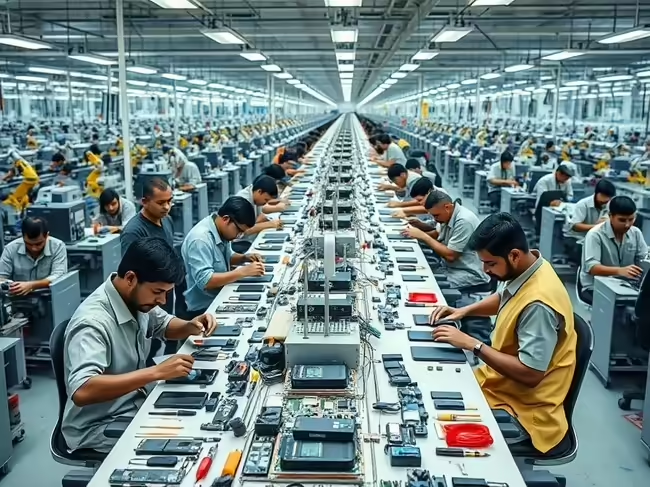
A decade ago, India imported nearly every phone its citizens used. Today, mobile phones are the single largest thing India sells to the rest of the world, and the shift happened so gradually that almost nobody noticed the exact moment it became true.
Ten years ago, if you bought a smartphone in India, there was a good chance it arrived from a factory in China or Vietnam, assembled somewhere far from where it was sold. Today, that picture has flipped so completely that mobile phones are now India's single largest exported item, according to figures Electronics and Information Technology Minister Ashwini Vaishnaw presented to Parliament on July 29, 2026.
The numbers behind that claim are large enough to be worth sitting with. India's mobile phone exports rose from ₹1,500 crore in 2014-15 to ₹2.59 lakh crore in 2025-26, a 165-fold increase in a decade. Total mobile phone production grew 33-fold in the same window, to ₹6.27 lakh crore. India now makes an estimated 99.2% of the phones it sells within its own borders, up from a country that, a decade ago, largely assembled or imported finished handsets rather than building them.
<stats> 165x | Growth in India's mobile phone exports over a decade Rs 2.59 lakh crore | Mobile phone exports in 2025-26 99.2% | Share of domestically sold phones now made in India </stats>The policy behind the number
This did not happen by accident or by simple market forces. It is the direct result of a government program called the Production Linked Incentive scheme, or PLI, introduced in 2020, which pays manufacturers a cash incentive tied directly to how much they actually produce and export in India, rather than simply subsidizing factories that might sit idle. The logic was straightforward: instead of asking companies to trust that India was a good place to build, the government offered to share the financial risk of scaling up production here, and let the incentive taper off as companies proved they could compete without it.
Why Apple's numbers tell the story best
Perhaps the clearest single proof point of the policy working is Apple. The company joined India's smartphone PLI scheme in the 2022 fiscal year, and by December 2025, cumulative iPhone exports from India had crossed $50 billion, a threshold reached in under four years. In just the first nine months of the current fiscal year alone, iPhone shipments from India touched nearly $16 billion. Apple now builds iPhones in India across five large assembly facilities, three run by Tata Group entities and two by Taiwan's Foxconn, a level of manufacturing depth that simply did not exist in the country a decade ago.
The part that makes this genuinely surprising
Here is what most people miss about this shift. India has spent decades being known internationally for a specific kind of export: services, software engineers, call centers, back-office work for global companies. Physical manufacturing, especially of complex electronics with hundreds of precision components, was widely assumed to be China's game to lose, not India's game to win. A phone assembled with global supply chains for cameras, chips, and displays, then exported at scale, requires a level of manufacturing coordination that critics doubted India could pull off quickly. The fact that this happened within about a decade, and specifically inside the smartphone category where margins are thin and competition is brutal, is a genuinely unusual outcome for industrial policy anywhere in the world.
A simple way to picture the shift
Think of a local tailor who spent years importing finished suits to sell in their shop, then slowly built up the skill, thread, and machinery to make suits from scratch, good enough that customers abroad started ordering suits made in that same small shop. That is roughly the arc mobile phone manufacturing in India has followed, except at a scale involving hundreds of millions of units and some of the largest electronics brands on earth.
India now manufactures roughly 99.2% of the mobile phones sold within its own borders, and mobile phones are its single largest exported item.
The honest catch
Not every part of this story is settled. Critics of the PLI scheme, including some industry voices covered in Indian business press, note that scale and cost remain real hurdles for the broader PLI 2.0 program covering other electronics categories, and that success in mobile phones does not automatically transfer to chips, laptops, or other complex hardware India also wants to build domestically. There is also a fair question about how much of the value captured in India is true manufacturing versus final-stage assembly of components still largely sourced from elsewhere, a distinction that matters for how much of the economic benefit actually stays within the country.
What to actually watch next
Watch whether India's semiconductor manufacturing push, a much harder technical challenge than phone assembly, shows similar early traction over the next two to three years, since chips are the next frontier the government has explicitly targeted with a similar incentive logic. Watch how much of the value chain, components like camera modules, batteries, and displays, gradually shifts to being made in India rather than just imported and assembled, since that shift would mark the difference between assembly hub and true manufacturing base. And watch whether other countries competing for the same manufacturing investment, particularly Vietnam, start offering comparable incentives that could slow India's momentum.
A country that spent decades importing the phones in its own citizens' pockets now exports more of them than almost anything else it makes. It is the kind of shift that happens one factory, one incentive check, and one Parliament session at a time, which is exactly why it took a decade for anyone to notice the ranking had flipped.
Frequently Asked Questions
What is "India quietly became a phone exporting nation, and almost nobody noticed the ranking flip" about?
Electronics Minister Ashwini Vaishnaw told Parliament on July 29, 2026, that India's mobile phone exports have surged 165-fold in a decade, from ₹1,500 crore in 2014-15 to ₹2.59 lakh crore in 2025-26. Mobile phone production grew 33-fold over the same period to ₹6.27 lakh crore, and India now manufactures roughly 99.2% of the phones it sells domestically. Mobile phones are now India's single largest exported item, ahead of categories that have dominated Indian exports for decades. Apple alone has shipped more than $50 billion worth of India-made iPhones since 2022.
Why does this india macro topic matter?
This topic covers a significant development in india macro that affects economies, industries, and everyday people. Qrio breaks it down in plain English so you can understand the implications without needing specialized knowledge.
How long does it take to read this explainer?
The brief takes about 30 seconds. The full deep dive takes just a few minutes. You can choose how deep you want to go.
More from Qrio

Oura wants $16 billion for a ring, and one number explains why

India's biggest stock exchange is finally going public and it has to list on its rival