India let Amazon and Flipkart hold their own inventory, but only to sell it abroad
4 min read · by Qrio · 28 Jul 2026
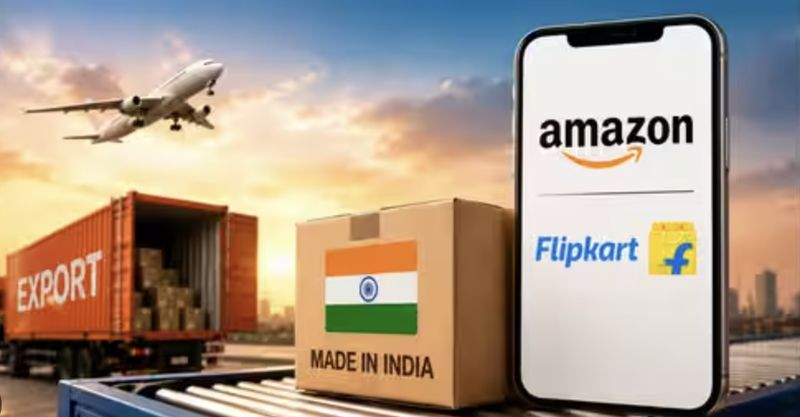
For over a decade, India has blocked Amazon and Flipkart from selling their own inventory to Indian shoppers, to protect small retailers. That rule didn't change. A new one, running in the opposite direction, just did.
The rule that finally moved
On July 23, 2026, India's Department for Promotion of Industry and Internal Trade relaxed a long-standing restriction on foreign investment in e-commerce, one of the country's most tightly guarded retail policies. Foreign-backed e-commerce companies can now run an inventory-based model, meaning they can own, warehouse and directly sell goods rather than merely operating a marketplace connecting third-party sellers to buyers, but only, the rule specifies, "exclusively for the export of goods/products manufactured and/or produced in India," under the terms of the Foreign Trade Policy 2023. It is a narrow but genuine crack in a wall India has maintained since e-commerce FDI rules were first written specifically to stop companies like Amazon from competing directly against India's enormous population of small, independent retailers.
What actually stays the same
This is the detail worth sitting with. Nothing changed about how Amazon or Flipkart can operate inside India. The marketplace-only rule for domestic sales, the one that has shaped how both companies structure their Indian operations for years, remains exactly as strict as before. Foreign e-commerce giants still cannot hold their own inventory and sell it directly to a shopper in Mumbai or Patna. What they can now do is hold that same inventory and ship it to a shopper in Munich or Portland. India didn't open its retail sector. It opened an export door in a wall built to keep the front door shut.
Why the direction matters
The government's own framing leans entirely on outbound trade. The stated goal is to give Indian manufacturers and sellers, particularly smaller businesses in tier-2 and tier-3 cities, "easier and increased access to global markets" by letting foreign e-commerce infrastructure, warehousing, logistics, cross-border payment rails, do the heavy lifting of reaching international buyers. Amazon's own response leaned into exactly that framing, saying the policy "would assist producers in smaller towns and cities in reaching international clients," and tying it directly to the company's stated ambition of exporting $80 billion worth of goods from India by 2030.
Who's unhappy, and why
The Confederation of All India Traders, which represents small and mid-sized Indian retailers, the exact constituency the original marketplace-only rule was designed to protect, has already objected. CAIT Secretary General Praveen Khandelwal argued, "There must be stringent regulation because of the history of several major tech businesses," pointing to long-running complaints that Amazon and Flipkart have previously used complex corporate structures to get around India's marketplace rules and effectively compete with the sellers on their own platforms. The concern this time is less about domestic competition, since this reform doesn't touch domestic sales, and more about whether an export-only carve-out quietly becomes a template, or a loophole, for further exceptions down the line.
The bigger pattern this fits into
This reform doesn't arrive in isolation. It lands the same week as reporting on a broader shift in how India's economy is being steered, away from the metro-heavy, software-first growth model of the last decade and toward manufacturing, exports and deep tech, backed by a new Rs 10,000 crore Startup India Fund of Funds 2.0 explicitly weighted toward those categories. Read that way, this isn't really an e-commerce liberalization story. It's an export-promotion story that happens to route through e-commerce law.
"There must be stringent regulation because of the history of several major tech businesses." Praveen Khandelwal, Secretary General, Confederation of All India Traders
The honest catch
An export-only carve-out is only as good as the enforcement separating it from domestic sales. India's e-commerce giants have a documented history of structuring around similar restrictions before, and CAIT's objection is really a bet that this line will get tested. Whether authorities can actually police the difference between inventory warehoused for export and inventory that quietly ends up serving Indian shoppers is the practical question this policy has not yet answered.
India spent over a decade making sure Amazon and Flipkart couldn't sell their own stock to Indian shoppers. That rule is still standing. What just changed is who they're allowed to sell it to instead.
Frequently Asked Questions
What is "India let Amazon and Flipkart hold their own inventory, but only to sell it abroad" about?
India's Department for Promotion of Industry and Internal Trade relaxed FDI rules on July 23, letting foreign-backed e-commerce firms like Amazon and Flipkart run inventory-based models, warehousing and selling directly, for the first time. The catch, it only applies to exporting Indian-made goods abroad. Amazon says the move supports its goal of exporting $80 billion from India by 2030. Trader body CAIT is already pushing back, warning about the "history of finding loopholes by major tech company to compete againse retail traders"
Why does this india macro topic matter?
This topic covers a significant development in india macro that affects economies, industries, and everyday people. Qrio breaks it down in plain English so you can understand the implications without needing specialized knowledge.
How long does it take to read this explainer?
The brief takes about 30 seconds. The full deep dive takes just a few minutes. You can choose how deep you want to go.
More from Qrio

Oura wants $16 billion for a ring, and one number explains why

India's biggest stock exchange is finally going public and it has to list on its rival