India launched Semicon 2.0 to dominate the global chip market by the end of the decade
4 min read · by Qrio · 17 Jul 2026
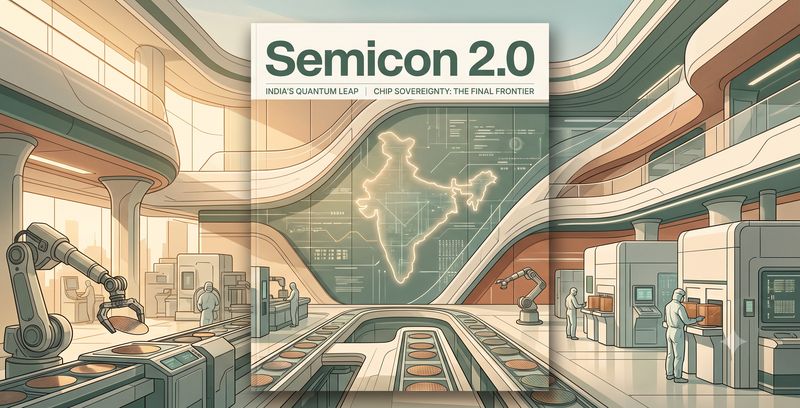
India's newly unveiled Semicon 2.0 blueprint shows how a nation can shift from chasing isolated manufacturing plants to building an independent, multi-layered technology empire.
What India just announced
On Wednesday, July 15, 2026, the Union Cabinet, chaired by Prime Minister Narendra Modi, officially cleared the Semicon 2.0 programme. The massive policy update locks in a historic budget outlay of ₹1,27,500 crore. This fresh capital represents a substantial escalation from the ₹76,000 crore allocated under the first phase of the national chip mission.
The expanded funding signals a permanent change in how the country plans to compete in the global technology race. Instead of focusing exclusively on attracting glamorous mega-factories, the state is spreading its financial power across six strategic pillars. The goal is to build a comprehensive internal network that handles chip design, raw material chemical production, advanced assembly packaging, and academic research simultaneously under a single domestic ecosystem.
The six pillars of the new ecosystem
The core architecture of Semicon 2.0 systematically addresses the hidden operational gaps that usually leave manufacturing nations vulnerable to international disruptions.
- The first pillar pours immediate resources into domestic chip design. It builds directly on the foundations of 105 local startups and small enterprises that are already developing custom semiconductor intellectual property for artificial intelligence, drones, and satellite communications.
- The second pillar targets raw material security, offering direct incentives to companies involved in processing specialized chemical gases, rare minerals, and high-purity liquids essential for chip production.
- The third pillar drives manufacturing expansion, actively working to secure additional silicon fabrication plants, compound semiconductor facilities, and display manufacturing units. This comes as the nation's first major commercial fabrication plant remains on schedule to be commissioned in 2028.
- The fourth pillar expands advanced Assembly, Testing, Marking, and Packaging capabilities, ensuring that raw printed silicon can be converted into finished commercial products locally.
- The fifth pillar funds advanced research and development through global institutional collaborations to help local engineers progress beyond current legacy technology nodes.
- The sixth pillar focuses entirely on talent development. Over 315 universities have already been equipped with industry-standard electronic design tools, creating a highly specialized workforce for the expanding ecosystem.
What the initial phase has already delivered
To understand why global tech ecosystems are taking this updated policy so seriously, you have to look at what the first phase of the India Semiconductor Mission has already achieved on the ground. Under Semicon 1.0, the government successfully approved twelve distinct manufacturing projects, drawing cumulative corporate investment commitments exceeding ₹1.64 lakh crore.
This initial portfolio includes a foundational silicon fab, a specialized silicon carbide facility, an integrated gallium nitride micro LED display plant, and nine advanced packaging facilities. Commercial production has already commenced at high-tech complexes operated by prominent electronics anchors like Micron, Kaynes, and CG Semi, with additional industrial units scheduled to begin active operations later this fiscal year.
Global chipmakers vote with their wallets
This rapid operational execution has triggered an immense wave of international confidence, with the world's most valuable semiconductor equipment and design corporations pledging massive capital investments directly to the subcontinent.
Direct corporate commitments have crossed historic thresholds, with global giants Applied Materials and AMD each pledging $400 million to local operations, Lam Research committing $1.1 billion, and KLA announcing a dedicated $400 million investment.
Simultaneously, premier technology vendors like ASML, IBL Electron, and Merck have signed formal agreements with industrial conglomerates like the Tata Group to support the localized manufacturing rollout. These corporate agreements are backed by a strong web of strategic government-to-government partnerships established between India and major technological hubs, including the United States, the European Union, Japan, Singapore, the Netherlands, and Germany.
The road to a hundred billion dollar market
The ultimate commercial objective of this massive policy expansion is to radically alter India's position in the global trade hierarchy. The domestic semiconductor market has expanded rapidly, growing from roughly $38 billion in 2023 to an estimated $45 billion to $50 billion over the current annual cycle.
By 2030, the government targets an absolute market size of $100 billion to $110 billion, allowing India to capture a powerful ten percent slice of total global semiconductor demand. More importantly, policy planners project that by 2029, the country will possess the native capability to design and manufacture the specific chips required for nearly seventy to seventy-five percent of all domestic industrial, automotive, and telecommunications applications.
Real technological sovereignty is never won by simply hosting the final assembly line, but by owning the design tools, the academic research, and the material chemistry that power the entire machine.
Frequently Asked Questions
What is "India launched Semicon 2.0 to dominate the global chip market by the end of the decade" about?
Indian government officially approved a monumental ₹1.27 lakh crore budget for its updated semiconductor mission, known as Semicon 2.0. This massive upgrade represents a major escalation from the initial program, moving past simple factory incentives to build an absolute, end-to-end silicon ecosystem. The new policy covers everything from local chip design and raw material processing to advanced university training. India is attempting to secure a dominant 10% of global chip market by the end of the decade.
Why does this tech & ai topic matter?
This topic covers a significant development in tech & ai that affects economies, industries, and everyday people. Qrio breaks it down in plain English so you can understand the implications without needing specialized knowledge.
How long does it take to read this explainer?
The brief takes about 30 seconds. The full deep dive takes just a few minutes. You can choose how deep you want to go.
More from Qrio

Oura wants $16 billion for a ring, and one number explains why

India's biggest stock exchange is finally going public and it has to list on its rival