India just struck the biggest trade deal in its history. It could not have come at a better time.
6 min read · by Qrio · 20 Jun 2026
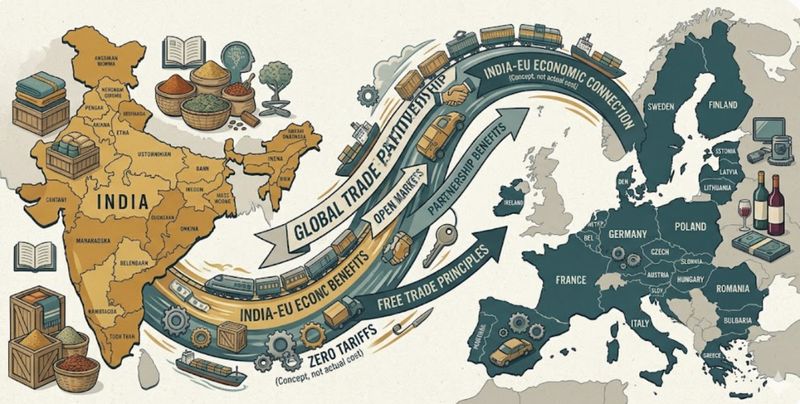
A deal that looks like it is about cheaper cars and wine is really India's biggest economic move in years, and the timing is everything.
The deal India chased for eighteen years
In January 2026, standing beside Narendra Modi in New Delhi, European Commission chief Ursula von der Leyen called it "the mother of all deals." She was not exaggerating. After eighteen years of talks that began in 2007 and collapsed more than once, India and the EU finally agreed on a free trade agreement, the largest either side has ever signed.
A free trade agreement is simply a pact to cut the taxes, called tariffs, that countries charge on each other's goods, so those goods get cheaper to buy across borders. This one is enormous. It links India and the 27 EU nations into a single market of roughly two billion people and nearly a quarter of the world's economy. The talks were sealed in January, and at the G7 summit this June, the EU confirmed the final step: the deal will be formally signed by the end of 2026.
The numbers that frame it:
- The deal covers about two billion people and nearly 25 percent of global economic output.
- The EU will scrap tariffs on 99.5 percent of Indian goods; India will cut or remove them on 96.6 percent of EU goods.
- The EU will drop duties on about 90 percent of Indian goods immediately once it starts.
- Two-way trade, around $190 billion today, is expected to roughly double in the years after.
What India actually gains
This is the part that matters most for India, and it is bigger than cheaper imports. The deal hands India's most job-heavy industries, textiles, leather, gems and jewellery, seafood and chemicals, near zero-duty access to one of the world's richest markets of 450 million consumers. These are exactly the sectors that employ millions of ordinary Indians, and roughly $33 billion of such labour-intensive exports now get preferential entry. Estimates suggest it could support well over a million new jobs.
There is a quieter win for the services economy too. The deal opens 144 service categories and makes it far easier for Indian IT firms to send engineers to work across Europe without the usual visa battles, a potentially huge opening for the sector that already powers much of urban India's middle class.
What gets cheaper, and who gets squeezed
For the Indian consumer, the visible effect is on European goods. A German luxury car today costs more than double its base price because of import duties near 110 percent. As those fall toward about 10 percent over the next five to ten years, cars from BMW, Mercedes and Audi will get markedly cheaper. So will European wine, where tariffs of 150 percent shrink toward 20 to 30 percent, along with spirits, olive oil and chocolate.
But every trade deal cuts both ways. The moment the agreement was announced, shares of Indian carmakers like Tata Motors and Mahindra fell, as did wine and spirits firms like Sula and United Breweries. Cheaper European imports mean tougher competition at home, and the market priced that in within hours.
The real reason both sides rushed
Here is the part the cheaper-cars headline hides. This deal is not really about wine or BMWs. It is a geopolitical move, and to understand it you have to look at who is not in the room: the United States. India spent years in no hurry to sign this agreement, talks first began back in 2007 and collapsed more than once. What changed is that the US, under its current administration, slapped tariffs as high as 50 percent on Indian goods, hammering exactly the industries, textiles, leather, jewellery, that employ millions of Indians. Suddenly India needed a new large market for those exports, fast, and the EU was the obvious answer. For India's struggling exporters, the deal offers zero-duty access to a wealthy market of 450 million people precisely when their biggest market, America, has turned hostile. The EU has its own version of the same motive. Its relationship with the US, long its closest trading partner, has frayed under the same administration's trade aggression. And both India and the EU share a deeper worry: an overwhelming dependence on China for manufactured goods. India alone runs a trade deficit with China of around $94 billion, its largest with any country. By binding themselves closer together, India and the EU are each trying to reduce their reliance on both an unpredictable America and a dominant China.
A trade deal that looks like it is about cheaper wine is really about two economies trying to escape a hostile America. Underneath is two large economies quietly building a lifeboat.
The catch worth knowing
There is one honest caveat the celebratory coverage skips. While the EU cuts tariffs with one hand, it has brought in a new charge with the other, the** Carbon Border Adjustment Mechanism, or CBAM. It is a tax on imports made with carbon-heavy energy like coal, and it targets exactly what India sells, steel, aluminium and cement.** So the deal makes Indian steel cheaper to send to Europe, while the carbon tax quietly adds the cost back. India is negotiating hard on this, but it remains unresolved.
Why this is a genuine milestone
Step back, and this is one of India's most significant economic moves in a generation. For decades India was a cautious, protect-everything trader, slow to open up. This deal is the opposite instinct: a bet that India's future lies in exporting to the world, not hiding from it, and it arrives at the precise moment its biggest customer turned away. But signing is the easy part. The deal still needs ratification, likely stretching into 2027, before it fully takes effect. And a market opening means little if India cannot fill it. The real work is making sure its factories can scale, its small businesses can reach 27 new countries, and its negotiators can blunt the carbon tax before it eats the gains.
India spent eighteen years deciding whether to open its doors to Europe. The hard part begins now: proving it can walk through them. The deal hands India a market of 450 million people at the exact moment it needed one most. Whether that becomes a turning point or just a headline depends on what India builds to fill it.
Frequently Asked Questions
What is "India just struck the biggest trade deal in its history. It could not have come at a better time." about?
On the sidelines of last week's G7 summit, India and the EU confirmed they will sign a sweeping trade deal by the end of 2026. For Indian consumers, it means European cars, wine, whisky, and olive oil will get dramatically cheaper over the coming years. But the same deal threatens Indian carmakers and wineries, whose shares fell on the news. And the real reason both sides rushed to sign has little to do with wine, and everything to do with America and China.
Why does this geopolitics topic matter?
This topic covers a significant development in geopolitics that affects economies, industries, and everyday people. Qrio breaks it down in plain English so you can understand the implications without needing specialized knowledge.
How long does it take to read this explainer?
The brief takes about 30 seconds. The full deep dive takes just a few minutes. You can choose how deep you want to go.
More from Qrio
Oura wants $16 billion for a ring, and one number explains why
India's biggest stock exchange is finally going public and it has to list on its rival