India is the world's fastest-growing major economy. Its currency just hit a record low.
6 min read · by Qrio · 17 Jun 2026
Growth measures how much a country produces. Currency measures how money flows in and out. They are not the same thing, and confusing them is one of the most common mistakes in economics.
The number that should not exist
In one quarter of 2025, India's GDP surged 8.2 percent, beating every forecast. It was the fastest growth the country had posted in six quarters. On any normal reading, that should have been a signal of strength, the kind of number that attracts investment and lifts a currency. Instead, the rupee barely moved. It continued falling, hitting fresh record lows, finishing the year as the worst-performing major Asian currency. By May 2026, it had slipped past 95 to the dollar. At one point, the Reserve Bank of India's own annual report acknowledged it had touched nearly 97. An economy growing faster than almost every other on the planet, with a currency that keeps sinking. The two facts sit side by side, and to most people, they make no sense together.
The numbers that frame the paradox:
- India's GDP grew 7.7 percent in FY 2025-26, making it the fastest-growing major economy in the world for the third consecutive year.
- The rupee fell from about 84 per dollar at the start of 2025 to nearly 97 by mid-2026, a decline of roughly 15 percent.
- The RBI's foreign exchange reserves dropped to $681.4 billion by late May 2026, down $7.5 billion in a single week, as the central bank sold dollars to slow the rupee's fall.
- India's gold reserves climbed to 880 metric tonnes by March 2026, a quiet hedge against the very currency pressure the RBI was fighting.
The bucket with holes in the bottom
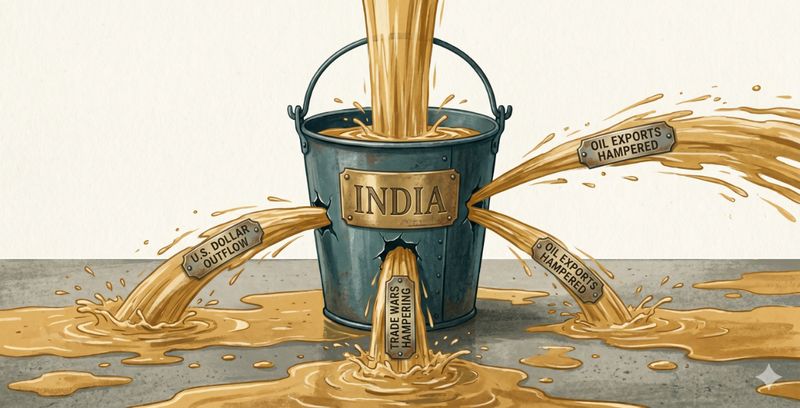
Here is the simplest way to understand the paradox, and once you see it, the confusion disappears. Think of the economy as a bucket being filled with water. GDP measures how fast the water pours in. India fills the bucket faster than almost anyone. But the rupee does not measure how fast the bucket fills. It measures the water level, and the water level depends on how much leaks out the bottom. India has three large holes in the bucket, and in 2025 and 2026, all three opened wider at the same time.
- The first hole is oil. India imports over 80 percent of the crude oil it needs, and oil is priced in dollars. Every time a tanker arrives, India has to sell rupees and buy dollars to pay for it. When oil prices rose through 2025, pushed higher by tensions in the Middle East and fears about the Strait of Hormuz, through which roughly half of India's crude imports pass, the drain got bigger.
- The second hole is foreign investors leaving. When the US Federal Reserve kept interest rates high, money flowed out of India and into American bonds, because investors could earn a safer return. Foreign portfolio investors sold Indian stocks and bonds, converting the rupees they received into dollars and taking them home. The outflows were persistent and large.
- The third hole is trade. In late 2025, the US imposed 50 percent tariffs on Indian goods, and India became one of the few major economies without a formal trade deal with Washington. Exports to the US, India's largest trading partner, dropped. Fewer exports meant fewer dollars flowing into India, which meant less support for the rupee.
GDP measures how fast the bucket fills. The currency measures the water level. India fills fast, but the holes in the bottom got bigger.
Why the RBI cannot simply fix it
The Reserve Bank of India has fought hard to slow the fall, and the scale of its intervention has been enormous. It sold billions of dollars from its reserves to prop up the rupee, draining its stockpile at a pace that made economists nervous. It restricted how much banks could bet against the rupee in currency markets. It told state-owned oil companies to shift their dollar buying away from the spot market to reduce sudden pressure. It even signalled rate cuts to stimulate the economy, cutting by a full percentage point through 2025. Each measure helped temporarily. None could fix the underlying problem, because the forces pushing the rupee down, oil prices, investor outflows, and trade friction, were all coming from outside India's borders. The RBI can slow the fall. It cannot reverse forces it does not control.
What the falling rupee is really telling India
And that is the real lesson. The rupee is not a report card on how well India is run. It is a measure of how much India still depends on things it cannot control. Read that way, the falling rupee is not bad news. It is a to-do list, and each hole points to the fix.
- The oil hole says: build energy independence. Every barrel India imports is rupees sold for dollars. The faster India shifts to solar, nuclear, electric vehicles and homegrown fuels, the smaller its single biggest drain becomes, and the less the rupee stays hostage to a strait halfway across the world.
- The trade hole says: become an export power. India needs more dollars flowing in, not fewer. That means looking beyond a hostile US, signing trade deals, and climbing from low-value goods to high-value manufacturing, seizing the once-in-a-generation moment as the world hunts for an alternative to China.
- The money-leaving hole says: attract investment that stays. Hot money that flees at the first US rate hike will always punish the rupee. Long-term investment, the kind that builds factories and hires people, does not run at the first sign of trouble. Deeper reforms, easier rules and better infrastructure are what turn fast money into patient money.
None of this is quick, and that is the point. India has a rare combination right now: strong growth, a young workforce, and a world looking for a partner that is not China. That window will not stay open forever.
The rupee is not falling because India is weak. It is falling because India still depends on a world it cannot control. India cannot change that world. It can depend on it less, and the moment to start is now, while the growth is still there to pay for it.
Frequently Asked Questions
What is "India is the world's fastest-growing major economy. Its currency just hit a record low." about?
India's real GDP expanded by a robust 7.7% for the full 2025–26 financial year, faster than China, US, and every other large economy on earth. In the same period, the rupee fell to nearly 97 to the dollar, its weakest level ever. The central bank spent billions of dollars trying to slow the fall. Both facts are true at the same time, and understanding why teaches you something most people get wrong about how money actually moves between countries.
Why does this india macro topic matter?
This topic covers a significant development in india macro that affects economies, industries, and everyday people. Qrio breaks it down in plain English so you can understand the implications without needing specialized knowledge.
How long does it take to read this explainer?
The brief takes about 30 seconds. The full deep dive takes just a few minutes. You can choose how deep you want to go.
More from Qrio

Oura wants $16 billion for a ring, and one number explains why

India's biggest stock exchange is finally going public and it has to list on its rival