India Is Making Fuel Cheaper and Cleaner. So Why Are Drivers Unhappy About It?
7 min read · by Qrio · 10 Jun 2026
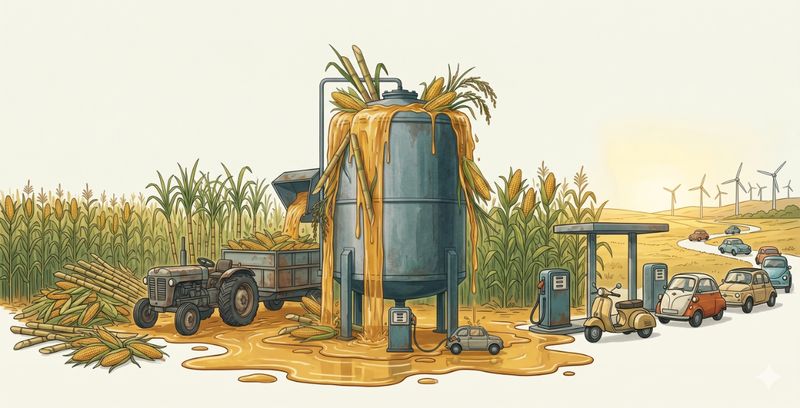
The puzzle is not what E85 is. It is why India is suddenly in such a hurry to sell it. The answer is a problem most people have never heard of: an alcohol glut.
The launch that did not seem to make sense
On 5 June 2026, World Environment Day, India's petroleum minister inaugurated a new fuel at 48 stations across the country. It is called E85, and it is radical: up to 85 percent ethanol, the alcohol made from crops, and as little as 15 percent petrol. The day before, Maruti Suzuki unveiled the Wagon R Flex Fuel, India's first mass-market car built to run on it. On the surface this looks like steady progress in a clean-energy plan. But look closer and something does not add up. Only in April 2025 did E20, the much milder 20 percent blend, become the standard fuel at Indian pumps, and it immediately triggered a wave of complaints about falling mileage and worried engine owners. So why, with drivers still grumbling about 20 percent ethanol, ** is India suddenly racing to sell a fuel that is 85 percent ethanol?** The answer is not about your car at all. It is about a problem building quietly inside India's factories.
The numbers that explain the rush:
- India built ethanol production capacity of roughly 2,000 crore litres a year, helped by generous government incentives.
- But total demand, even counting medicines, sanitisers, liquor, and industry, is only about 1,350 crore litres. The E20 fuel programme uses just over 1,000 crore of that.
- That leaves hundreds of crore litres of ethanol-making capacity with nowhere to go.
- E85 is priced about ₹20 a litre cheaper than petrol, and the government plans to expand it from 48 stations to 5,000 by the end of 2027.
The glut nobody talks about
Here is the part that reframes everything. For years the government pushed hard to build ethanol factories, offering incentives and guaranteed prices so distilleries would invest. They did, enthusiastically, and India now has the capacity to make far more ethanol than it can actually use. Demand never caught up with the factories. This is the real engine behind the E85 launch. India is sitting on a growing surplus of ethanol-making capacity, and that surplus has to find a home, or all that investment turns into idle, money-losing plants. The natural question is, why not just put the extra ethanol into diesel, the fuel that runs India's trucks and buses? The answer is chemistry: ethanol and diesel do not mix well, they separate over time and burn differently, so blending them reliably does not work yet. That leaves only one place for the surplus to go: petrol, and at much higher concentrations than before. E85 is, in large part, a solution to an overcapacity problem dressed up as a fuel launch.
India built more ethanol factories than it had demand for. E85 is where the leftover alcohol goes.
What Brazil's 50-year head start teaches
To see where this might lead, look at the one country that has already lived it: Brazil, the model India openly copied.** Its story is both an encouragement and a warning.** Brazil began blending ethanol in the 1970s, after an oil crisis left it desperate to cut fuel imports, the same motivation India has today. The path was not smooth. In the 1980s, Brazil pushed cars that ran on pure ethanol, and the program nearly collapsed when global oil prices crashed and cheap petrol made ethanol pointless overnight. Drivers who had bought ethanol-only cars felt trapped. The breakthrough came in 2003, not from a new fuel but from a new kind of engine: the flex-fuel vehicle, the same technology India is rolling out now, which let drivers fill up with whatever was cheaper that week. Within two years, flex-fuel cars outsold regular ones, because the choice put power in the driver's hands. Today Brazil runs nearly 20 million of them, ethanol makes up a quarter of its road fuel, and the country earns more from ethanol than from its famous beef exports. It took 50 years, but Brazil genuinely loosened its dependence on foreign oil. The prize India is chasing is real.
But Brazil also carries the warning India cannot ignore. As sugarcane fields expanded to feed demand, they pushed cattle ranching off its old land, and that ranching moved deeper toward the Amazon, contributing to the clearing of the very rainforest the world relies on to absorb carbon. A fuel sold as green ended up linked to the loss of forests, which release huge amounts of carbon when destroyed. The clean label only holds if the land and water used to grow the crops do not cause more harm than the fuel prevents. That question hangs heavily over India, which has far less spare land and water than Brazil ever did, and it is why what India chooses to make its ethanol from, surplus crops and farm waste rather than food and forests, matters far more than the blend number printed on the pump.
Brazil sold ethanol as a green fuel. Then the fields to grow it helped push cattle ranching toward the Amazon.
Why this will not touch your car yet
If you are now worried about pouring 85 percent alcohol into your scooter, relax: you cannot, and the government is not asking you to. E85 only works in a special kind of vehicle called a flex-fuel vehicle, one built to run on anything from low ethanol blends right up to pure ethanol. Almost no private vehicle on Indian roads today can use it. And here the government has, sensibly, learned from its E20 mistakes. Rather than forcing the new fuel on ordinary drivers, it is steering the first flex-fuel cars, like the Wagon R Flex Fuel, toward fleet operators and cab companies like Ola and Uber, not private buyers. This is a smart, proven playbook. It is exactly how India built early demand for electric vehicles, by putting them in taxi fleets first. Cabs rack up in two or three years the mileage a private car takes a decade to reach, so they will quickly reveal how these engines hold up, how they wear, and what maintenance they need, all before a regular buyer has to take the risk. The commercial operators absorb the uncertainty. The everyday consumer waits for the answers.
The costs hiding behind the cleaner fuel
E85 sounds like a clean win, and in some ways it is, with up to 61 percent lower greenhouse emissions and a price ₹20 a litre below petrol. But two catches grow larger at higher blends. The first is the cheaper-but-not-really trap. Ethanol holds about a third less energy than petrol, so a flex-fuel car burns noticeably more of it per kilometre. At 85 percent ethanol, that gap is wide, so the lower price at the pump does not become a real saving, because you buy more litres to cover the same distance. The second, and more serious, is water. All this ethanol comes from thirsty crops like rice, sugarcane, and maize. Producing a single litre of ethanol from rice can swallow around 10,000 litres of water, in a country where the monsoon is increasingly unreliable and many states already run dry. The more ethanol India decides to burn, the more water and farmland it must pour into the tank.
It all depends on execution
So the real story of E85 is not a triumphant leap into clean energy, nor is it a scam. It is the predictable next move in a policy that built its factories faster than its demand. India created a vast ethanol-making machine, and now it must keep that machine fed and running, which means finding ever more fuel to pour the alcohol into. The vision behind it, less imported oil, richer farmers, cleaner air, remains genuinely good, and Brazil proves it can work given enough time and the right choices. But somewhere along the way the order reversed. Instead of demand pulling the fuel into existence, the fuel is now searching for demand.
The next time you see a headline about India reaching an even higher ethanol blend, the question worth asking is not how green it is. It is whether the country is building these fuels because drivers need them, or because the factories do.
Frequently Asked Questions
What is "India Is Making Fuel Cheaper and Cleaner. So Why Are Drivers Unhappy About It?" about?
On World Environment Day, India launched E85, petrol that is up to 85 percent ethanol, the alcohol made from crops. It is priced about ₹20 a litre below normal petrol and burns far cleaner. Cheaper and greener should make everyone happy. Yet drivers are wary, because ethanol gives less mileage, so you burn more of it, and older engines were never built for it. And the real reason India is rushing this fuel out has nothing to do with helping you.
Why does this india macro topic matter?
This topic covers a significant development in india macro that affects economies, industries, and everyday people. Qrio breaks it down in plain English so you can understand the implications without needing specialized knowledge.
How long does it take to read this explainer?
The brief takes about 30 seconds. The full deep dive takes just a few minutes. You can choose how deep you want to go.
More from Qrio
Oura wants $16 billion for a ring, and one number explains why

India's biggest stock exchange is finally going public and it has to list on its rival