India and Japan both depend on China. This week they quietly agreed to depend on it less.
5 min read · by Qrio · 6 Jul 2026
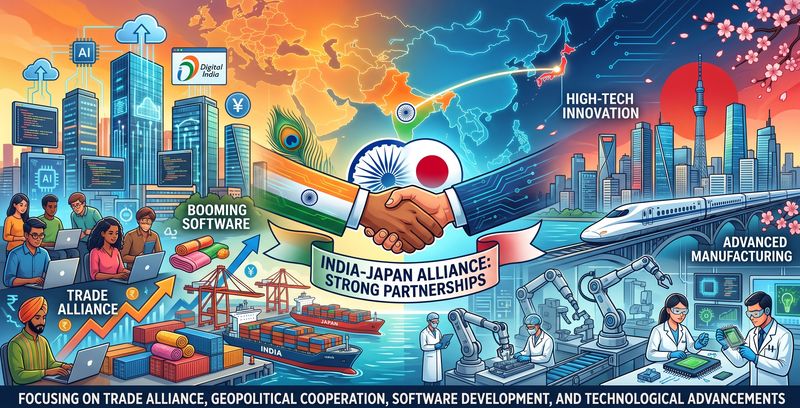
It looked like a handshake about trade and energy. Underneath, two of China's biggest customers were quietly building an escape route.
What actually happened
From July 1 to 3, 2026, Japan's new prime minister made her first official visit to India for the annual summit at Hyderabad House in New Delhi. India and Japan have been close for decades, and they call their relationship a "Special Strategic and Global Partnership." This meeting was about making it deeper.
They organised everything around three areas: defence and security, the economy, and people-to-people ties. Plenty of deals were signed, from a bullet train to biogas plants. But to understand why this summit mattered, you have to see the single idea hiding underneath all of it.
The one thread through everything: less China That idea is reducing dependence on China. India and Japan signed a joint declaration on economic security promising to work together on the things that decide a modern economy: semiconductors, critical minerals, information technology, clean energy and medicines. The stated goal was to build "resilient" supply chains and "avoid reliance on any one country."
China is the biggest trading partner of both India and Japan. Neither wants a war with Beijing, and both do huge business with it. Yet both are quietly scared of leaning on it too much, because China has shown it can choke off critical minerals or components to pressure a country. So this is not about hating China. It is about hedging against it, two big customers building a backup plan so they can never be squeezed.
Why these two fit together so well
The genius is how neatly India and Japan complete each other. Japan is rich, with world-class technology and deep pockets, but its population is old and shrinking, so it is short of workers. India is young and huge, with a massive, tech-savvy workforce and a giant market, but it needs capital and advanced know-how.
So Japan brings the money and the machines. India brings the people and the scale. The two even agreed to move up to 5 lakh Indian students and workers to Japan over the next five years, filling Japan's labour gap while giving Indians high-value jobs. One country's weakness is the other's strength.
What is actually in the deal
The agreements stretched across nearly every field:
- A first-ever joint defence project called UNICORN, an advanced antenna mast that makes warships stealthier, built together under "Make in India."
- The economic security pact on chips, critical minerals, AI and medicines to reduce reliance on China.
- A ¥10 trillion Japanese investment target in India, plus a fresh $10 billion investment package.
- The Mumbai-Ahmedabad bullet train, targeting its first section in 2027, part of a dream of a 7,000 km high-speed network.
- 1,000 biogas plants for rural India, plus a big clean-ammonia project in Odisha.
- Their first-ever AI strategic dialogue, to build trusted AI and digital systems together.
The energy part, told honestly
Energy got the headlines, but it is smaller than the hype. India and Japan are both among the world's biggest energy buyers, so both suffer when prices swing. They agreed to share knowledge on emergency oil reserves, keep vital shipping lanes like the Strait of Hormuz open, and back India's bid to join the global energy club, the IEA. This is sensible insurance against shocks, not a scheme to control oil prices.
The catch worth knowing
Now the honest part. India and Japan have made grand promises before and delivered slowly. Despite being close friends, their trade is only about $27 billion a year, tiny next to the business each does with China, and heavily tilted in Japan's favour. The bullet train, their flagship project, has been delayed for years over land problems. Japanese companies often complain about India's red tape and unpredictable rules, and language and culture make it hard to place Indian workers in Japan quickly.
In short, the vision is excellent. The delivery has always been the weak link.
What to actually watch
So watch for real action, not press releases. Does the UNICORN defence project actually get finished? Does the bullet train finally hit its 2027 target? And most importantly, does that ¥10 trillion of Japanese money truly start flowing into Indian factories, or sit stuck in paperwork? Those answers will tell you whether this was a turning point or just another friendly summit.
The most telling thing about this meeting is what nobody said out loud. Two nations that trade more with China than with almost anyone else spent three days planning how to need China less. That is the quiet logic of the new world: you can keep doing business with a giant while carefully building the tools to survive without it. Whether India and Japan can turn that clever plan into real factories, fast, is the test that actually counts.
Frequently Asked Questions
What is "India and Japan both depend on China. This week they quietly agreed to depend on it less." about?
India hosted Japan's new prime minister, Sanae Takaichi, for their 16th annual summit in New Delhi. On the surface it looked like a routine friendly meeting about trade and energy. But one idea runs through almost everything the two signed: two countries that both lean heavily on China have decided to quietly build their own alternative together, in chips, minerals, AI, defence and clean energy. Japan brings the money and technology, India brings the youth and scale. Here is what really happened, and why it matters far beyond a diplomatic photo.
Why does this tech & ai topic matter?
This topic covers a significant development in tech & ai that affects economies, industries, and everyday people. Qrio breaks it down in plain English so you can understand the implications without needing specialized knowledge.
How long does it take to read this explainer?
The brief takes about 30 seconds. The full deep dive takes just a few minutes. You can choose how deep you want to go.
More from Qrio
Oura wants $16 billion for a ring, and one number explains why

India's biggest stock exchange is finally going public and it has to list on its rival