In 2016, one man gave away free internet to a billion people. It was never about the internet
6 min read · by Qrio · 12 Jun 2026
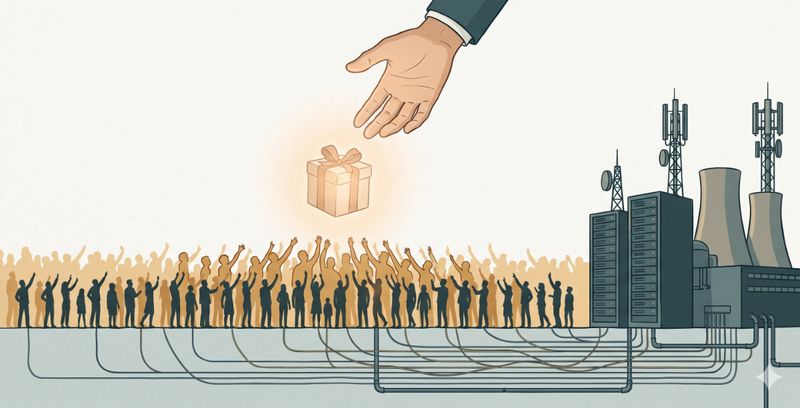
The Jio story looks like a telecom disruption. It was actually rehearsal for a much bigger play, and that play is now live.
The destruction that started with a gift
In September 2016, Mukesh Ambani walked onto a stage and announced that Jio would offer free voice calls and data at prices so low they barely registered. For a country where a gigabyte of mobile data cost hundreds of rupees, the offer felt like a miracle. Over 100 million people signed up in the first 170 days, a pace of adoption never seen before in the history of telecommunications anywhere in the world. What followed was a massacre. Aircel went bankrupt. Reliance Communications, run by Ambani's own brother, collapsed. Tata Docomo and Telenor sold themselves to Airtel. India went from roughly a dozen mobile operators to effectively three.
Ambani had not entered a market. He had detonated it.
The scale of what Jio became:
- Jio now has over 500 million subscribers, making it one of the largest mobile networks on earth.
- Each subscriber uses an average of over 30 gigabytes of data per month, roughly triple the global average.
- Jio's revenue reached approximately ₹1.25 trillion in 2024, and its platform is valued at roughly ₹8.6 trillion.
- It controls the network, the streaming (JioHotstar, 600 million users), the groceries (JioMart), the payments (JioFinancial), and the retail (250 million customers).
The product was never the data
Here is the insight most coverage of Jio misses. The cheap data was the bait. The real product was the 500 million people it captured. Once you have half a billion Indians reaching for their phone every day through your network, you own the gateway to their attention, their spending, and their habits. Reliance has spent every year since 2016 building toll booths on that gateway, from groceries to streaming to lending. None of these businesses make sense individually at the scale Reliance built them. Together, connected by the same half-billion people, they form a closed loop where Reliance earns a cut of nearly everything an Indian consumer does on a screen. That was act one. Act two is now live.
In 2016, the weapon was the cheapest data. In 2026, the weapon is the cheapest AI. The playbook has not changed. The prize has gotten bigger.
The AI play, in concrete moves
In February 2026, Ambani announced ₹10 lakh crore, roughly $110 billion, in AI infrastructure investment over seven years. That alone would be a headline. What makes it a strategy is the five specific things Reliance is building underneath that number.
- First, gigawatt-scale data centres at Jamnagar in Gujarat, already under construction. The first 120 megawatts of AI computing capacity will come online in the second half of 2026. These are not ordinary server farms. They are built to train and run the kind of large AI models that today only American and Chinese companies operate.
- **Second, Reliance's own power supply. **The Jamnagar centres will run on up to 10 gigawatts of green energy that Reliance already generates from solar projects in Kutch and Andhra Pradesh. This is the structural advantage no competitor in India can match: the data centres sit next to power Reliance already owns, on land it already controls, connected to a grid it already built. While American tech giants wait five to seven years for grid connections, Reliance plugs in.
- Third, global partnerships that give it the best technology without building it from scratch. Google is building a dedicated cloud region inside the Jamnagar facility, combining Google's AI hardware with Reliance's power and Jio's network. Meta has formed a $100 million joint venture where Reliance holds 70 percent to deploy Meta's AI models as a service for Indian businesses. Nvidia is supplying its latest Blackwell chips, the same hardware that powers OpenAI and Anthropic. Reliance is not trying to out-research Google or OpenAI. It is positioning itself as the company that brings their technology to India, on its infrastructure, at its prices.
- Fourth, JioBrain, an AI platform already running inside Reliance's own operations across retail, energy, telecom, and finance. The plan is to perfect it internally, then offer it to every other Indian business as a ready-made AI layer they can plug into, the same way companies today plug into Jio's network without building their own towers. 5.** Fifth, and this is the direct echo of 2016: free AI for consumers.** Reliance has partnered with Google to give its Jio subscribers free access to Google's AI Pro subscription for 18 months, a service that normally costs ₹1,950 a month. It starts with users aged 18 to 25, then expands to all 500 million subscribers. The stated goal is to create "the world's lowest AI inferencing cost, right here in India," making AI cheaper to use in India than anywhere else on the planet.
In 2016, it was the cheapest gigabyte. In 2026, it is the cheapest AI query.
Why this is almost impossible to compete with
The reason this strategy is so hard to fight is that no single competitor has all the pieces. Airtel can compete on telecom but does not own power plants. Google can compete on AI models but does not own 500 million Indian subscribers. Amazon can compete on cloud computing but does not own the retail stores, the entertainment platform, and the payment system. Reliance owns the network the data travels on, the power that runs the machines, the users who will consume the AI, and the businesses that will deploy it. Each layer feeds the others: the 500 million users generate the data, the data trains the models, the models improve the services, the services lock in the users.
The last time Ambani ran this play, a dozen telecom companies bet that the free data could not last. They were right that it could not last. They were wrong that it mattered, because by the time prices normalised, Jio already had the users and the competition was already dead. The AI play has the same shape, the same patience, and a much bigger prize. Ambani himself has framed it explicitly: "AI will be the fuel in 2026 the way data was in 2016." The companies watching from the sidelines have seen this movie before. The uncomfortable part is that last time, knowing the ending did not help anyone avoid it.
Frequently Asked Questions
What is "In 2016, one man gave away free internet to a billion people. It was never about the internet" about?
When Reliance launched Jio with free calls and nearly free data, a dozen Indian telecom companies existed. Within three years, half were bankrupt or swallowed. Jio now has over 500 million subscribers. But the cheap data was never the product. The subscribers were. Now Reliance is running the exact same play with artificial intelligence: give it away for free, capture everyone, then own the infrastructure underneath.
Why does this business topic matter?
This topic covers a significant development in business that affects economies, industries, and everyday people. Qrio breaks it down in plain English so you can understand the implications without needing specialized knowledge.
How long does it take to read this explainer?
The brief takes about 30 seconds. The full deep dive takes just a few minutes. You can choose how deep you want to go.
More from Qrio

Oura wants $16 billion for a ring, and one number explains why
India's biggest stock exchange is finally going public and it has to list on its rival