How China Turned a Group of Little-Known Metals Into Its Most Powerful Weapon
4 min read · by Qrio · 2 Jun 2026
What these metals actually are
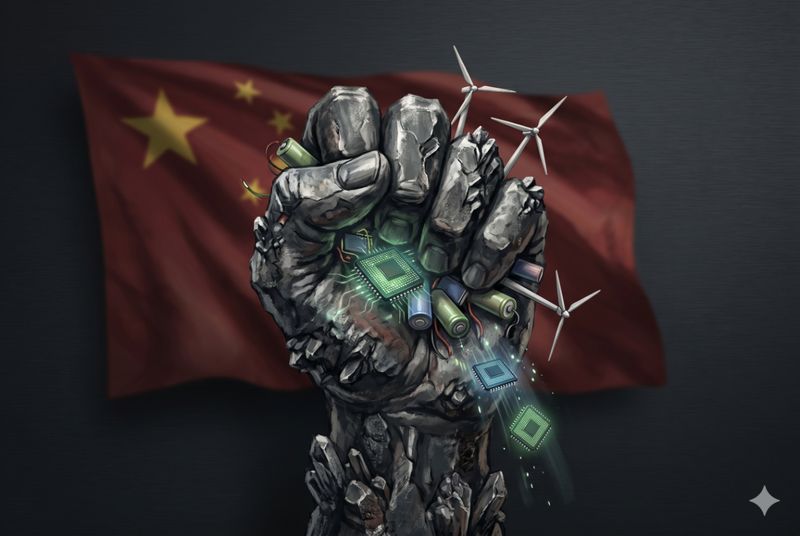
Rare earths are a group of seventeen metals with names most people never learn: neodymium, dysprosium, terbium, yttrium, and others. They are not actually rare in the ground. What makes them valuable is what they do. A small amount of neodymium makes a magnet many times stronger than a normal one, and that magnet holds its power without any electricity to keep it going. These metals sit inside wind turbines, AI hardware, electric vehicles and fighter jets. Take them out of the supply chain, and a startling share of the modern economy simply cannot be built.
A few numbers show how concentrated this control is:
- China refines around 90 percent of the world's rare earths, the step that turns raw ore into usable material.
- When China rationed supply in 2025, prices outside the country rose to six times the price inside it.
- For some buyers, fewer than one in four export requests were approved.
- Experts estimate it would take 20 to 30 years to build a full alternative supply chain.
Where the real control sits
The natural assumption is that whoever owns the mines owns the resource. Rare earths break that assumption. China does about 60 percent of the world's mining, but 90 percent of the refining, the chemically difficult step that turns raw ore into usable material. A country can dig these metals out of its own soil, as the United States and Australia do, and still have to ship the ore to China to be processed, because almost no one else has built the plants to do it. Owning the mine is not the chokepoint. Owning the factory that refines what the mine produces is.
How the weapon was fired
In April 2025, in response to American tariffs, China put seven of these metals and the magnets made from them under export licensing. Export volumes fell sharply, and automakers in the United States, Europe and beyond struggled to source magnets. Some had to cut production or temporarily shut factories. European suppliers confirmed plants had stopped after running out, and that only about a quarter of the hundreds of licence applications had been approved. Then in October 2025, Beijing went further, claiming authority over any product made anywhere in the world that contained even tiny amounts of Chinese rare earths. For the first time, China's rules reached beyond its own borders.
China is not running out of these metals. It is choosing when to let the world have them.The clever part is the restraint
Here is the move that separates a blunt embargo from a precision weapon. China never cut supply off completely. In November 2025, after a meeting between Xi and Trump, it suspended the toughest new controls for a year, and exports partly recovered. The restrictions are deliberately temporary and reversible, and that design does two things at once. It keeps prices and leverage high, and it discourages anyone from spending the enormous sums needed to build an alternative. The moment a Western company commits billions to a new refinery, China can turn the taps back on and make that investment worthless. A permanent cutoff would unite the world against Beijing. Calibrated, on-and-off control keeps everyone dependent and unsure, which is far more useful.
Why there is no quick escape
Western governments see the trap. Escaping it is the hard part. A working alternative needs mines, refineries, metal plants and magnet factories, all built at once, with permits and long-term financing behind them. All the new processing and magnet projects announced as of early 2026 add up to only about a third of even the new mining capacity being built, which means the world is on track to dig up more rare earths than it can actually refine outside China. The bottleneck just moves one step down the chain. The pieces of an alternative do exist. Australia mines. The United States is restarting plants and buying stakes in producers. Japan, one of the few places outside China that makes these magnets, is now itself a target of the controls. Assembling all of it into something that works will take most of the next decade. In a trade war fought with tariffs, a country can hit back within days. In a trade war fought over refining factories, the side without the factories can only wait, and pay.
Frequently Asked Questions
What is "How China Turned a Group of Little-Known Metals Into Its Most Powerful Weapon" about?
Tariffs are the trade war everyone watches. But the real weapon? A group of 17 metals most people have never heard of — rare earths. They go into electric cars, fighter jets, wind turbines, and AI servers. China doesn't just mine most of them. It processes 90 percent of the world's supply. In 2025, it started limiting exports. European car factories ran out of parts and shut down. Prices outside China shot up six times higher than inside. The striking part: China isn't running low. It's simply deciding who gets them, and when.
Why does this geopolitics topic matter?
This topic covers a significant development in geopolitics that affects economies, industries, and everyday people. Qrio breaks it down in plain English so you can understand the implications without needing specialized knowledge.
How long does it take to read this explainer?
The brief takes about 30 seconds. The full deep dive takes just a few minutes. You can choose how deep you want to go.
More from Qrio
Oura wants $16 billion for a ring, and one number explains why

India's biggest stock exchange is finally going public and it has to list on its rival