Britain once ruled the world. Today it can't fix its own economy.
4 min read · by Qrio · 27 Jun 2026
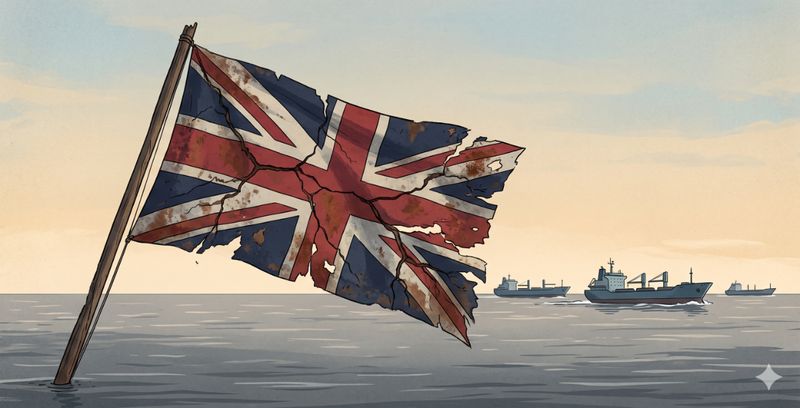
Britain isn't collapsing in some dramatic way. It is quietly stuck, and the numbers show just how far it has slipped.
From running the world to running on empty
A hundred years ago, Britain set the world's currency, controlled the seas, and wrote the rules of global trade. At its peak it produced close to 20% of everything made on the planet. Today, its share of the world's manufacturing has fallen to just about 2%.
The slide shows up everywhere you look. The economy is now growing at barely 1% a year. Government debt has roughly doubled since 2008 and is near 100% of everything the country earns in a year, the highest in over half a century. Ordinary people's pay stopped rising about fifteen years ago, leaving the average British family thousands of pounds poorer than families in countries like Germany, France or Australia. And the political system is so shaky that Britain has changed its prime minister six times in just nine years.
So this is not a poor country. It is a rich country that has stopped moving forward.
Everything Britain tried, and why it failed
The frustrating part is that Britain has not sat still. It has tried one big fix after another, and each one made things worse:
- It cut spending to save money. Years of cuts broke local councils and overloaded hospitals, and growth still never came back. 2.It left the European Union to trade more freely. Instead, trade got harder and the economy ended up about 6% smaller. The promised new deals with other countries never made up the loss.
- It slashed taxes to spark growth (2022). Investors panicked, borrowing costs exploded, and the plan was scrapped within 49 days, taking the prime minister down with it.
- It tried taxing the rich more (2025). Around 16,500 millionaires simply left the country, the biggest exodus on record, taking their money and jobs with them.
Four sensible-sounding fixes, four failures. That tells you the problem is deeper than any single policy.
What actually caused the fall
The clearest turning point was Brexit, the 2016 decision to leave the European Union. The EU was Britain's biggest customer, a huge market it could sell to with no paperwork or border checks. Leaving meant new costs, new forms, and new delays for every business. Many small exporters simply gave up, investment slowed, and confidence dropped. That single choice quietly shrank the economy and is still hurting it years later.
But Brexit only sped up a fall that had been coming for a long time. For more than a century, countries like the United States, Germany, Japan and especially China built factories faster and cheaper than Britain ever could. Bit by bit, the world stopped buying British-made goods and started buying theirs. Britain's factories faded, and the country leaned more and more on finance and services in London instead. That worked for a while, but it left the rest of the country underinvested and exposed.
Then came the final blows in quick succession. COVID forced the government to borrow enormous sums. The **war in Ukraine **sent energy prices soaring and pushed prices in the shops to their highest in 40 years. On top of a mountain of debt, these shocks left Britain with almost no room to breathe. Any one of them was survivable. All of them together pushed the country into the corner it is in now.
The way forward, and the lesson for the rest of us
Britain is not finished. It still has world-class universities, a powerful financial centre, and real global influence. But experts agree it now has to do the boring, hard things it avoided for decades: invest steadily in roads, energy, housing and skills, build up its cities beyond London, and give businesses stable rules instead of a new crisis every year. None of that is glamorous, and all of it takes patience the country's politics has lacked. The bigger lesson is for fast-rising nations like India that are watching. Britain shows what happens when a country lives off its past glory instead of constantly building its future. It shows that chasing away your wealth creators can backfire, that piling on debt slowly steals your freedom to act, and that no amount of history protects you from bad choices.
Britain spent 200 years becoming the richest country on earth, and barely 15 forgetting how it got there. Its story is a quiet warning to every ambitious nation: real strength is not the size of your past, it is whether you keep investing in what comes next.
Frequently Asked Questions
What is "Britain once ruled the world. Today it can't fix its own economy." about?
For 200 years, Britain was the richest and most powerful country on earth. It made about a fifth of everything the world produced and ruled over a third of all people. It is still wealthy today, but it is clearly in trouble. Its economy has barely grown for years, its debt has ballooned, its towns are cutting basic services, and its richest residents are leaving. Britain has tried several big fixes, and almost all of them have backfired. Here is what is really happening, in simple terms.
Why does this geopolitics topic matter?
This topic covers a significant development in geopolitics that affects economies, industries, and everyday people. Qrio breaks it down in plain English so you can understand the implications without needing specialized knowledge.
How long does it take to read this explainer?
The brief takes about 30 seconds. The full deep dive takes just a few minutes. You can choose how deep you want to go.
More from Qrio
Oura wants $16 billion for a ring, and one number explains why
India's biggest stock exchange is finally going public and it has to list on its rival