Business
Bira 91 tried to get IPO-ready and the paperwork ended up destroying the company
By Ashish Kumar · 24 July 2026 · 4 min read
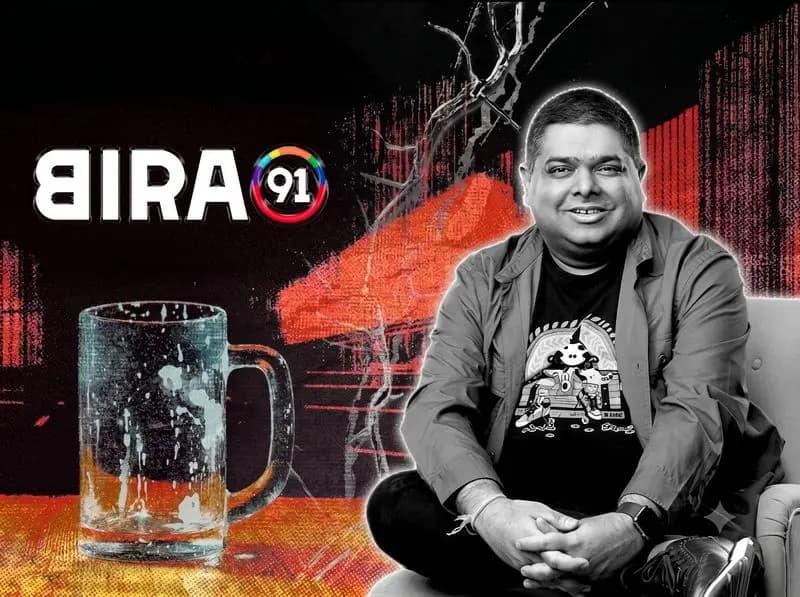
Bira 91 didn't lose to a competitor. It lost to a technicality it created for itself while getting ready to impress public market investors.
The exit
This week, Ankur Jain stepped down from the board of B9 Beverages, the parent of Bira 91, and surrendered his family's 17.8 percent stake in the company. The deal settles a dispute that had run for nearly two years with the company's lenders, Anicut Capital and Hero Corporate Services' family office, and its investors, Peak XV Partners, Sofina, and Japan's Kirin Holdings. In exchange for giving up the stake, the lenders agreed to withdraw all claims and litigation against Jain, and the personal guarantees he had given against the company's corporate borrowings were released.
The brand that defined a category
It is worth remembering what Bira 91 actually was before any of this. It was the brand that made craft, import-style beer feel cool in urban India, the orange monkey logo that showed up in every trendy bar in Delhi, Mumbai and Bengaluru. At its peak, in FY23, the company's revenue crossed $100 million.
What actually broke it
Here is the detail that separates this story from an ordinary startup cash crunch. In January 2024, the company changed its legal name from "B9 Beverages Private Limited" to "B9 Beverages Limited," a routine-sounding step taken specifically to satisfy the compliance requirements for a planned public listing. Under India's state-by-state excise laws, however, that name change was treated as the creation of an entirely new legal entity. That meant every single beer variant the company sold needed fresh excise licences, fresh label approvals, and fresh product registrations, filed separately, in every state where Bira was sold.
The practical result was a roughly six-month sales blackout. Retailers across the Delhi-NCR and Mumbai markets simply ran out of stock. Distributors refused to place new orders, worried about regulatory penalties for selling under an unresolved registration. Roughly ₹80 crore worth of beer that had already been brewed had to be written off entirely, because it could no longer be legally sold under the company's old name.
The numbers that followed
The financial damage was severe. In FY24, the company posted a net loss of ₹748.8 crore on revenue of just ₹638.5 crore, with negative operating cash flow of ₹84 crore. By March 2024, its accumulated losses had reached ₹1,904 crore, and its liabilities exceeded its assets by more than ₹619 crore. Roughly ₹1,000 crore in debt sat on the books. By October 2025, more than 250 employees had written directly to the board, investors and lenders demanding Jain's removal, citing governance lapses, mismanagement and prolonged delays in salary payments. The company also lost control of its pub chain, The Beer Cafe, after Kirin Holdings and Anicut Capital took over shares that had been pledged to them as collateral.
The irony at the centre of it
Sit with the sequence for a moment. A company preparing to impress public market investors tried to formalise its legal structure so it would look clean and audit-ready. That single formalising step, a name change nobody expected to matter operationally, triggered a state-by-state regulatory chain reaction that made it illegal to sell its own product for half a year. It is the corporate equivalent of reorganising your entire filing cabinet the night before an audit and accidentally locking yourself out of your own office in the process. The very act of preparing for scrutiny is what caused the damage scrutiny was supposed to prevent.
The honest catch
To be fair, the name change alone did not create a ₹1,000 crore debt pile. The company had also expanded aggressively during good times and taken on significant borrowing, and those existing cracks were what turned a paperwork problem into an existential one. The settlement is not the end of Bira 91 as a brand. B9 Beverages is expected to undergo an out-of-court recapitalisation, clear its statutory, employee and vendor dues, and restart operations under fresh management, without Jain. Whether that revival succeeds now depends on finding a new investor willing to put in fresh capital.
What to actually watch next
Watch whether Kirin Holdings fully exits its stake or stays on as a smaller partner in the restructured company. Watch whether a new strategic investor steps in to fund the reboot. Watch whether Bira 91 can win back the retail shelf space it lost to rivals during its six-month blackout. And if you are a founder anywhere preparing your own company for an IPO, watch this as the cautionary footnote about checking what a routine legal filing actually triggers before you file it.
The fastest way to lose control of a company, it turns out, can be trying too hard to look ready to run one for somebody else.
Watch on Qrio
One-minute reels on this and related topics.



More business stories
Business
Your milk costs up to ₹4 more from today. Here is who gets the extra money
Amul and Mother Dairy raised milk prices by ₹2 to ₹4 per litre from November 12, 2026. Amul Taaza toned milk is up ₹2 (3.3%) and Amul Gold is up ₹4 (5.5%) across India. In Delhi-NCR, Mother Dairy full cream milk goes from ₹72 to ₹76 a litre and toned milk from ₹60 to ₹62. Both dairies blame costlier fodder, cattle feed, packaging and fuel after an uneven monsoon, and both say most of what you pay goes back to farmers: about 80% for Amul, 75% to 80% for Mother Dairy. It is the second hike since May, and it comes two weeks after Karnataka raised Nandini milk by ₹8.
12 November 2026 · 6 min read
Business
Razorpay plans to list for a third less than its 2021 value, after paying $150 million to come home
Razorpay, the Bengaluru company behind the checkout page on many Indian websites, has reportedly received SEBI's approval for its IPO. Reports put the issue at roughly ₹5,000 to 6,500 crore and the valuation at about $5 billion, with a listing expected between January and March 2027. That is about a third below the $7.5 billion it was valued at in 2021. Razorpay had first moved its parent company from the US to India, a switch reported to have cost about $150 million in taxes. It grew revenue 65% in FY25 to ₹3,783 crore but booked a loss tied to one-time costs. Neither Razorpay nor SEBI has confirmed the approval publicly.
5 November 2026 · 7 min read