India Macro
A carbon copy answer sheet just set an entire state on fire
By Qrio · 14 August 2026 · 6 min read
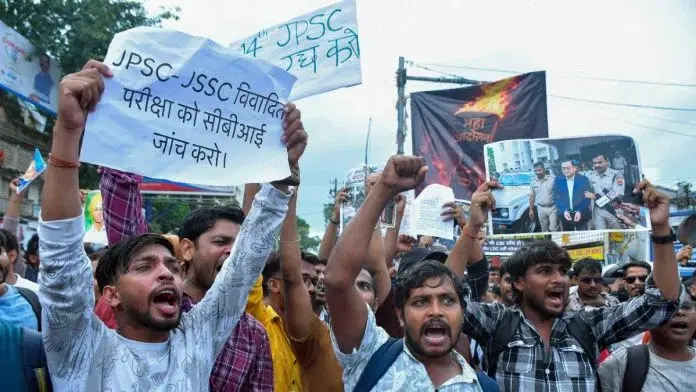
The students of Jharkhand aren't protesting one leaked paper. They're protesting the suspicion that the exam system itself has a price list.
One answer sheet, 48 questions, and a state's patience running out
The spark was almost mundane. After the Jharkhand Public Service Commission declared results of its 14th Combined Civil Services preliminary exam on July 2, 2026, a carbon copy of a successful candidate's OMR answer sheet began circulating online. It showed the candidate had attempted just 48 of 100 questions on the first paper, and still qualified. More than 36,000 candidates had appeared for that exam in April, competing for just 103 posts. Only 2,204 made the cut. For lakhs of young people in a state where a government job is often the only stable employment in sight, that one sheet read as confirmation of what they had long suspected: the merit list wasn't a merit list.
By July 22, the state CID had registered a case and begun arrests, including JPSC deputy controller Shweta Kumari Gupta and directors of TSR Data Processing Pvt Ltd (TDPL), the private agency handling exam data. On July 29, students began an indefinite sit-in at Jaipal Singh Munda Stadium in Ranchi. It hasn't stopped since.
The older wound underneath: JSSC-CGL and the Rs 12 lakh price tag
To understand why the protest exploded rather than fizzled, you have to go back to the JSSC-CGL exam, the state's biggest recruitment test, with about 6.4 lakh applicants for 2,025 posts. Its January 2024 edition was cancelled after a paper leak. The September 2024 re-exam was itself dogged by leak allegations: phones seized from accused candidates contained 187 answers, 66 of which matched exam questions, and leaked material reportedly circulated on Telegram, with candidates coached in hotels in Asansol, Muzaffarpur and even Nepal days before the exam.
The state government's defence in court was that "scammers" had made educated guesses from past papers, not obtained the real one. The High Court in December 2024 ordered an FIR but refused to cancel the exam or hand the case to the CBI. The Supreme Court in January 2026 upheld that, making all appointments conditional on the criminal investigation's outcome.
Then, on August 10, 2026, the CID's own investigation blew a hole in the "educated guesses" theory. Interrogating Abhay Tiwari alias Manoj Kumar Tiwari, a former TDPL marketing manager who himself cleared JSSC-CGL with rank 48, investigators found that 15 candidates in Bokaro were charged Rs 12 lakh each, a total of Rs 1.80 crore, and given 65 questions with answers to memorise before the exam. Tiwari's brother and sister-in-law also cleared the same exam and got government jobs. The paper allegedly came from the owner of Webel, the very agency that took over question paper printing after TDPL was de-empanelled.
August 10: the day the state blinked and swung at the same time
The movement's climax so far came on August 10, when thousands of students marched to gherao (encircle) the Jharkhand Assembly on the opening day of its monsoon session. Devendra Nath Mahto, the student leader whose hunger strike had entered its ninth day, joined the march in an ambulance. When protesters breached police barricades, police responded with lathi charge, tear gas and water cannons. Multiple students were injured; the police said 14 of their own personnel were hurt too. Mahto was hospitalised the same day.
And yet, within hours, the government gave more ground than it had in two weeks: former JPSC chairman L Khiangte was arrested by the CID, three JPSC members resigned, and the government agreed to cancel three examinations. The next day, the BJP called a statewide bandh over the police action, and more than 200 ABVP members were detained trying to march on the Assembly. Chief Minister Hemant Soren cautioned students against becoming, in his framing, instruments of the opposition's narrative.
"The process has become a punishment for us students in the state." Piyush Singh, 34, member of the protest's core committee, to ThePrint
The Delhi shadow: why these students believe they can win
The protesters themselves name their inspiration openly. Earlier in 2026, the Delhi protests over the NEET (UG) paper leak, led by the Cockroach Janta Party (CJP), ended with the resignation of Union Education Minister Dharmendra Pradhan, a scalp student movements in India almost never claim. "The success of the CJP-led protests in Delhi has given us the confidence that accountability can be sought," core committee member Vinay Mehta told ThePrint. CJP founder Abhijeet Dipke has publicly backed the Jharkhand students.
But the Jharkhand movement has learned another Delhi lesson too: it is fiercely guarding its independence. Students have maintained a stage separate from political outfits, including the JLKM, precisely to avoid the movement being co-opted, even as every party in the state tries to attach itself to it.
A useful parallel
Think of a lottery where a few winners are quietly allowed to buy their tickets after the draw. The scandal isn't just that they won. It's that every honest ticket-holder now has to wonder whether any draw was ever real. Jharkhand's recruitment exams have had leak scandals in 2003, 2012 (when the CBI charged 50 people including a former JPSC chairman), 2024 and now 2026. At some point, the individual scandal stops mattering and the institution itself goes on trial. That's what's happening in Ranchi.
The honest catch
The students' central demand, a CBI probe, sits on shakier legal ground than the moral one. Both the High Court and Supreme Court have already declined to order a CBI investigation into JSSC-CGL, and courts are generally reluctant to transfer cases when a state investigation is producing arrests, which the CID visibly is: the deputy controller, the TDPL directors, the former chairman. It's also genuinely hard to untangle how much of the political support around the movement is solidarity and how much is opportunism; the BJP's bandh serves its own contest with the Soren government as much as it serves the students. And cancelling exams cuts both ways: every cancellation punishes honest candidates who cleared them, some of whom have now been waiting years across multiple scrapped attempts.
A state can survive a leaked paper. What it can't easily survive is a generation of its most determined young people concluding that studying honestly was the mistake.
More india macro stories
India Macro
India's biggest stock exchange is finally going public and it has to list on its rival
On September 4, the Securities and Exchange Board of India cleared the National Stock Exchange to launch its IPO, ending a wait of nearly a decade. The issue is an offer for sale of 14.89 crore shares, about 6% of the company, worth roughly Rs 30,000 crore. That would make it the largest public issue in Indian history, ahead of Hyundai Motor India's Rs 27,870 crore in October 2024, and implies a valuation above Rs 5 lakh crore. Subscription is expected to open September 15. The shares will trade on the BSE, the rival NSE has spent thirty years leaving behind.
7 September 2026 · 4 min read

India Macro
India grew at 7.8% and its stock market shrugged
India's economy expanded 7.8% year on year in the June quarter, comfortably beating both the Reserve Bank of India's 7% projection and a market consensus of about 7.1%. That is a strong number for an economy absorbing a six-month oil shock. The stock market's response has been a shrug. On Thursday the Sensex fell 417.49 points to 76,152.86 and the Nifty 50 slipped to 23,873.45, after opening higher and briefly crossing 24,000. Foreign investors have pulled $24.6 billion out of Indian equities this year. The index and the economy are not the same animal.
4 September 2026 · 3 min read