Business
A 27-year-old high school dropout just raised $1 billion to mass-produce nuclear reactors for AI
By Qrio · 23 August 2026 · 3 min read
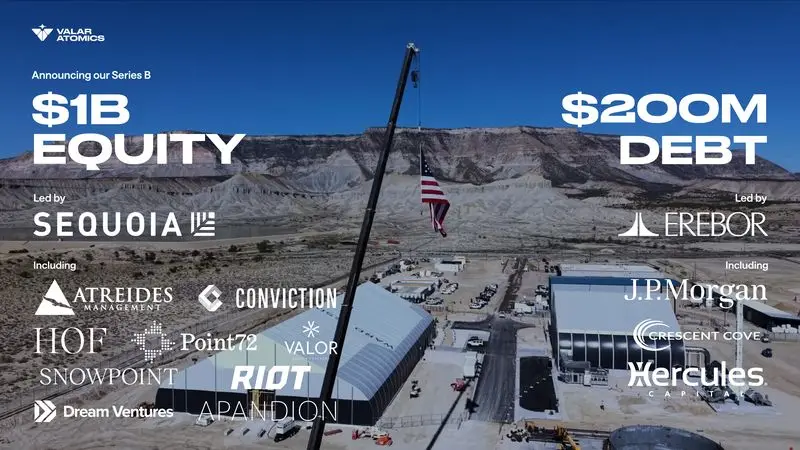
AI's hunger for electricity has made nuclear power fashionable again, and the person leading one of its biggest bets never finished high school.
In early August 2026, Valar Atomics closed a $1 billion Series B funding round led by Sequoia Capital, with Sequoia partner Shaun Maguire joining the board. Apandion, Atreides Management, Conviction, Dream Ventures, HOF Capital, Point72, Riot Ventures, Snowpoint Ventures, and Valor Equity Partners all joined the round. Separately, a $200 million credit facility led by Erebor Bank and JPMorgan brought Valar's total announced financing past $1.2 billion. Less than a year earlier, the company had raised just $130 million, and talks over the summer had reportedly valued it at around $6 billion.
The founder is the strangest part of this story.
Isaiah Taylor, born in 1999, dropped out of high school at 16 to work as a coder, inspired partly by his great-grandfather Ward Schaap, a nuclear physicist who worked on the Manhattan Project. He founded Valar Atomics in 2023, when he was 24. The company, based in Southern California, builds high-temperature, helium-cooled small modular reactors, designed not as one-off custom megaprojects but as standardized products that can be manufactured on a repeatable line. It has already demonstrated a reactor called the Ward 250 generating electricity used to power an Nvidia Blackwell AI system, and announced a collaboration with Nvidia on a waterless, 30-megawatt AI data center design.
Why nuclear, of all things, is suddenly a hot startup category.
Nuclear power has spent most of the last five decades as almost the opposite of startup-friendly: multi-decade permitting timelines, multi-billion-dollar custom builds, and financing that historically required government backing. What's changed isn't the physics. It's the demand curve. AI data centers already consume an estimated 40 gigawatts of electricity today, and that figure is projected to roughly double by 2030. Utilities in many regions are years away from adding equivalent grid capacity through conventional means. That gap, not any nuclear breakthrough, is what's pulling billion-dollar venture rounds into an industry venture capital mostly avoided for decades.
The idea that makes Valar's pitch different.
Traditional nuclear plants are custom-engineered projects, each built over a decade or more, closer to a shipyard building one enormous, unique yacht than a factory building cars. Valar's bet is that manufacturing identical, smaller reactors on a repeatable line, the way a car company builds the same model over and over, is what finally makes nuclear fast enough to matter for an industry that plans in quarters, not decades.
"A project can build one reactor, but a fleet requires manufacturing." Isaiah Taylor, founder and CEO, Valar Atomics
The honest catch.
No small modular reactor company, Valar included, has yet delivered a fully licensed, grid-connected commercial reactor at real scale, and nuclear regulatory approval typically takes years even for designs that are already proven. The distance between "raised $1 billion" and "actually powering a data center at commercial scale" remains largely unbuilt, and betting heavily on unproven reactor designs has burned nuclear investors before. A single demonstration powering one Nvidia system is a proof of concept, not a finished product.
The kid who thought nuclear reactors were being built too big just convinced some of Silicon Valley's most serious investors to bet $1 billion that he's right, on a timeline the entire AI industry is now quietly waiting on.
More business stories
Business
Unacademy sold for 94% less than what it was once worth. Its CEO said so himself
India's edtech firm Unacademy has officially been acquired by rival upGrad in an all-stock deal closing at just over $200 million (₹19.55 billion), roughly 94% below Unacademy's peak private valuation of $3.44 billion in 2021. Unacademy had raised nearly $880 million across 13 funding rounds from SoftBank, Tiger Global, and General Atlantic. Co-founder and CEO Gaurav Munjal didn't dress it up: "We raised at a peak, but sold at a fraction of that." No layoffs are planned for Unacademy's roughly 1,000 employees. The deal closes a five-year arc for one of India's most-funded startups, and it began with the opposite problem entirely.
3 September 2026 · 3 min read
Business
Sachin Bansal ran his fintech alone for eight years before taking anyone's money
Navi, the Bengaluru fintech founded by Flipkart co-founder Sachin Bansal, raised $100 million from Prosus at a roughly $1.3 billion valuation, its first institutional funding round in eight years of operation, TechCrunch reported on August 19, 2026. Bansal had personally bankrolled Navi since founding it in 2018. The company's UPI app processed 947 million transactions worth about ₹483 billion (~$5.05 billion) in July 2026 alone, and its lending arm carries roughly ₹130 billion (~$1.4 billion) in assets. Navi is now preparing an IPO targeting about $2 billion, after abandoning an earlier attempt in 2023.
29 August 2026 · 3 min read